Skip to Content
You are currently on the new version of our website. Access the old version .

Soil Systems

Soil Systems - formerly Soils - is an international, scientific, peer-reviewed, open access journal on soil science, published monthly online by MDPI. 
The Italian Society of Soil Science (SISS) is affiliated with Soil Systems and its members receive discounts on the article processing charges.
Quartile Ranking JCR - Q2 (Soil Science)

All Articles (815)

The distribution of water-soluble organic matter (or dissolved organic matter DOM) in narrow (nano-and micrometer) fractions of chernozem was studied by sequential filtration on track-etched membranes. Multimodal (IR and fluorescence) two-dimensional correlation (2D-COS) spectroscopy was used. Protocols for attenuated total reflectance (ATR) FTIR of DOM were proposed. ATR-FTIR 2D-COS provides a larger volume of information on characteristic bands compared to traditional FTIR, especially in C–H ranges (3000–2800 and 1450–1300 cm−1). The fluorescence excitation–emission matrix 2D-COS showed that the indexes and ratios of humic- to protein-like compounds are reproducible, and exhibit significant variation among size fractions, with maximum amounts of saturated humic-like compounds in the largest (2–10 μm) and finest fractions (0.01–0.03 μm), while medium fractions (0.05–1 μm) are dominated by fulvic acids and fresh organic matter. Heterospectral fluorescence–IR 2D-COS enhanced the accuracy of identification and assessment of DOM group composition and showed that C–H IR band intensities correlate with tyrosine-like EEM bands and biogenic fluorescence indexes, while carboxylic components have humate-like bands and humification fluorescence indexes. Element profiles in DOM fractions correlate with fluorescence indexes; humification indexes with P, S, Cr, Mg, Ca, Cu, and Zn; biogenic with Mg, P, Cr, Cd, K, S, and Ca.

13 February 2026

Regions of the excitation–emission matrix that correspond to certain groups of compounds. Green frames correspond to previously used boundaries, A, B, C, and T, which were proposed previously [85,86] in light magenta frames, and to broader boundaries A*, B*, C*, and T* proposed in this study; fraction of 0.01–0.03 µm. Details of the regions are summed up in Table 2.

Soil cadmium (Cd) pollution poses a significant threat to rice production and food safety. Although lime amendment is known to reduce Cd bioavailability in soils, the optimal growth stage for its application remains unclear. This study employed pot experiments with the rice cultivar Wuyouhuazhan as the test material to investigate the effects of lime (Ca(OH)2) application during four critical rice growth stages, namely seedling (LS), tillering (LT), booting (LB), and filling (LF), on Cd availability, soil properties, and Cd accumulation in rice. Results showed that lime application at all stages significantly reduced soil-available Cd by 53–63%, primarily by promoting the transformation of exchangeable Cd into more stable residual forms. Lime also increased biomass across rice tissues by 1–153%, with the most pronounced effects observed when applied at the seedling stage. Following lime application at different stages, Cd concentrations in all rice tissues showed a decreasing trend. Compared to CK (without lime application), Cd concentrations decreased by 2–26% in roots, 33–80% in stems, and 8–62% in grains. Among the treatments, LS was the most effective in reducing Cd levels, while LT, LB, and LF exhibited progressively weaker reductions. Structural equation modeling indicated that soil pH and stem Cd concentrations were key factors influencing grain Cd accumulation. These findings demonstrate that lime application at the early seedling stage is most effective in mitigating Cd uptake by rice, providing a practical strategy for safe rice production in Cd-contaminated soils.

12 February 2026

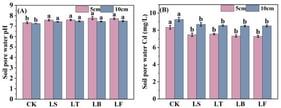
Changes in soil solution pH (A) and Cd2+ (B). Different letters represent a significant difference between treatments at the p < 0.05 level, and the same letters represent non significant difference between treatments. (Comparing values and significance across bar charts of the same color.)

This study aimed to evaluate the effectiveness of spectral absorption-feature indices, derived from soil hyperspectral diffuse reflectance spectroscopy, as covariates within a multivariate geostatistical framework to enhance the digital mapping of soil organic carbon (SOC). The approach also incorporated exhaustively measured auxiliary variables derived from topographic and textural attributes. The research was conducted in a 1.39-km2 forested catchment, where 135 topsoil samples (0–0.20 m depth) were collected from soils classified as Typic Xerumbrepts and Ultic Haploxeralfs. All samples were analyzed for SOC concentration, soil texture, and diffuse reflectance spectra across the VIS–NIR–SWIR region (350–2500 nm). The continuum-removal technique was applied to compute radiometric indices associated with absorption features in the visible region and at 1400, 1900, and 2200 nm. Results demonstrated that these indices effectively captured the SOC spatial variability when combined with silt fraction and topographic attributes, which, among the other covariates, actually exhibited the strongest spatial relationships with SOC. Compared to univariate ordinary kriging, the multivariate geostatistical approach yielded improved prediction accuracy in cross-validation, mostly due to the use of hyperspectral indices as auxiliary variables. Moreover, the geostatistical analysis revealed that the multivariate frame of spatial association was characterized by two distinct spatial scales. The findings of this work then support the use of hyperspectral indices as valuable covariates for digital modelling of SOC distribution even in landscapes characterized by heterogeneous topography and pedology.

12 February 2026

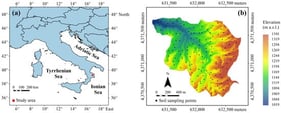
Location (a) digital elevation model (b) of the study area. Locations of soil sampling points are also reported. In (b), coordinates are reported using the World Geodetic System (1984) with the Universal Transverse Mercator zone 33 North Projection (WGS84 UTM 33N).

While the effect of domestication on various aspects of plant ecophysiology has been studied, less is known about its effect on plant–soil interaction. Here, we studied three botanical species of barley in comparison with four old cultivars and four contemporary cultivars with bare soils and two perennial grasses. Aboveground and belowground biomass decreased from botanical species to old cultivars and contemporary cultivars. Aboveground biomass of all barley cultivars was about one third lower in mineral fertilizer compared to the organic one, and this difference was similar in all barley cultivars. Biomass of perennial grasses was up to one third of barley biomass, but grass biomass did not differ significantly between fertilization treatments. Belowground biomass of botanical barley is significantly higher than that of modern cultivars; this discrepancy is even more pronounced under mineral fertilizer where belowground biomass of botanical barley significantly increased, and that of modern cultivars significantly decreased in comparison with organic fertilizer treatment, which means that modern barley cultivar in combination with mineral fertilizers provides less belowground litter to soil. This in the long term can potentially, together with other factors, contribute to the depletion of cultivated soil for organic matter. Microbial respiration in soil did not differ between treatments supplied by organic fertilizer, while in mineral fertilizer treatments old cultivars had lower respiration than other treatments. Microbial biomass did not differ between treatments supplied by mineral fertilizer, but in treatments supported by organic fertilizer, perennial grasses supported more microbial biomass than all barley treatments. The same pattern was observed in C content in soil. Carbon distribution in individual soil fractions did not differ between perennial grasses and barley treatments. In general, when hotspots of organic matter were provided, plants transferred this organic matter to soil, and this activity was more pronounced in perennial grasses than in barley treatments.

11 February 2026

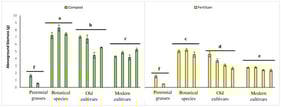
Aboveground biomass of different barley species and grasses under two treatments: compost litter bags and liquid fertilizer. Plant species are in this order from left to right: perennial grasses (Arrhenantherum elatius, Dactylis glomarata), botanical species (Hordeum vulgare subsp. spontaneum, H.spo, Azerbaijan; Hordeum vulgare subsp. spontaneum, H.spo, Syria; Hordeum vulgare subsp. spontaneum, H.spo, Syria), old cultivars (Hordeum vulgare subsp. vulgare, Local (Azerbajdzan), Azerbaijan; Hordeum vulgare subsp. vulgare, Local (Balkan), Greece; Hordeum vulgare subsp. vulgare, local (Peloponnes), Greece; Hordeum vulgare subsp. vulgare, Mozdokskij, mestnyj, Former Soviet Union), and modern cultivars (Hordeum vulgare subsp. vulgare, KWS Meridian, Germany; Hordeum vulgare subsp. vulgare, Titus, Germany; Hordeum vulgare subsp. vulgare, KWS Kosmos, Germany; Hordeum vulgare subsp. vulgare, LG Triumph, France). Data represent mean ± standard error (SE). Significant differences indicated by two-way ANOVA are shown in Table 1. Letters show the difference among plant classes using the Tukey post hoc test.

News & Conferences

Issues

Open for Submission

Editor's Choice

Reprints of Collections

Integrated Soil Management
Reprint

Integrated Soil Management

Food Supply, Environmental Impacts, and Socioeconomic Functions
Editors: José L. S. Pereira, Vítor João Pereira Domingues Martinho

Get Alerted

Add your email address to receive forthcoming issues of this journal.

XFacebookLinkedIn
Soil Syst. - ISSN 2571-8789