Skip Content
You are currently on the new version of our website. Access the old version .

Soil Systems

Soil Systems - formerly Soils - is an international, scientific, peer-reviewed, open access journal on soil science, published monthly online by MDPI. 
The Italian Society of Soil Science (SISS) is affiliated with Soil Systems and its members receive discounts on the article processing charges.
Quartile Ranking JCR - Q2 (Soil Science)

All Articles (810)

Agriculture must balance productivity with greenhouse gas emissions, biodiversity, and resource concerns. This study examined how tillage (conventional, CT; minimum, MT), nitrogen fertilisation (0–221 kg N ha−1), and herbicide rates (0–100%) interactively affected soil CO2 emissions, vegetation vigour, and weed diversity in maize production during 2022. A factorial experiment was conducted on a 1 ha with 40 plots monitored soil temperature, moisture, penetration resistance, normalised difference vegetation index (NDVI), weed diversity (Simpson’s Index), and CO2 emissions (closed-chamber method). Minimum tillage increased soil water retention (9.3 ± 6.5% vs. 5.4 ± 4.3%), soil temperature (28.0 ± 1.5), and compaction (0.6 ± 0.3 vs. 0.1 ± 0.0 MPa), while enhancing weed diversity (0.53–0.80 vs. 0.38–0.67). MT produced higher CO2 emissions than CT, especially at 147 kg N ha−1 (49.9 ± 15.7 vs. 29.1 ± 11.6 μmol m−2 s−1), peaking under MT-147 kg N ha−1-H75 (79.4 ± 1.2 μmol m−2 s−1). NDVI responses varied between tillage systems; under CT, vegetation vigour peaked at 75% herbicide application, while under MT vegetation was more responsive to nitrogen and more sensitive to herbicide, highlighting nitrogen × herbicide interaction trade-offs. Overall, MT enhanced water conservation and weed diversity but increased short-term CO2 emissions. This study reports first-year, site-specific results from an ongoing multi-year field experiment; therefore, the findings were interpreted as short-term, season-specific responses. This highlights the need for site-specific, climate-smart management that integrates emissions, soil health, biodiversity, and productivity.

5 February 2026
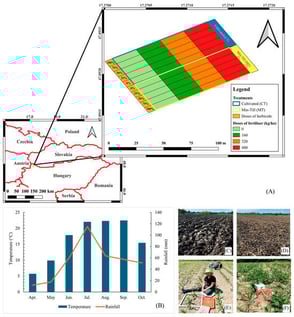
Overview of the experimental site. (A) Geographical map of the study area and experimental design; (B) Climate data; (C) Conventional tillage (CT); (D) Minimum tillage (MT); (E) Weed data collection; and (F) CO2 emission sensor and closed-chamber system.

FTIR spectroscopy, attenuated total reflection (ATR), and diffuse reflectance (DRIFT) modalities, along with ICP–AES spectroscopy and correlation analysis, including two-dimensional correlation spectroscopy (2DCOS), were used for the detailed analysis of Kastanozem (chestnut) soils. Microaggregates (20–200 μm) and macroaggregates (200–1000 μm) of characteristic horizons of uncultivated (fallow) and cultivated (arable land) chestnut soils of the same origin were physically fractionated by wet sieving. The combination of these molecular and atomic spectroscopy techniques in combination with correlation analysis was able to find direct correlations between matrix-forming anions and soil organic matter (SOM) of Kastanozems. Humic substances were separated from the corresponding soil samples to reveal SOM contributions more explicitly. Microaggregates of the size fractions of 20–40 μm and 40–60 μm bore the most comprehensive information for both techniques used. Most significant differences between land-use Kastanozem samples were observed in topsoil horizons (arable P versus light-colored humic AJ horizon), and for the next pair of horizons along the profile xerometamorphic BMK horizon to structural metamorphic BM horizon. These differences included carbonate matrix and SOM amounts and composition. Topsoil arable land showed significantly smaller amounts of total organic carbon and a decrease in the share of long-chain hydrocarbons compared to fallow, which has a more distinctive character compared to similar land-use samples of Chernozem. An increase in carbonate contents with soil depth was found for both land-use samples, while the amounts and composition of the silicate matrix remained largely unchanged within the depth profile. The heterospectral 2DCOS comparison of FTIR (between horizons and land-use samples), ICP–AES (between land-use samples), and FTIR–AES (for the same sample) showed the possibility of a more reliable attribution of FTIR absorption bands and revealed the differences in the macro- and micro-aggregate elemental and SOM composition of Kastanozems.

3 February 2026

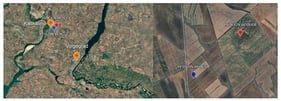
Location of Kastanozem soil sampling sites. Red marks show fallow land, and blue marks, arable land.

The development of urban green infrastructures (UGI) is considered among the main nature-based solutions for climate mitigation in cities; however, the role of soils in the carbon (C) balance of UGI ecosystems remains largely overlooked. Urban green spaces are typically dominated by constructed Technosols, created by adding organic materials on top of former natural or agricultural subsoils. The combined effects of land-use history and current UGI management result in a high spatial variation of soil organic carbon (SOC) stocks and soil CO2 emissions. Our study aimed to explore this variation for the case of Wageningen University campus. Developed on a former agricultural land, the campus area includes green spaces dominated by trees, shrubs, lawns, and herbs, with well-documented management practices for each vegetation type. Across the campus area (~32 ha), a random stratified topsoil sampling (n = 90) was conducted to map the spatial variation of topsoil (0–10 cm) SOC stocks. At the key sites (n = 8), representing different vegetation types and time of development (old, intermediate, and recent), SOC profile distribution was analyzed including SOC fractionation in surface and subsequent horizons, as well as the dynamics in soil CO2 emissions, temperature, and moisture. Topsoil SOC contents on campus ranged from 1.1 to 5.5% (95% confidence interval). On average, SOC stocks under trees and shrubs were 10–15% higher than those under lawns and herbs. The highest CO2 emissions were observed from soil under lawns and coincided with a high proportion of labile SOC fraction. Temporal dynamics in soil CO2 emissions were mainly driven by soil temperature, with the strongest relation (R2 = 0.71–0.88) observed for lawns. Extrapolating this relationship to the calendar year and across the campus area using high-resolution remote sensing data on surface temperatures resulted in a map of the CO2 emissions/SOC stocks ratio, used as a spatial proxy for C turnover. Areas dominated by recent and intermediate lawns emerged as hotspots of rapid C turnover, highlighting important differences in the role of various UGI types in the C balance of urban green spaces.

29 January 2026

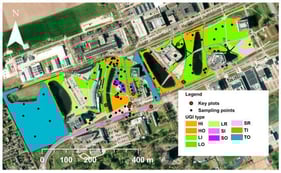
UGI types sampling locations and monitoring key plots on top of the aerial photograph (2023). HI—intermediate herbs, HO—old herbs, LI—intermediate lawns, LO—old lawns, LR—recent lawns, SI—intermediate shrubs, SO—old shrubs, SR—recent shrubs, TI—intermediate trees, TO—old trees.

Role of Pedoagroclimate Settings in Enhancing Sorghum Production in Indonesia

  • Yiyi Sulaeman,
  • Nana Sutrisna and
  • Anny Mulyani
  • + 6 authors

Sorghum is a strategic crop for food, feed, and bioenergy. However, information on its cultivation area and agronomic profile in Indonesia remains limited. Therefore, this study aimed to identify, characterize, and evaluate sorghum cultivation in different agroecosystems and pedoagroclimatic settings in Indonesia. We surveyed published articles, newspapers, and other digital resources, collating a dataset that contained pedoagroclimatic characteristics. We then conducted a field survey to gather data on sorghum farming practices. The results show that sorghum is planted in 11 agroclimatic zones, mainly in D3, B1, and E4, and in seven soil types, mainly in Inceptisols, Mollisols, Vertisols, and Andisols. The cultivated varieties cover Bioguma 1, Bioguma 2, Bioguma 3, Numbu, Kawali, UPCA-S1, Suri 3 Agritan, Soper 9, and local varieties. Under smallholder farmers’ management, the average sorghum yield ranges from 3.6 to 7.5 Mg ha−1. The 15–68% of the yield gap can be closed by implementing site-specific technologies, including high-yielding varieties and soil management. These findings provide a baseline for supporting efforts to increase sorghum production and develop robust sorghum cultivation technologies.

27 January 2026

Existing sorghum cultivation areas in Indonesia, as plotted on the agroclimate map. Supplementary Table S1 provides descriptions of the location numbers. The agroclimate map was redrawn from the regional agroclimate map of Sumatra [32], Java [31], Kalimantan [35], Sulawesi [34], Maluku and Irian Jaya, Bali, Nusa Tenggara Barat, and Nusa Tenggara Timur [33].

News & Conferences

Issues

Open for Submission

Editor's Choice

Reprints of Collections

Integrated Soil Management
Reprint

Integrated Soil Management

Food Supply, Environmental Impacts, and Socioeconomic Functions
Editors: José L. S. Pereira, Vítor João Pereira Domingues Martinho

Get Alerted

Add your email address to receive forthcoming issues of this journal.

XFacebookLinkedIn
Soil Syst. - ISSN 2571-8789