Skip Content
You are currently on the new version of our website. Access the old version .

Societies

Societies is an international, peer-reviewed, open access journal on sociology, published monthly online by MDPI.

Quartile Ranking JCR - Q2 (Sociology)

All Articles (1,830)

This article examines graduate employability challenges in the tourism and hospitality sector of Marrakech, a major tourism destination and strategic regional labour market in Morocco, characterised by strong seasonality, high labour turnover, and persistent education–employment mismatches. Rather than focusing exclusively on technology, the study analyses employability as a multidimensional and context-dependent process, in which digitalisation and artificial intelligence (AI) constitute one influencing factor among others. The research adopts a qualitative, purposive design based on semi-structured interviews conducted between August and October 2025 with 20 stakeholders directly involved in recruitment, training, or early career integration. These include five-star hotel general managers and HR officers, riad managers, travel agencies, recruitment intermediaries, representatives of Morocco’s public employment service (ANAPEC—National Agency for the Promotion of Employment and Skills) and private, regional tourism authorities, academics and young tourism graduates. Interview transcripts were thematically analysed using NVivo to identify recurrent patterns in recruitment practices, skill expectations, and the impact of AI in employability. The results, reflecting stakeholders’ perceptions within this local labour market, show that employability is shaped by six interrelated dimensions: (1) the structure and functioning of the tourism labour market (segmentation, turnover, mobility); (2) partial misalignment between training provision and operational service realities; (3) recruitment standards that prioritise behavioural and relational competences alongside formal qualifications, particularly for frontline positions; (4) language proficiency, especially English and French, as a baseline employability condition; (5) growing expectations regarding digital literacy linked to tourism operations (property management systems, reservation platforms, online reputation management); and (6) the perceived impact of AI-enabled tools (automation of routine tasks, decision-support systems, chatbots), which is seen less as a source of job destruction than as a driver of task reconfiguration and skill upgrading. By situating employer and graduate perceptions within the broader Moroccan employment and training context, the study contributes a place-based understanding of employability in tourism. It highlights the shared responsibility of individuals, employers, and education and training institutions in supporting skill development. The article concludes by discussing policy and practice-oriented levers to strengthen graduate employability, including co-designed curricula, structured internships and mentoring schemes, employer-supported upskilling in tourism-specific digital and AI-related competences, and reinforced labour-market intermediation through ANAPEC and regional governance actors.

11 February 2026

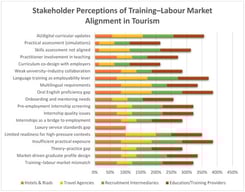
Stakeholder Perceptions of Training–Labour Market Alignment in Tourism. Source: Developed by authors.

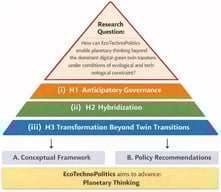
This article advances EcoTechnoPolitics as a transformational conceptual and policy recommendation framework for hybridizing digital–green twin transitions under conditions of planetary polycrises. It responds to growing concerns that dominant policy approaches by supranational institutions—including the EU, UN, OECD, World Bank Group, WEF, and G20—remain institutionally siloed, technologically reductionist, and insufficiently attentive to ecological constraints. Moving beyond the prevailing digital–green twin transitions paradigm, the article coins EcoTechnoPolitics around three hypotheses: the need for planetary thinking grounded in (i) anticipatory governance, (ii) hybridization, and (iii) a transformational agenda beyond cosmetic digital–green alignment. The research question asks how EcoTechnoPolitics can enable planetary thinking beyond digital–green twin transitions under ecological and technological constraints. Methodologically, the study triangulates (i) an interdisciplinary literature review with (ii) a place-based analysis of two socially cohesive city-regions—the Basque Country and Portland (Oregon)—and (iii) a macro-level policy analysis of supranational digital and green governance frameworks. The results show that, despite planetary rhetoric around sustainability and digitalization, prevailing policy architectures largely externalize ecological costs and consolidate technological power. Building on this analysis, the discussion formulates transformational policy recommendations. The conclusion argues that governing planetary-scale ecotechnopolitical systems requires embedding ecological responsibility within technological governance.

11 February 2026

The choice to age in a familiar home environment within the community without relying on residential services can prolong independence, provided care services are customised to the specific needs of the household. However, this model of care provision frequently conceals the hidden costs for women who are often the spousal carer. The navigation of care needs of a spouse when aged 65+ often contains challenges linked to accessing quality community care and respite. These challenges are further compounded by the impact of personal health realities that come with ageing. To explore the support needs of older adults choosing to remain in their own homes, qualitative semi-structured interviews took place with 26 individuals aged 65 and above. This article concentrates on a specific subset of the research using constructivist grounded theory to examine the caregiving realities of six women and one man. A significant finding was that these predominantly female carers often felt unsupported, fatigued, and time-poor, largely attributable to the scale of care needed. Formal care support was particularly valued when it prioritised relationships over task-oriented care. A key recommendation to enable couples to remain living at home and avoid residential care is that more support for spousal (informal) carers is required.

11 February 2026

Work-related stress is one of the most important health problems arising from the interaction between workers and the psychosocial conditions of their work environment. One of its most common physical consequences is musculoskeletal pain, especially in the back and neck. This study analyzes the effectiveness of an intervention program combining Global Postural Re-Education and Virtual Reality techniques to improve psychosocial working conditions and overall mental health. A quasi-experimental design was implemented with four independent groups: virtual reality alone, postural re-education with a hammock-type device, a combination of virtual reality and postural re-education, and rest break with music (placebo). The CarMen-Q questionnaire was used to assess psychosocial work factors, while the GHQ-28 was administered to evaluate general mental health. Forty-four participants completed ten intervention sessions over two consecutive weeks. The results showed a significant overall improvement in perceived work conditions and mental health after participation. The combined VR + RPG condition produced the greatest reduction in emotional demands and performance pressure, whereas the simple rest condition yielded the greatest improvement in psychological well-being. These findings suggest that brief interventions integrating physical and cognitive relaxation components can effectively reduce work-related stress and promote occupational well-being.

11 February 2026

News & Conferences

Issues

Open for Submission

Editor's Choice

Get Alerted

Add your email address to receive forthcoming issues of this journal.

XFacebookLinkedIn
Societies - ISSN 2075-4698