

Need Help?
Announcements
6 November 2025
MDPI Launches the Michele Parrinello Award for Pioneering Contributions in Computational Physical Science
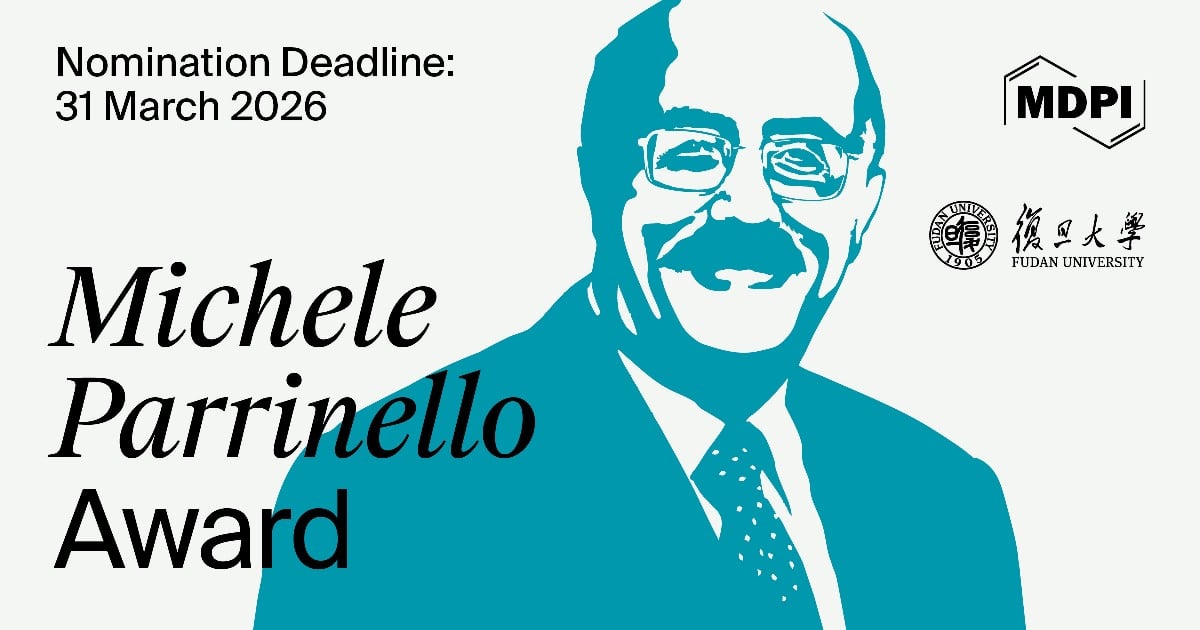
MDPI is delighted to announce the establishment of the Michele Parrinello Award. Named in honor of Professor Michele Parrinello, the award celebrates his exceptional contributions and his profound impact on the field of computational physical science research.
The award will be presented biennially to distinguished scientists who have made outstanding achievements and contributions in the field of computational physical science—spanning physics, chemistry, and materials science.
About Professor Michele Parrinello
"Do not be afraid of new things. I see it many times when we discuss a new thing that young people are scared to go against the mainstream a little bit, thinking what is going to happen to me and so on. Be confident that what you do is meaningful, and do not be afraid, do not listen too much to what other people have to say.”
——Professor Michele Parrinello
 |
Born in Messina in 1945, he received his degree from the University of Bologna and is currently affiliated with the Italian Institute of Technology. Professor Parrinello is known for his many technical innovations in the field of atomistic simulations and for a wealth of interdisciplinary applications ranging from materials science to chemistry and biology. Together with Roberto Car, he introduced ab initio molecular dynamics, also known as the Car–Parrinello method, marking the beginning of a new era both in the area of electronic structure calculations and in molecular dynamics simulations. He is also known for the Parrinello–Rahman method, which allows crystalline phase transitions to be studied by molecular dynamics. More recently, he has introduced metadynamics for the study of rare events and the calculation of free energies. |
For his work, he has been awarded many prizes and honorary degrees. He is a member of numerous academies and learned societies, including the German Berlin-Brandenburgische Akademie der Wissenschaften, the British Royal Society, and the Italian Accademia Nazionale dei Lincei, which is the major academy in his home country of Italy.
Award Committee
 |
The award committee will be chaired by Professor Xin-Gao Gong, a computational condensed matter physicist, academician of the Chinese Academy of Sciences, and professor at the Department of Physics, Fudan University. Professor Xin-Gao Gong will lead a panel of several senior experts in the field to oversee the evaluation and selection process. The Institute for Computational Physical Sciences at Fudan University (Shanghai, China), led by Professor Xin-Gao Gong, will serve as the supporting institute for the award. |
"We hope the Michele Parrinello Award will recognize scientists who have made significant contributions to the field of computational condensed matter physics and at the same time set a benchmark for the younger generation, providing clear direction for their pursuit—this is precisely the original intention behind establishing the award."
——Professor Xin-Gao Gong
The first edition of the award was officially launched on 1 November 2025. Nominations will be accepted before the end of March 2026. For further details, please visit mparrinelloaward.org.
About the MDPI Sustainability Foundation and MDPI Awards 
The Michele Parrinello Award is part of the MDPI Sustainability Foundation, which is dedicated to advancing sustainable development through scientific progress and global collaboration. The foundation also oversees the World Sustainability Award, the Emerging Sustainability Leader Award, and the Tu Youyou Award. The establishment of the Michele Parrinello Award will further enrich the existing award portfolio, providing continued and diversified financial support to outstanding professionals across various fields.
In addition to these foundation-level awards, MDPI journals also recognize outstanding contributions through a range of honors, including Best Paper Awards, Outstanding Reviewer Awards, Young Investigator Awards, Travel Awards, Best PhD Thesis Awards, Editor of Distinction Awards, and others. These initiatives aim to recognize excellence across disciplines and career stages, contributing to the long-term vitality and sustainability of scientific research.
Find more information on awards here.
14 November 2024
Recruiting Editorial Board Members for Societies
In order to further enhance the international influence of Societies (ISSN: 2075-4698) and support the Editorial Board with additional expertise, Societies is inviting interested and eligible researchers from academia to apply for Editorial Board membership.
Editorial Board Members will hold the position for two years, with the possibility of renewal for a second term.
Application eligibility:
- Researchers must have completed their doctorate/Ph.D. in the past 10 years (considering exceptions for career interruptions, including medical and family leave);
- Researchers must have served as the first author/corresponding author on at least five peer-reviewed and published manuscripts in the last five years;
- Researchers must have published impactful work in the field of sociology;
- Researchers must currently (at the time of application) hold a Senior Lecturer, Associate Professor, or Professor title in academia;
- Researchers must be actively engaged in their community (e.g., experienced at presenting at conferences or involved in professional organizations).
Benefits for Editorial Board Members include the following:
- A certificate of appointment as an Editorial Board Member will be provided;
- An Editorial Board Member may publish one paper per year, free of charge, in an open access format;
- The journal will regularly acknowledge those who have participated in the peer review process on the journal’s website;
- There will be opportunities to participate in or host annual meetings and online seminars organized by the Editor-in-Chief and the Editorial Board Members.
Responsibilities of Editorial Board Members include the following:
- An Editorial Board Member is asked to review a couple of manuscripts per year and make decisions (i.e., whether to accept or reject them for publication);
- An Editorial Board Member may also write papers for the journal or serve as a Guest Editor of a Special Issue related to their research interests;
- The Editorial Office will seek advice from the Editorial Board whenever this is necessary or productive.
Applications:
Please fill in the application form here.
Please send the application form and your resume to societies@mdpi.com
with the subject “Societies Editorial Board Application + Name”.
Application deadline: 15 May 2025.
Selection process:
The initial screening of application materials will be followed by selection by the Editor-in-Chief and Editorial Board Members; an email notification will follow, and thereafter a certificate of appointment will be issued.
20 February 2026
MDPI Virtual Academic Publishing Workshop (New Harvest), 25 February 2026
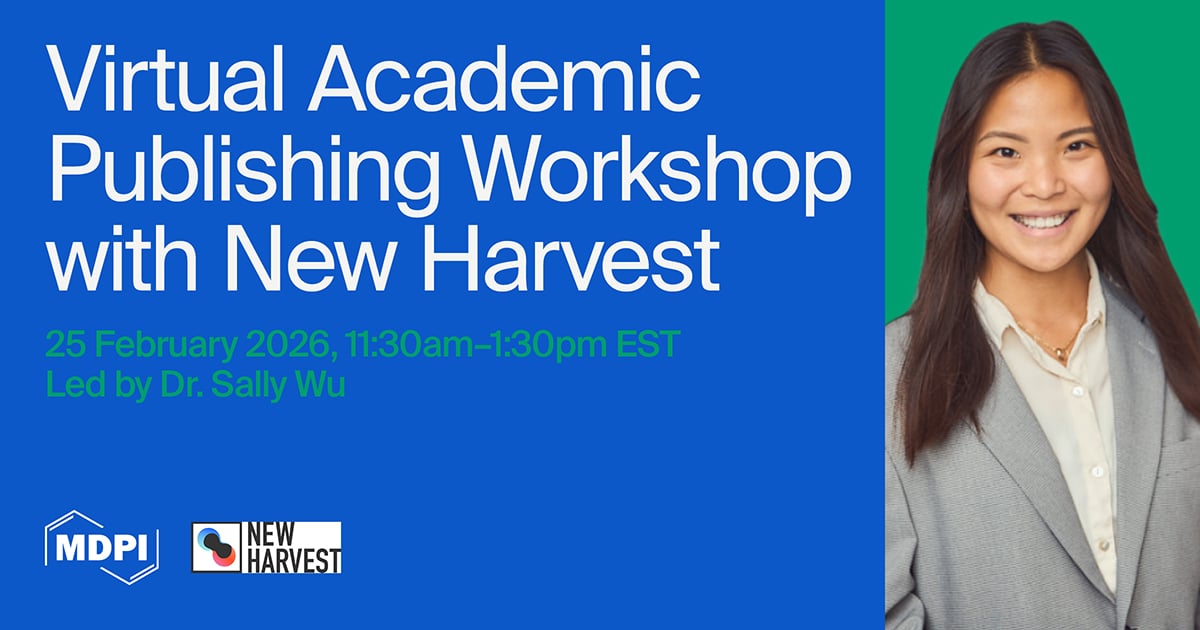
This Academic Publishing Workshop will be led by MDPI Regional Journal Relations Specialist, Dr. Sally Wu, on “Author Training”. Participants will receive practical advice on essential aspects of writing academic articles. Participants will leave with a clearer understanding of the academic publishing landscape and how to successfully contribute to it.
Date: 25 February 2026
Time: 11:30 a.m.–1:30 p.m. EST
Schedule:
|
Speaker |
Program |
Time in EST |
|
Dr. Sally Wu |
Introduction |
11:30–11:40 a.m. |
|
Dr. Sally Wu |
Tips for Writing Great Research Papers
|
11:40 a.m.–12:15 p.m. |
|
Dr. Sally Wu |
How to Respond to Peer Reviewers
|
12:15–12:50 p.m. |
|
Dr. Sally Wu |
AI in Publishing: Challenges and Opportunities
|
12:50–13:30 p.m. |
Speakers:
|
|
Dr. Sally Wu received a PhD in medical science from the University of Toronto in the fall of 2025. She joined MDPI in February 2025 as an Assistant Editor for Cells. She was recently promoted to Regional Journal Relations Specialist position in August. In this role, she works with many journals, liaising with authors, board members, and EiCs. She has attended several conferences across North America, hosted scholar visits, and taken part in other outreach events. |

18 February 2026
MDPI’s Open Access Program Reaches 1,000 Institutions Worldwide
MDPI has surpassed the milestone of 1,000 partners within the Institutional Open Access Program (IOAP). The agreements span 59 countries, covering North and South America, Europe, Asia, Africa, and Oceania.
Last year alone, more than 150 new libraries and academic institutions joined MDPI’s IOAP. With the expansion of an existing consortium deal in Sweden we welcomed a further 75 partners to the program in January 2026, enabling us to surpass the 1,000-partners milestone.
The IOAP supports affiliated researchers by streamlining submission processes, reducing administrative burdens, and offering discounted Article Processing Charges (APCs). Through IOAP membership, more than 61,300 research articles received APC discounts in 2025, driving greater visibility and accessibility for partner institutions and global research communities alike.
"This milestone marks a significant step towards expanding MDPI’s global impact," said Stefan Tochev, MDPI's CEO. "Reaching 1,000 IOAP partnerships is a true testament to the growing trust and collaboration we’ve built with universities, libraries, and research organizations worldwide. We are proud to lead the way in Open Access publishing, ensuring researchers have the support they need to reach global audiences." "The success of our program is reflected in the growing global demand for Open Science and quality publishing services," said Becky Castellon, MDPI institutional partnerships manager. "Equally, institutions are increasingly seeking Open Access publishing options that support funder and national mandates. Joining the IOAP makes compliance simple."
13 February 2026
World Day of Social Justice, 20 February 2026

World Day of Social Justice, observed annually on 20 February, highlights the global commitment to building fairer and more inclusive societies. Established by the United Nations General Assembly, the day draws attention to persistent challenges such as inequality, social exclusion, unemployment, and poverty, and calls for collective action to address the structural barriers that limit opportunity and participation.
Despite ongoing progress, many individuals and communities continue to face systemic discrimination and unequal access to education, healthcare, and decent work. These interconnected challenges reinforce cycles of disadvantage, underscoring the need for sustained research, dialogue, and evidence-based solutions to advance social justice worldwide.
In support of World Day of Social Justice 2026 and Sustainable Development Goal 16 (Peace, Justice and Strong Institutions), MDPI journals aim to foster interdisciplinary dialogue and research on equity, inclusion, and social development. Through Special Issues and research articles, MDPI provides platforms to explore social justice from diverse perspectives, including sociology, public policy, education, and human rights.

| Social Sciences, Arts and Humanities |
Business and Economics Computer Sciences and Mathematics |

“Digital Intermediation and Precarity: Experiences of Domestic Workers in Chile’s Platform Labor Economy”
by Rosa Villarroel-Valdés, Carla Valdés-Sarmiento and Nelson Lay-Raby
Platforms 2025, 3(4), 19; https://doi.org/10.3390/platforms3040019
“Exploring the Intersection of Youth Development, Physical Education, Teacher Education, and Social Justice”
by Cory Elijah Dixon
Youth 2025, 5(2), 59; https://doi.org/10.3390/youth5020059
“The Vulnerability and Injustices Faced by Young Carers in Developed Societies”
by Gottfried Schweiger
Societies 2025, 15(4), 101; https://doi.org/10.3390/soc15040101
“Inter-American Human Rights System and Social Change in Latin America”
by Martha Gutiérrez
Laws 2025, 14(2), 14; https://doi.org/10.3390/laws14020014
“Cross-Disciplinary Rapid Scoping Review of Structural Racial and Caste Discrimination Associated with Population Health Disparities in the 21st Century“
by Drona P. Rasali, Brendan M. Woodruff, Fatima A. Alzyoud, Daniel Kiel, Katharine T. Schaffzin, William D. Osei, Chandra L. Ford and Shanthi Johnson
Societies 2024, 14(9), 186; https://doi.org/10.3390/soc14090186
“One Justice for All? Social Dilemmas, Environmental Risks and Different Notions of Distributive Justice”
by Ulf Liebe, Heidi Bruderer Enzler, Andreas Diekmann and Peter Preisendörfer
Games 2024, 15(4), 25; https://doi.org/10.3390/g15040025
“The Evolving Landscape of Spanish Language Representation in U.S. Media: From Overt to Covert Discrimination”
by Grace A. Parker, Maia Botek and Diego Pascual y Cabo
Languages 2024, 9(6), 220; https://doi.org/10.3390/languages9060220
“Applied Theatre: Research-Based Theatre, or Theatre-Based Research? Exploring the Possibilities of Finding Social, Spatial, and Cognitive Justice in Informal Housing Settlements in India, or Tales from the Banyan Tree”
by Selina Busby
Arts 2024, 13(2), 63; https://doi.org/10.3390/arts13020063
“Educating Youth to Civic Engagement for Social Justice: Evaluation of a Secondary School Project”
by Mara Martini, Chiara Rollero, Marco Rizzo, Sabrina Di Carlo, Norma De Piccoli and Angela Fedi
Behav. Sci. 2023, 13(8), 650; https://doi.org/10.3390/bs13080650

| “Social Justice in Theological Education: Challenges and Opportunities” Guest Editor: Prof. Dr. Ana Thea Filipović Submission deadline: 31 May 2026 |
“Chinese Languages and Their Neighbours in Southeast Asia” Guest Editors: Dr. Pui Yiu Szeto and Prof. Dr. Umberto Ansaldo Submission deadline: 31 August 2026 |
 |
 |
| “Innovations in Affordable Housing Design” Guest Editors: Prof. Dr. Noelia Cervero Sánchez and Prof. Dr. Jaime J. Ferrer Forés Submission deadline: 30 September 2026 |
“Photography, Civil Society and the Crisis of Democracy” Guest Editor: Dr. Terri Weissman Submission deadline: 15 November 2026 |
 |
 |
| “Shakespeare After Democracy―Shakespeare in the Age of New Authoritarianism” Guest Editor: Prof. Dr. Marcela Kostihova Submission deadline: 30 November 2026 |
“Migration and Transnational Religions: Identities and Networks” Topic Editors: Prof. Dr. Nanlai Cao, Dr. Francis Khek Gee Lim and Prof. Dr. Giuseppe Giordan Submission deadline: 31 January 2027 |
 |
 |

 |
 |
 |
11 February 2026
Meet Us at the Population Association of America 2026 Annual Meeting, 6–9 May 2026, St. Louis, Missouri, USA

Conference: Population Association of America 2026 Annual Meeting
Organization: Population Association of America
Date: 6–9 May 2026
Place: Missouri America’s Center, St. Louis, Missouri, USA
MDPI journals will be attending the Population Association of America 2026 Annual Meeting as exhibitors. This meeting will be held at the Missouri America’s Center, St. Louis, Missouri, USA, from 6 to 9 May 2026.
The Population Association of America’s annual meeting is the premier conference of demographers and social and health scientists from the United States and abroad. Since PAA’s first conference in 1932, much important research has been presented on topics ranging from migration to reproductive health to race and gender issues.
The following MDPI journals will be represented:
- Populations;
- Societies;
- IJERPH;
- Youth;
- World;
- Social Sciences;
- Genealogy;
- Geographies;
- Sexes;
- Adolescents;
- Women;
- Humans;
- Econometrics.
If you will be attending this conference, please feel free to visit our booth. Our delegates look forward to meeting you in person and answering any questions that you may have.
11 February 2026
International Day of Women and Girls in Science—“Synergizing AI, Social Science, STEM and Finance: Building Inclusive Futures for Women and Girls”, 11 February 2026

The International Day of Women and Girls in Science, observed annually on 11 February, celebrates the achievements of women and girls in STEM while advocating for equal opportunities in science and innovation. The 2026 theme, “Synergizing AI, Social Science, STEM and Finance: Building Inclusive Futures for Women and Girls”, highlights the importance of integrating these four pillars to address widening inequalities. By combining AI’s transformative potential with social science insights, technical expertise in STEM, and inclusive financial mechanisms, societies can ensure that innovation benefits women and girls and supports sustainable development.
In recognition of the International Day of Women and Girls in Science, MDPI reaffirms its commitment to advancing inclusive and interdisciplinary research. Through open access publishing, we promote gender-responsive AI, women-led innovation, and equitable STEM participation—ensuring knowledge is accessible, and empowering women and girls to shape a more inclusive future in science and beyond.
 |
 |
 |
 |
 |
 |
 |
 |
 |
“Financial Discrimination: Consumer Perceptions and Reactions”
by Miranda Reiter, Di Qing, Kenneth White and Morgen Nations
Int. J. Financial Stud. 2025, 13(3), 136; https://doi.org/10.3390/ijfs13030136
“Women in STEM in the Eastern Partnership: EU-Driven Initiatives and Challenges of External Europeanisation”
by Gabriela-Roxana Irod, Cristian Pîrvulescu and Marian Miculescu
Societies 2025, 15(7), 204; https://doi.org/10.3390/soc15070204
“The Role of Digital Financial Services in Narrowing the Gender Gap in Low–Middle-Income Economies: A Bayesian Machine Learning Approach”
by Alicia Fernanda Galindo-Manrique and Nuria Patricia Rojas-Vargas
Risks 2025, 13(5), 96; https://doi.org/10.3390/risks13050096
“Drivers for Women Entrepreneurship in Greece: A Case Analysis of Early-Stage Companies”
by Marcus Goncalves, Suela Papagelis and Daphne Nicolitsas
Businesses 2025, 5(1), 1; https://doi.org/10.3390/businesses5010001
“Empowering Women in Tech Innovation and Entrepreneurship: A Qualitative Approach”
by Teresa Felgueira, Teresa Paiva, Catarina Alves and Natália Gomes
Educ. Sci. 2024, 14(10), 1127; https://doi.org/10.3390/educsci14101127
“Advancing Women’s Leadership in United Arab Emirates Higher Education: Perspectives from Emirati Women”
by Shaikha Ali Al-Naqbi and Semiyu Adejare Aderibigbe
Educ. Sci. 2024, 14(9), 1002; https://doi.org/10.3390/educsci14091002
“Empowering Female High School Students for STEM Futures: Career Exploration and Leadership Development at Scientella”
by Simon J. Ford, Raquel dos Santos and Ricardo dos Santos
Educ. Sci. 2024, 14(9), 955; https://doi.org/10.3390/educsci14090955
“The Influence of Women on Boards on the Relationship between Executive and Employee Remuneration”
by María L. Gallén and Carlos Peraita
Int. J. Financial Stud. 2024, 12(3), 84; https://doi.org/10.3390/ijfs12030084
“Mentoring and Networking as the “Silver Lining” of Being Women Leaders: An Exploratory Study in Top World Forestry Schools”
by Pipiet Larasatie, Taylor Barnett and Eric Hansen
Trends High. Educ. 2024, 3(1), 169-179; https://doi.org/10.3390/higheredu3010010
““I’m an Academic, Now What?”: Exploring Later-Career Women’s Academic Identities in Australian Higher Education Using Foucauldian Discourse Analysis”
by Matthew James Phillips and Peta Louise Dzidic
Soc. Sci. 2023, 12(8), 442; https://doi.org/10.3390/socsci12080442
| “Gender Equity in K-12 Education, Academia and Higher Education: A Global Perspective” Guest Editor: Prof. Dr. James Etim Deadline for submissions: 31 August 2026 |
“Teacher Education and Education for Sustainability” Guest Editors: Dr. María Teresa Fuertes Camacho, Dr. Sílvia Albareda-Tiana and Dr. María del Carmen Solís-Espallargas Deadline for submissions: 31 August 2026 |
 |
 |
4 February 2026
Acknowledgment to the Reviewers of Societies in 2025

The editorial office of Societies would like to extend its sincere gratitude to all reviewers who contributed to the improvement of the journal quality by providing their expert opinion and evaluation of the submitted research.
We appreciate that thorough peer review demands considerable time and intellectual investment from our reviewers. In 2025, Societies received 1580 review reports from contributors across 85 countries and territories, demonstrating the breadth of international expertise and scholarly engagement that has strengthened our publication standards.
The reviewers who agreed to have their names published this year are listed below in alphabetical order by first name. The editorial team acknowledges with gratitude all reviewers, named and anonymous alike, for their vital role in maintaining the scholarly standards of Societies.
| Abdul Majeed | José Alves |
| Abel Ponce Delgado | José Antonio Martín Herrero |
| Adam Abukari | José Carlos Vázquez-Parra |
| Afsin Sahin | José E. Ramos-Ruiz |
| Agwu Agwu Ejem | José F. Durán Vázquez |
| Ahmad Ismail | José Ramón Cardona |
| Ahmed Al Mansur | Joseph Mukuni |
| Aiching Yen | Josje Van Der Linden |
| Alenka Žerovnik | Juan Luis Rivas Navarro |
| Alex Panicacci | Juan R. Coca |
| Alexander Alich | Karen M. Collier |
| Alexandra Fratila | Katrin Bente Karl |
| Alic Birca | Keith J. Watts |
| Alkinoos Ioannis Zourmpakis | Kittisak Jermsittiparsert |
| Amanda Watkins | Konrad Glombik |
| Amie Cieminski | Konstantinos Kotsidis |
| Amila Jayasinghe | Krisztián Kis |
| Aminreza Iranmanesh | Kundi Viktória |
| Amirreza Kazemikhasragh | Lara Carrascosa Puertas |
| Ana C. Romea | Laura Jovell |
| Ana Maria Cazan | Leena Bhattacharya |
| Ana Maria Cuesta Sánchez | Ligita Stramkale |
| Ana Rodriguez-Olalla | Lisa A. Finnegan |
| Anas Ali Al-Qudah | Lisbeth Weitensfelder |
| Anastasia Atabekova | Liu Liu |
| Andreea Barbu | Longxi Li |
| Angel Justiz-Vaillant | Lorry-Ann Austin |
| Angel Saul Cruz-Ramirez | Lucia Morosan-Danila |
| Anna Irena Szymańska | Luis Miguel Francisco Ginja |
| Anna K. Zarkada | Luiza Loredana Năstase |
| Anna Zaptsi | Luminita Iosif |
| Annabel Martín | Lydia Mabel Okabe |
| Anna-Maria Kanzola | Magdalena Pycińska |
| Antonio Cubero-Atienza | Magdalini Katsikidou |
| António Duarte Santos | Małgorzata Szyszka |
| Antonio Luís Martinez-Pujalte | Manuel B. Garcia |
| Asli E. Telli | Manuel João Cruz |
| Asmita Patel | Marcin Janusz |
| Atabek Atabekov | Marco Carradore |
| Atsunori Fujii | Marco López-Paredes |
| Barbara Pisker | Marco Palmieri |
| Beata Hysa | Margaret Shirley Mutu |
| Beata Stasiak-Cieślak | Maria Romana Allegri |
| Bernardo Trejos | Marieta Georgieva Stefanova |
| Bess Rowen | Marina Lucian |
| Bharat Chandra Rout | Marisa Fariña-Sánchez |
| Branco Di Fátima | Marita Brčić Kuljiš |
| Brett Bligh | Mark Debono |
| Brian Gregory Caraher | Marlene Haupt |
| Bruno Matijašević | Martin Mujinga |
| Burcu Yilmaz Kaya | Martina Feilzer |
| Caleb Esteban | Martina Vuk Grgic |
| Caleb Probst | Mary Margaret Sweatman |
| Camelia Daniela Plǎstoi | Mary P. Corcoran |
| Carlo Deregibus | Massoud Moslehpour |
| Cátia Sousa | Mathieu Fradet |
| Celalettin Ozden | Matilda Nikolić Ivanišević |
| Chantal Louise Bourgault Du Coudray | Matt Smith |
| Charles Edward Atkins | Max Stephenson |
| Chen Li | Mayan Navon |
| Cherra M. Mathis | Md Sakhawot Hossain |
| Christopher Brown | Mehdi Zamani |
| Christopher Slobogin | Meri Manucharyan |
| Ciprian Streza | Michail Kalogiannakis |
| Ciro De Vincenzo | Michelle E. Kelly |
| Clarissa R. Steele | Mika Merviö |
| Clarisse Pessôa | Modisa Abraham Mkhondo Mzondi |
| Craig D. Sims | Mohammed Almahfali |
| Cristobal Macias Villalobos | Monica Ewomazino Akokuwebe |
| Dag Heede | Mónica Lopes |
| Dan Valeriu Voinea | Monika Sidor |
| Dane W. Stickney | Moran Pollack |
| Daniel Homocianu | Mothana Gasaymeh |
| Daniel Sansó-Rubert Pascual | Murat Öztürk |
| Daniel Silva | Natalia Mora-López |
| Daniel Yordanov Pavlov | Natalie Mcmaster |
| Daniela Esperança Monteiro Da Fonseca | Nathaniel D. Porter |
| Daniela Traficante | Nick Poulakis |
| Darryl B. Plecas | Nicola Ielapi |
| Dennis P. Petri | Nicolas Martins Da Silva |
| Desislava Serafimova | Nikola Mijatov |
| Despina Cochliou | Nina Gumzej |
| Dimitrios Gousopoulos | Nomatter Sande |
| Dimitris Kourkouridis | Oksana Pochapska |
| Domenico Marino | Oliver Ramos |
| Edward Kyei Twum | Orlaith Rice |
| Efthimios Dragotis | Panteha Farmanesh |
| Ekaterina Sokolova | Paolo Contini |
| Elena Ciobanu | Paula Cunha |
| Elena Dimitrova | Paula Rodríguez Rivera |
| Elena Mihailovna Rozhdestvenskaia | Paulo Carvalho |
| Eleni Rompoti | Pedro Danilo Ponciano |
| Eleonora Pinto | Pedro Pereira |
| Elisabeth Maué | Peter F. Meiksins |
| Elliot David Lasson | Philipp Öhlmann |
| Elsa Simoes | Pietro Pavone |
| Emiliana Mangone | Pinghua Liu |
| Eran Shadach | Plamena Ivanova Markova |
| Erica Russell | Qinyu Cui |
| Ericka Janet Rechy-Ramirez | Raffaela Puggioni |
| Esra Akgul | Raghed Ibrahim Esmaeel |
| Essa A. Alibraheim | Raluca Răcăşan |
| Esther Cores-Bilbao | Rastyam T. Aliev |
| Ettiyagounder Parameswari | Raúl Martínez-Corcuera |
| Fabian Belmar | Robin Ladwig |
| Fabiana Battisti | Roee Peretz |
| Fabrizio Traversa | Roman Esin |
| Fatemeh Mahdavirad | Roselyn Gonzales |
| Fàtima Canseco-López | Rubén Rivas-de-Roca |
| Fernando Miguel Santos | Rui Zhou |
| Flavio Brescianini | Salvador Martinez Puche |
| Florence Akumu Juma | Sami A. Khan |
| Gábor Mélypataki | Samyia Safdar |
| Gabriella Hideg-Fehér | Santhi Ramanathan |
| Gaetano Di Donna | Sara Jones |
| Gavril Flora | Sarah Michelle Stearne |
| George Ramos | Sayyed Khawar Abbas |
| Georgios E. Trantas | Senka Šekularac-Ivošević |
| Georgios Kapsalis | Sergej Kmetec |
| Gherheș Vasile | Şeyda Bostancı |
| Giacomo Buoncompagni | Shital Desai |
| Giuseppe Bianco | Silvia Molina Plaza |
| Gorana Petković | Sinan Bataklar |
| Grażyna Rosa | Sini Mikkola |
| Greg Simons | Sipho Sibanda |
| Guangfan Sun | Siquan Wang |
| Hafte Gebreselassie Gebrihet | Siyabulela Nyikana |
| Hayoung Wong | Sofia K. Gkarane |
| Heidi Flavian | Sondes Turki |
| Helena Maria Andre Bolini | Sonia Barriuso Ortega |
| Helena Victorovna Guitiss Navas | Sonia Varadinova Mileva |
| Henrique Manoel Pires Teixeira Gil | Soonhee Hwang |
| Henryk Kazimierz Mizerek | Stefan Van Der Hoek |
| Hongjian Wang | Stefanie Panke |
| Huiling Luo | Stefanos Balaskas |
| Hye-soo Lee | Stelios Pantazidis |
| Ian Hodgson | Stéphanie J. Madill |
| Iara Teixeira | Stephen Bagwell |
| Ibrahim A. Elshaer | Steven John Collings |
| Ida Skubis | Stoyan Kirilov |
| Ildikó Vančo | Sukie Van Zyl |
| Indranil Saha | Suzana Ilija Lović Obradović |
| Ioannis Zervas | Svetlana Hristiforova Hristova |
| Iryna Humeniuk | Szymon Machajewski |
| Isabel Maria Abreu Rodrigues Fragoeiro | Taylor Ellis |
| Ivana Matijević | Teodora Dominteanu |
| Iwona Florek | Teodora Rajković |
| Jacqueline Lechuga | Teresa Felgueira |
| Jaeseok Jason Lee | Theodore Koutroukis |
| Jafriansen Damanik | Tito Vagni |
| Jairo Vanegas López | Tjaša Učakar |
| Jakub Michulek | Tobias Nowy |
| James O. Finckenauer | Tomasz Peciakowski |
| Janusz Majewski | Turnwait Otu Michael |
| Jelena Maric | Valdemar Freitas Sousa |
| Jelena Osmanović Zajić | Valentina D'Auria |
| Jennifer Cutri | Valentina Vinšalek Stipić |
| Jennifer Lara Fagen | Valeria Rossini |
| Jens Kai Perret | Vedran Ivanković |
| Jessica F. Sparks | Venera-Mihaela Cojocariu |
| Jessica L. Elf | Victor Frimpong |
| Jiangtao Fu | Víctor Manuel Pérez-Martínez |
| Jie Gao | Wei Yan |
| Jihwan Choi | Wenhao Kang |
| Joan Garcia-Perales | Williams Gilberto Jiménez-García |
| Joan Solé-Pla | Xinxiang Li |
| João Vicente Capucho | Yaser Hasan Al-Mamary |
| Joe Llerena-Izquierdo | Yinshan Lin |
| Jolanta Miliauskaite | Yu Chen |
| Jon Reiersen | Yuhang Liu |
| Joni Murti Mulyo Aji | Zsófia Rakovics |
| Jorge Lizandra | Zubair Ahmad |
2 February 2026
MDPI INSIGHTS: The CEO's Letter #31 - MDPI 30 Years, 500 Journals, UK Summit, Z-Forum Conference, APE

Welcome to the MDPI Insights: The CEO's Letter.
In these monthly letters, I will showcase two key aspects of our work at MDPI: our commitment to empowering researchers and our determination to facilitating open scientific exchange.
Opening Thoughts

MDPI at 30: Three Decades of Open Science, Built Together
As we begin 2026, we approach a meaningful milestone in MDPI’s history: 30 years of advancing Open Science.
What began in 1996 as a small, researcher-driven initiative has grown into a global open-access publisher, supporting hundreds of journals, millions of researchers, and a shared belief that scientific knowledge should be openly available to all. Over these three decades, Open Access has moved from the margins to the mainstream, and MDPI has been proud to help shape that transformation.
To mark this anniversary year, we are pleased to share our MDPI 30th Anniversary logo.
The Anniversary logo is intentionally simple, confident, and enduring, designed to work across cultures, disciplines, and digital environments. It reflects both continuity and progress, honouring MDPI’s established identity while representing the company we are today. The green accent symbolizes our connection to the research communities we serve and the collaborative nature of Open Science itself.
Alongside the visual identity, we are also introducing our 30th Anniversary tagline:
30 Years of Open Science, Built Together.

This phrase captures what has always defined MDPI. Open Science is not the work of a single organization: it is a collective effort shaped by researchers, editors, reviewers, institutions, and the many teams who support the publishing process every day. MDPI’s role has been to provide the infrastructure and commitment that allow this collaboration to thrive.
Throughout 2026, we will mark this anniversary through regional events, global conversations, and editorial initiatives that reflect on MDPI’s evolution, its impact across disciplines, and the communities that make this work possible.
“Open Science is a collective effort”
Whether you have been part of MDPI’s journey for decades or are engaging with us for the first time this year, this milestone belongs to all of us. The past 30 years have shown what is possible when openness, trust, and collaboration are placed at the centre of scholarly communication.
As we look ahead, our focus remains clear: continuing to strengthen quality, integrity, and partnership – so that Open Science can keep moving forward, together.
Impactful Research

A Shared Milestone: MDPI’s Journal Portfolio Reaches 500 Titles
MDPI has reached an important milestone: our journal portfolio grew to more than 500 academic journals last year, spanning the fields of chemistry, engineering, biology, medicine, environmental sciences, the social sciences, and beyond.
The number itself is significant, but what matters more is what supports it: hundreds of scholarly communities that have chosen to collaborate, grow, and publish with MDPI.
From our beginnings nearly 30 years ago with a single Open Access journal (Molecules), MDPI has been guided by a simple aim: advancing Open Science. Reaching 500 journals is not an endpoint. It reflects the diversity of disciplines, ideas, and research cultures that now form part of our shared ecosystem.
Growth with Purpose
Every journal exists because a specific community believes there is a need for focus, visibility, and dialogue in a particular field. As our portfolio has expanded, so has our responsibility to ensure that scale is matched with strong editorial standards, robust research integrity practices, and meaningful academic leadership.
This milestone comes as we enter MDPI’s 30th anniversary year, a fitting moment to reflect on what scale in scholarly publishing truly requires: not only reach, but also dedicated long-term stewardship.
New Journals, New Communities
In December 2025 alone, MDPI welcomed eight newly launched journals and three journal transfers (details below), all of which published their inaugural issues by year-end.

Each of these journals is shaped by its Editors-in-Chief, Associate Editors, and Editorial Board Members, who define its scope, standards, and direction. We are grateful for the time, expertise, and commitment they bring to building these new communities.
Welcoming Transferred and Acquired Journals
We were pleased to publish the first MDPI issues of three recently transferred or acquired journals:
- Cardiovascular Medicine – advancing research on the prevention, diagnosis, and treatment of cardiovascular disease
- Germs – addressing infectious diseases through clinical, public health, and translational perspectives
- Romanian Journal of Preventive Medicine (RJPM) – supporting population health, early detection, and preventive care in collaboration with the Romanian Society of Preventive Medicine
Each of these journals brings an established identity and legacy. Our role is to support their continued development with the same editorial rigor, transparency, and Open Access principles that guide our broader portfolio.
A Collective Achievement
Reaching more than 500 journals is not the achievement of any single team or individual. It is the result of collaboration across the entire scholarly ecosystem. As such, I would like to thank our authors, reviewers, academic editors, and Editorial Board Members, as well as our colleagues across MDPI, who support these communities every day.
As we look ahead, we will continue to expand the breadth and depth of our publishing activities while remaining attentive to the evolving expectations of Open Science, research integrity, and responsible growth.
This milestone is a reminder that Open Access publishing is not only about making research available. It is about building platforms where knowledge can be shared, challenged, improved, and trusted, at scale, and with care.
Inside Research

MDPI UK Summit 2026 in Manchester (21–22 January)
On 21–22 January, we had the pleasure of hosting the MDPI UK Summit 2026 in Manchester. Over two days, we welcomed more than 20 Editors-in-Chief (EiC), Section Editors-in-Chief (SEiC), and Associate Editors for an open, in-depth conversations about how MDPI supports Open Science, editorial independence, and research standards across our journals.
What stood out most was not just the quality of the discussions, but the openness, curiosity, and mutual respect that shaped every session.
|
|
|
|
|
|
|
|


What We Covered
The programme was designed to give insight into how MDPI works behind the scenes and how different teams collaborate to support our journals and editors. Topics included:
- MDPI overview and the evolving Open Access market
- MDPI–UK collaboration and local engagement
- Editorial and peer-review processes
- Research integrity and publication ethics
- Institutional partnerships
- Indexing, journal development, and academic community engagement
Sessions were led by MDPI colleagues across editorial, research integrity, indexing, partnerships, and UK operations, showing how cross-functional our work truly is.
What We Heard
The feedback from editors was both encouraging and grounding:
- 92% rated the Summit Excellent (8% Good)
- 100% said their understanding of MDPI’s values, editorial processes, and local collaborations had significantly improved
- 69% attended primarily to stay informed about academic publishing and research integrity
- 85% felt fully heard and engaged
A few comments that stayed with me:
- “Today’s event truly gave me the opportunity to see the heart of MDPI UK.”
- “The summit was very informative – I really enjoyed seeing the behind-the-scenes operations.”
- “Keep being open to discussions and making editors feel part of the MDPI family.”
These reflections remind us that transparency, listening, and dialogue are not nice-to-haves: they are foundational to trust.
|
|
|
|


Looking Ahead
The UK Summit is one of more than 10 MDPI Summits we are organizing this year across North America, Europe, and APAC. Each one is an investment in relationships, shared understanding, and improvement.
Thank you to the MDPI UK team and supporting colleagues across departments who made this event possible. This was a positive step in strengthening our editorial engagement and kicking off a year of MDPI Summits.
Coming Together for Science

Recapping the Z-Forum 2026 Conference on Sustainability and Innovation (15–16 January 2026)
In January, MDPI supported and participated in the Z-Forum on Sustainability and Innovation, held across Zurich (ETH Zurich) and the city of Baden. With 96 participants and more than 30 speakers and panellists, the forum brought together leaders from government, academia, industry, and innovation ecosystems to explore how sustainability, Open Science, and innovation intersect in practice.
Why this mattered for MDPI
As a Swiss-based publisher with global reach, our investment in Z-Forum reflects a strategic intent: to anchor MDPI more deeply within Swiss research networks while contributing to national and international conversations on sustainability and innovation.
This was not only about visibility; it was also about relationship-building and long-term engagement with institutions shaping research policy and practice in Switzerland.
|
|
|
|
|
|
|
|
|
|


High-level participation and credibility
The forum was supported and sponsored by several key Swiss institutions, including:
- The Swiss National Science Foundation (SNSF) – Switzerland’s central research funding body
- ETH Zurich
- The University of Zurich
- The University of Basel
- Swiss Innovation Park Central
The sponsorship of SNSF lent the forum strong institutional credibility and signalled the relevance of the themes discussed, especially around sustainability, innovation frameworks, and responsible research practices.
|
|
|


Beyond the Room: Extending the Conversation
While attendance was intentionally focused to encourage dialogue, the forum’s reach extended well beyond the venue. Multiple LinkedIn posts before and during the event (e.g., Link 1, Link 2, Link 3, and more) built on the discussions and helped position MDPI as an active and credible contributor within Switzerland’s research and innovation landscape.
A Broader Strategic Signal
Z-Forum is part of a wider effort to:
- Build on MDPI’s Swiss institutional relationships
- Reinforce our leadership in Open Science and sustainability
- Engage proactively with funders, universities, and innovation bodies
- Ensure MDPI remains a visible and constructive partner in the ecosystems where research policy and practice are shaped
Thank you to our Conference team and everyone involved in supporting this event, both behind the scenes and on the ground. These moments of engagement may be small in scale, but they are foundational in impact.

Closing Thoughts

Reflections from the Academic Publishing in Europe Conference
During 13-14 January, I attended the Academic Publishing in Europe (APE) Conference in Berlin, a long-standing forum for discussing scholarly publishing and the deeper principles that support it.

MDPI was proud to be a Gold Sponsor of the 20th Anniversary of the APE conference, reflecting our continued commitment to supporting the scholarly community to engage in critical industry discussions.
This year’s program covered a range of topics, from AI and research integrity to policy, infrastructure, and trust, but one theme stood out clearly for me: academic freedom, and what it means to protect the conditions under which knowledge can be produced, evaluated, and shared responsibly.
Before turning to that, I would like to highlight the opening keynote by Carolin Sutton (CEO, STM), which helped set the tone for the conference.
An Independent Publishing Industry: The Case for Checks and Balances
In her opening remarks, Carolin focused on the importance of continually evolving systems of checks and balances, both operationally and at the marketplace level, to prevent any single actor from dominating knowledge production. Her framing emphasized shared responsibility across publishers, institutions, and research communities, rather than placing the burden on any one group.
As part of this, she revisited the work of sociologist Robert K. Merton, and his CUDOS norms of scientific ethos, first articulated in his 1942 work, The Normative Structure of Science.

Merton outlined four ideals that support healthy scientific systems:
- Communalism – knowledge as a public good
- Universalism – evaluation based on merit, not status or identity
- Disinterestedness – orientation toward truth over personal or financial gain
- Organized Skepticism – systematic, critical scrutiny of claims
While these are ideals, and not guarantees that are perfectly lived up to, they remain powerful reference points today for research systems and organizations as they aim to grow and scale.
It was interesting to see how closely these norms align with foundational principles of Open Access. For example, making research openly available supports communalism. Transparent peer review and editorial processes reinforce universalism and organized skepticism. Strong ethics frameworks and governance help counter conflicts of interest and support disinterestedness.
“Merton’s ideals remain powerful reference points today”
Safeguarding Research: Academic Freedom
Several of the conference sessions touched on the pressures faced by researchers, editors, and institutions: geopolitical tensions, online harassment, misinformation, reputational risk, shrinking resources, and politicized narratives around science.

“Integrity is not static. It must be actively maintained as systems grow.”
A particularly timely presentation came from Ilyas Saliba, who talked about academic freedom. His remarks resonated strongly and underlined the fact that safety in academia is not only physical or digital, but also intellectual.
Academic freedom means safeguarding the ability to ask difficult questions, challenge consensus, publish negative or unexpected results, and participate in scholarly debate without fear of undue personal, political, or commercial consequences. These discussions were a reminder that publishers play an important role in supporting the integrity, accessibility, and credibility of scholarly knowledge, particularly as researchers and institutions face mounting external pressures.
Looking Ahead
The discussions at APE reminded me that integrity is not static. It must be actively maintained as systems grow, expectations evolve, and pressures increase. This applies equally to research integrity, academic freedom, and the broader trust placed in scholarly communication.
I left APE encouraged by the openness of the dialogue and the willingness across publishers, institutions, and communities to engage with difficult questions rather than avoid them. Forums like this play a pivotal role in helping our industry pause, reflect, and recalibrate.
As MDPI continues to grow and as we enter our 30th anniversary, these conversations remind me of the core purpose of science: advancing knowledge for the benefit of society.
Chief Executive Officer
MDPI AG
30 January 2026
Meet Us at the 2026 AERA Annual Meeting, 8–12 April 2026, Los Angeles, CA, USA

Conference: 2026 AERA Annual Meeting
Organization: American Educational Research Association
Date: 8–12 April 2026
Place: Los Angeles, CA, USA
Booth: 129
Each year, the American Educational Research Association Annual Meeting is the world's largest gathering of education researchers and a showcase for groundbreaking, innovative studies across an array of areas. The 2026 AERA Annual Meeting, with the theme “Unforgetting Histories and Imagining Futures: Constructing a New Vision for Education Research”, will take place in Los Angeles, CA, from 8 to 12 April 2026.
With more than 2500 sessions to choose from, the meeting provides a dynamic experience, with opportunities to learn from prominent scholars, discover the latest research, engage in stimulating conversations, and foster professional relationships.
The following open access journals will be represented:
- Education Sciences;
- Disabilities;
- Encyclopedia;
- Psychology International;
- Social Sciences;
- Societies;
- Trends in Higher Education;
- Youth;
- Behavioral Sciences;
- Challenges;
- EJIHPE;
- IME.
If you plan on attending this conference, please feel free to visit our booth (#129). Our delegates look forward to meeting you in person to answer any questions you may have.
For more information about the conference, please visit the following link: https://www.aera.net/AERA2026.
