Skip Content
You are currently on the new version of our website. Access the old version .

Smart Cities

Smart Cities is an international, scientific, peer-reviewed, open access journal on the science and technology of smart cities, published monthly online by MDPI. 
The International Council for Research and Innovation in Building and Construction (CIB) is affiliated with Smart Cities and its members receive discounts on the article processing charges.
Quartile Ranking JCR - Q1 (Urban Studies | Engineering, Electrical and Electronic)

All Articles (834)

This study examines the potential of digital twin (DT) technology to strengthen urban security, with a specific focus on flood risk management in smart cities. A DT is understood as a virtual representation of real-world assets and processes, continuously synchronised with data from the physical environment. Building on an analysis of the existing DT literature and maturity assessment, identified operational requirements and the authors’ expertise in crisis management, this study proposes a structured set of DT maturity levels with stage boundary conditions and illustrative measurable indications and designs a maturity-driven data content model for a flood-oriented DT. The framework identifies essential data layers, sensing requirements and integration mechanisms necessary for representing hydrological, infrastructural and environmental conditions at operationally meaningful update frequencies. This study further outlines the conceptual architecture of a flood DT and discusses its potential to support prediction, situational awareness and decision making across crisis management phases. By providing recommendations for DT implementation and highlighting opportunities for future development, this study contributes to ongoing efforts to enhance the resilience and safety of urban areas through advanced digital technologies.

6 February 2026

Overview of the different types of DT maturity levels [1,11,12,13].

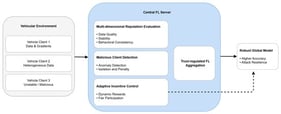
Federated learning (FL) has emerged as a promising paradigm for privacy-preserving distributed intelligence in modern urban transportation systems, where vehicles collaboratively train global models without sharing raw data. However, the dynamic nature of vehicular environments introduces critical challenges, including unstable participation, data heterogeneity, and the potential for malicious behavior. Conventional FL frameworks lack effective trust management and adaptive incentive mechanisms capable of maintaining fairness and reliability under these fluctuating conditions. This paper presents a reputation-aware federated learning framework that integrates multi-dimensional reputation evaluation, dynamic incentive control, and malicious client detection through an adaptive feedback mechanism. Each vehicular client is assessed based on data quality, stability, and behavioral consistency, producing a reputation score that directly influences client selection and reward allocation. The proposed feedback controller self-tunes the incentive weights in real time, ensuring equitable participation and sustained convergence performance. In parallel, a penalty module leverages statistical anomaly detection to identify, isolate, and penalize untrustworthy clients without compromising benign contributors. Extensive simulations conducted on real-world datasets demonstrate that the proposed framework achieves higher model accuracy and greater robustness against poisoning and gradient manipulation attacks compared to existing baseline methods. The results confirm the potential of our trust-regulated incentive mechanism to enable reliable federated learning in smart cities transportation systems.

4 February 2026

System design of the dynamic adaptive incentive mechanism. The Red crosses imply the rejected clients (with a reputation less than 0.6), while the subset of selected clients are encircled in Green (with a reputation value of 0.6 or greater).

This article examines differences between conventional manual measurements of tram operations and data extracted automatically using the REWIZOR program, based on the Yolo10s algorithm. The study addresses the broader question of how artificial intelligence can support analyses of passenger exchange processes in public transport and improve the efficiency of data collection. Measurements conducted in four Polish cities included tram types, stop times, and detailed boarding and alighting durations, while the REWIZOR software enabled automatic detection of stop times and passenger flows based on video recordings. The results show that, although both approaches yield consistent qualitative information regarding doors and passenger counts, significant quantitative discrepancies arise. These differences stem mainly from methodological inconsistencies and varying definitions of boarding, alighting, and stop times, as well as from software-related detection errors. The findings indicate that AI-based measurements require calibration against reference methods to allow reliable comparison with conventional datasets. As currently implemented, REWIZOR can be used effectively for internal analyses of passenger flows, if all compared data come from the same system. Further development—such as implementing simultaneous tracking of people and heads—may considerably improve accuracy and facilitate wider applicability in public transport studies.

2 February 2026

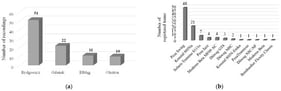
(a) Number of recordings made in different cities; (b) Number of registered trams by type.

Urban air pollution remains a critical public health issue, especially in densely populated cities where pedestrians experience direct exposure to traffic-related and environmental emissions. This study develops and tests a pollution-aware pedestrian routing framework for Thessaloniki, Greece, designed to minimize environmental exposure while maintaining route efficiency. The framework combines high-resolution air-quality data and computational techniques to represent pollution patterns at pedestrian scale. Air-quality is expressed as a continuous European Air Quality Index (EAQI) and is embedded in a network-based routing engine (OSRM) that balances exposure and distance through a weighted optimization function. Using 3000 randomly sampled origin-destination pairs, exposure-aware routes are compared with conventional shortest-distance paths across short, medium, and long walking trips. Results show that exposure-aware routes reduce cumulative AQI exposure by an average of 4% with only 3% distance increase, while maintaining stable scaling across all route classes. Exposure benefits exceeding 5% are observed for approximately 8% of medium-length routes and 24% of long routes, while short routes present minimal or no detours, but lower exposure benefits. These findings confirm that integrating high-resolution environmental data into pedestrian navigation systems is both feasible and operationally effective, providing a practical foundation for future real-time, pollution-aware mobility services in smart cities.

26 January 2026

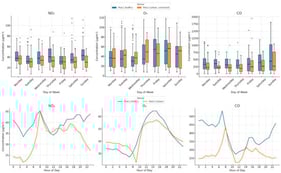
Weekly (top row) and hourly (bottom row) variations of NO2, O3, and CO concentrations measured by two AQMesh sensors deployed in Thessaloniki during September 2025. Pod 1 (blue) is located in a traffic-congested area, while Pod 2 (orange) is located at an urban background site. Strong microscale contrasts can be observed between the two sites, with consistenlty higher NO2 and CO levels at the traffic site and higher O3 concentrations at the background site due to reduced NO titration. Hourly patterns display pronounced rush-hour peaks at the traffic site for NO2 and CO, and a typical photochemical diurnal cycle for O3.

News & Conferences

Issues

Open for Submission

Editor's Choice

Reprints of Collections

Inclusive Smart Cities
Reprint

Inclusive Smart Cities

Editors: Thomas Bock, Rongbo Hu
Smart Cities
Reprint

Smart Cities

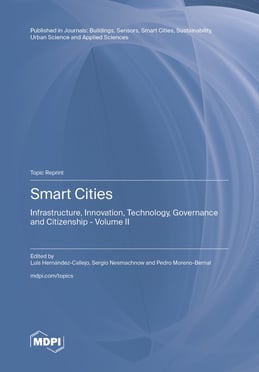
Infrastructure, Innovation, Technology, Governance and Citizenship Volume II
Editors: Luis Hernández-Callejo, Sergio Nesmachnow, Pedro Moreno-Bernal

Get Alerted

Add your email address to receive forthcoming issues of this journal.

XFacebookLinkedIn
Smart Cities - ISSN 2624-6511