Skip Content
You are currently on the new version of our website. Access the old version .
  • 34 days
    Time to First Decision

Sinusitis

Sinusitis (Volume 3, Issue 3 - 2018 was published with Sinusitis and Asthma) is a peer-reviewed, open access journal which focuses on medical research about sinusitis, and is published semiannually online by MDPI.

All Articles (92)

Primary ciliary dyskinesia (PCD) is a rare, genetically heterogeneous disorder of motile cilia that leads to impaired mucociliary clearance and recurrent airway infections. Children with PCD often present with ear and sinus disease resembling common pediatric conditions, yet the true burden and management remain incompletely defined. To address this gap, a systematic search for pediatric cohort studies published between 2020 and 2025 reporting otologic and sinonasal features of PCD was performed. Searches of PubMed, Embase, Scopus, and Web of Science identified 12 eligible studies, encompassing 524 children with confirmed PCD. Data extracted focused on demographics, otologic and sinonasal manifestations, vestibular findings, radiographic imaging, and interventions. Across studies, 60.3% had a history of otitis media and 39.1% had hearing loss, predominantly conductive. Tympanostomy tubes were utilized in more than half of patients, with many requiring multiple sets over time due to recurrent effusions or tube occlusion. Sinonasal disease was nearly universal, with 78.5% demonstrating chronic rhinosinusitis and most reporting nasal congestion and rhinorrhea; nasal polyps were uncommonly noted. Vestibular symptoms were also infrequently assessed but present in some patient cohorts. In conclusion, otologic and sinonasal disease are highly co-prevalent in pediatric PCD, highlighting the need for early recognition, regular surveillance, and standardized outcome reporting to guide long-term management of this complex chronic disease.

28 January 2026
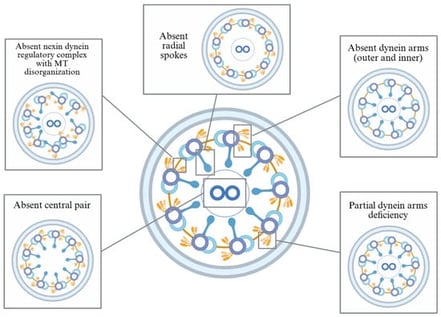
Normal 9 + 2 ciliary axoneme and structural variants in primary ciliary dyskinesia. Known defects include the following: loss of dynein arms (outer and/or inner), absent radial spokes, absent nexin-dynein regulatory complex with resultant microtubule disorganization, and absent central microtubule pair.

Asthma is a multifactorial respiratory condition affected by demographic, clinical, and lifestyle factors. Recognizing sex-related differences in risk factors may help develop personalized preventive strategies and ultimately enhance clinical outcomes. This study aims to compare the characteristics of male and female patients with asthma and to identify the primary risk factors linked to the condition in each group as well. A comparative analysis was conducted using regression models to evaluate the association between asthma and potential risk factors. Odds ratios (ORs) with 95% confidence intervals (CIs) were calculated to estimate the strength of associations for men and women separately. In females, obesity (OR, 1.85; 95% CI, 1.24–2.75), chronic obstructive pulmonary disease (COPD) (OR, 3.37; 95% CI, 1.77–6.43), chronic sinusitis (OR, 4.37; 95% CI, 1.02–18.64), and hypothyroidism (OR, 1.79; 95% CI, 1.09–2.94) were significantly associated with asthma. In males, COPD was the strongest predictor (OR, 4.35; 95% CI, 1.18–15.97), while other factors showed weaker or non-significant associations. Age was not a significant predictor in either sex. The findings highlight important sex differences in the risk profile for asthma. These results underscore the need for sex-specific approaches in the prevention, diagnosis, and management of asthma.

9 January 2026

The Effects of Microplastics and Nanoplastics in the Nasal Airway and Upper Respiratory Tract

  • Maayan S. Kahan,
  • Benjamin S. Bleier and
  • Alan D. Workman
  • + 1 author

Environmental microplastic pollution is rising, and the recent literature reflects these conditions primarily by focusing on the effects of microplastics in the human lung and gut region. Despite the specific prevalence of airborne microplastics, the bulk of the existing literature neglects the point of initial contact of microplastics with the human body, namely the upper airway, specifically the nasal region. This review aims to highlight recent findings surrounding the effects of microplastics in the nose in both in vitro and clinical models. Areas of particular interest include changes in cell morphology, microplastic permeation, cytotoxicity, and inflammatory effects. Although permeation and toxicity findings vary across studies, the literature collectively indicates hazards to cellular health and potential impacts on patient quality of life.

22 December 2025

Profile of Patients with Primary and Secondary Chronic Rhinosinusitis Treated at a Specialized Outpatient Clinic in Brazil

  • Yuri de Medeiros Alcântara,
  • Priscila Novaes Ferraiolo and
  • Cláudia Maria Valete-Rosalino
  • + 4 authors

Objective: To describe the sociodemographic profile and prevalence of different phenotypes of patients with chronic rhinosinusitis (CRS) treated at a specialized outpatient clinic of a university hospital in Brazil. Methods: A cross-sectional retrospective study was conducted on patients treated at a clinic in Brazil. The following were evaluated: sex, age, age at symptom onset, primary CRS phenotype, etiology of secondary CRS, and severity of symptoms. Results: A total of 342 patients were included, of whom 45.61% were men and 8.24% had secondary CRS. The median age of all patients with CRS was 61 years. Nasal polyps were present in 86.22% of patients. The median age at symptom onset was 41 years. The prevalence of primary CRS phenotypes was chronic eosinophilic rhinosinusitis (eCRS) (75%), anti-inflammatory drug exacerbated respiratory disease, which was considered a subgroup of eCRS (19.40%), chronic non-eosinophilic rhinosinusitis (18.66%), central compartment atopic disease (4.1%), and allergic fungal rhinosinusitis (2.24%). The most prevalent diagnoses of secondary CRS were allergic bronchopulmonary aspergillosis (ABPA) (27.59%), immunodeficiencies (20.69%), and vasculitis (13.79%). Conclusions: Patients diagnosed with CRS are predominantly women over 60 years of age who began experiencing nasal symptoms in their fifth decade of life. Most patients have CRS with nasal polyps, primary CRS, and a predominant eCRS phenotype. Secondary CRS accounted for 8.4% of cases, and the most prevalent diagnoses of secondary CRS were Allergic Bronchopulmonary Aspergillosis, immunodeficiencies, and vasculitis.

17 December 2025

News & Conferences

Issues

Open for Submission

Editor's Choice

Get Alerted

Add your email address to receive forthcoming issues of this journal.

XFacebookLinkedIn
Sinusitis - ISSN 2673-351X