Skip Content
You are currently on the new version of our website. Access the old version .

Sensors

Sensors is an international, peer-reviewed, open access journal on the science and technology of sensors, published semimonthly online by MDPI. 
Indexed in PubMed | Quartile Ranking JCR - Q2 (Instruments and Instrumentation | Chemistry, Analytical | Engineering, Electrical and Electronic)

All Articles (75,824)

Several blackouts have recently occurred in Europe and elsewhere. Blackouts are mostly the consequence of a series of events rather than a single event. Their intensity and frequency could be related to the stronger penetration of renewables into electric power systems. Although many different renewable power units may be installed, they all have some basic properties: their power is not consistent, and power inverters are used to connect renewables to electric power systems. Photovoltaic systems are the most typical representative of this large group of power sources. These devices have become more sophisticated over the past few years, allowing for the precise control of large photovoltaic fields. In this situation, all power converters act as one. This means that they could be turned on and off during short intervals. Furthermore, their power factor could be independently adjusted. These functions are desirable for small systems; however, their implications for stability at a larger scale are usually not considered. In this study, the stability issues of a system under the high penetration of renewables and a unique control system are investigated. The most prominent case of this influence is a high-impact rare (HR) event, also known as a “black swan”, which could cause a massive blackout in an electric power system.

6 February 2026
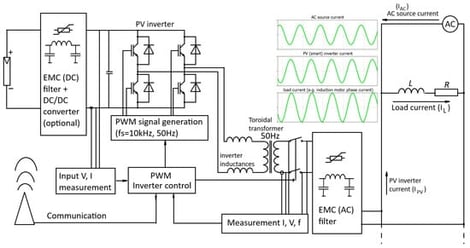
Power converter with reactive power control and three phase-shifted currents (AC generator, PV source, and load) in frame of IoT and (2).

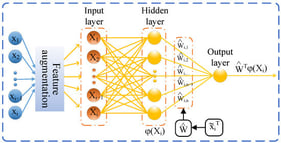
In this article, an adaptive neural network (ANN) controller based on feature augmentation (FA) is designed for quadrotors. The proposed controller consists of two components: a position sub-controller and an attitude sub-controller. We use the ANN to estimate unknown internal and external disturbance terms within quadrotors. To improve the learning accuracy of the ANN, we design an FA structure, which enables networks to more effectively learn the characteristics in the data. To increase the learning rate of the ANN, a state predictor (SP) is proposed to anticipate the state errors, which subsequently updates the learning rate of the ANN. Based on stability analysis, we prove that the closed-loop system is input-to-state stable (ISS). Finally, the effectiveness of our proposed control algorithm is demonstrated by comparing it with related control algorithms on both the MATLAB R2020a/Simulink simulation platform and a quadrotor experimental platform.

6 February 2026

Architecture of ANN based on FA.

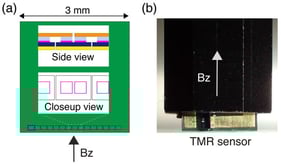
This paper reports magnetic microscopy using high-sensitivity room-temperature tunnel magnetoresistance (TMR) devices for thin geological sections. The sensitivity region of the TMR sensor has dimensions of 178 µm (L) × 0.1 µm (W) × 100 µm (H), consisting of two TMR devices. Magnetic images were obtained for a vertically magnetized Hawaii basalt thin section in two sensor configurations, with the sensor length aligned parallel to the X- (lift-off = 174 μm) and Y-axes (lift-off = 200 μm), without introducing anisotropic distortion in the magnetic images. Although the magnetic images obtained with a scanning SQUID microscope (SSM) were similar, slight discrepancies were observed in the high-spatial-resolution region. A magnetic point source (50 μm × 50 μm) with a perpendicular magnetization film was prepared for evaluation. The SSM measurements showed a clear magnetic dipole at an angle of approximately 1° from the vertical direction. The FWHMs for both the SSM and TMR sensors increased linearly with lift-off. However, the peak magnetic fields, magnetic moments, and dipole tilts of the TMR sensor were significantly larger than those of the SSM sensor. This discrepancy may be due to the vertical extent of the active region of the TMR sensor, as well as due to sensor noise and drift.

6 February 2026

TMR sensor used for the study. (a) Details of the original TMR sensor before length reduction. The green area represents a silicon chip with a series of paired TMR elements (an island) aligned along the upper edge. Fifteen islands are connected serially. Insets are close-up and side views of an island. Each island shares an electrode (yellow) and a free layer (dark blue; 100 μm × 178 μm). The pink color indicates MTJs, and the light blue represents pinned layers. The gaps between islands are 1 μm. Each island is connected to the adjacent islands via the upper electrode (orange). For this study, one island (the leftmost one, enclosed by thick blue dashed lines) is used as a sensor, which includes two TMR devices. The thickness of a free layer is 0.1 μm, which corresponds to the width of the magnetic field sensing region. (b) Appearance of the TMR sensor. The black part is an aluminum body holding the TMR sensor, which is tightly fixed to a vertically oriented aluminum frame in the magnetic shield case.

Context-Aware Multi-Agent Architecture for Wildfire Insights

  • Ashen Sandeep,
  • Sithum Jayarathna and
  • Charith Perera
  • + 3 authors

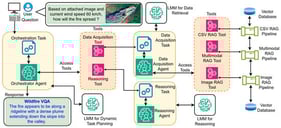
Wildfires are environmental hazards with severe ecological, social, and economic impacts. Wildfires devastate ecosystems, communities, and economies worldwide, with rising frequency and intensity driven by climate change, human activity, and environmental shifts. Analyzing wildfire insights such as detection, predictive patterns, and risk assessment enables proactive response and long-term prevention. However, most of the existing approaches have been focused on isolated processing of data, making it challenging to orchestrate cross-modal reasoning and transparency. This study proposed a novel orchestrator-based multi-agent system (MAS), with the aim of transforming multimodal environmental data into actionable intelligence for decision making. We designed a framework to utilize Large Multimodal Models (LMMs) augmented by structured prompt engineering and specialized Retrieval-Augmented Generation (RAG) pipelines to enable transparent and context-aware reasoning, providing a cutting-edge Visual Question Answering (VQA) system. It ingests diverse inputs like satellite imagery, sensor readings, weather data, and ground footage and then answers user queries. Validated by several public datasets, the system achieved a precision of 0.797 and an F1-score of 0.736. Thus, powered by Agentic AI, the proposed, human-centric solution for wildfire management, empowers firefighters, governments, and researchers to mitigate threats effectively.

6 February 2026

High-level architectural diagram of the proposed solution.

News & Conferences

Issues

Open for Submission

Editor's Choice

Get Alerted

Add your email address to receive forthcoming issues of this journal.

XFacebookLinkedIn
Sensors - ISSN 1424-8220