
Skip Content
You are currently on the new version of our website. Access the old version .

Ruminants

Ruminants is an international, peer-reviewed, open access journal on ruminants, including cattle, all domesticated and wild bovines, goats, sheep, giraffes, deer, gazelles, and antelopes, published quarterly online by MDPI.

All Articles (206)

This study aimed to evaluate recycled manure solids (RMSs) as an alternative to straw as dairy bedding under controlled in vitro conditions using two different conditioners. Pre-cut straw and RMSs were treated once with either 10 wt.% hydrated lime, 200 mL/m2 of an acidic liquid conditioner or left untreated, and incubated for three days at room temperature. Daily, samples were inoculated with manure and Klebsiella (K.) pneumoniae. Outcomes were aesculin-positive Streptococcus spp. and coliform counts, pH, and dry matter (DM) content. Hydrated lime reduced all target bacteria by >99% in both materials. The acidic conditioner decreased K. pneumoniae and streptococcal counts by 98.62%/96.6% (straw) and 98.63%/99.58% (RMSs), respectively. It reduced Escherichia (E.) coli counts by ~67% in both materials without statistical significance (p = 0.064). RMSs showed higher bacterial loads and lower DM content than straw but could be substantially improved by lime treatment. As the conditioner were applied following different manufacturer-recommended dosing principles, these findings reflect effectiveness under practical use rather than intrinsic superiority of one conditioner. RMSs might represent an alternative bedding material when managed with appropriate hygienic measures, although straw showed more favorable microbiological and physicochemical aspects. Both materials contained substantial bacterial loads prior to treatment.

5 February 2026
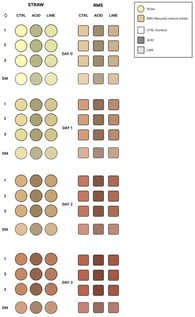
Cup-scale 2 × 3 factorial design. Treatments: CTRL (no conditioner/negative control), ACID (200 mL/m2 acidic liquid conditioner), LIME (10 wt.% hydrated lime). For each material × treatment, three cups were prepared per day; one additional cup was used for dry matter analysis. Sampling on days 0–3.

Feature Papers of Ruminants 2024–2025

  • Leilson R. Bezerra and
  • Phillip Lancaster

Ruminants continue to play a pivotal role in sustainable food production by converting abundant resources, such as rangelands, pastures, crop residues, and agro-industrial byproducts, into human-edible products of high nutritional value (meat, milk, and other dairy products) [...]

6 February 2026

The aim of this research was to evaluate the effect of agro-industrial waste from C. cajan shell, plantain peels (Musa spp.), and Zea mays cob husk on in situ ruminal degradation kinetics and in vitro gas production. Rumen degradation of DM in the soluble fraction (A) was higher (p = 0.0001) in plantain peel (37.5%). The insoluble but potentially degradable fraction (B) was higher (p = 0.0001) in C. Cajan shell (71.7%). Regarding the degradation rate in percentage per hour (c: 0.13%/h), degradation potential (A + B: 86.3%) and effective degradation at the different passage rates (k) (0.02: 79.6%, 0.05: 72.4%, and 0.08: 67.3% k, respectively), it was higher (p < 0.05) in the plantain peels. Rumen NDF degradation was higher (p < 0.05) in plantain peels for all degradation parameters (A + B: 80.8, k: 0.02: 57.1%, 0.05: 44.9%, and 0.08: 37.6%, respectively). Total gas production kinetics (D; 333.3 mLgas/0.5 g degraded DM) and gas production at 24, 48, and 96 h were lower (p = 0.0001) in plantain peels. CH4 production was low (p = 0.0001) in plantain peels at all evaluated times (24 h: 32.7, 48 h: 37.9, and 96 h: 53.5 mL/0.5 g degraded DM). CO2 production was lower (p < 0.05) in C. Cajan and plantain peels at all evaluated times. Under the conditions of this study, it can be concluded that the use of plantain peels (Musa spp.) can be beneficial to animals when incorporated into the diet, as it contains a similar protein content to tropical forages, as well as low fiber content, high ruminal degradation, and secondary compounds that benefit energy maximization by mitigating enteric gas production in ruminants.

2 February 2026

Small ruminants, such as newborn lambs, rely on timely colostrum intake to acquire passive immunity through the absorption of immunoglobulin (Ig). Evaluating Ig transfer is important for ensuring lamb health and survival. However, current methods such as enzyme-linked immunosorbent assay (ELISA) and radial immunodiffusion (RID) are widely used but remain costly and require specialized facilities. The immunocrit assay has been proposed as a lower-cost alternative for evaluating serum Ig concentrations. This study aimed to evaluate the immunocrit method in lambs by comparing it with ELISA, RID, and total serum protein. Serum was collected from 135 Katahdin-Easycare lambs 24–36 h after birth. Samples were analyzed using sheep immunoglobulin G ELISA, Sheep immunoglobulin G RID, serum protein, and the immunocrit method. Pearson’s correlation was used to assess linear relationships between the methods, and Receiver Operating Characteristics (ROC) analysis was used to evaluate test accuracy, with RID as the gold standard (15 mg/mL cutoff). The immunocrit showed a high correlation with RID (r = 0.870), moderate correlation with serum protein (r = 0.725), and good correlation with ELISA (r = 0.607). The ROC analysis showed that the immunocrit had a sensitivity of 100% at a cutoff of 4.34%. These results indicate that the immunocrit method provides comparable accuracy to RID and serum protein, and could serve as a reliable, practical, and inexpensive tool for on-farm evaluation of passive transfer in Katahdin-Easycare crossbred lambs between 24 and 36 h after birth.

31 January 2026

News & Conferences

Issues

Open for Submission

Editor's Choice

Get Alerted

Add your email address to receive forthcoming issues of this journal.

XFacebookLinkedIn
Ruminants - ISSN 2673-933X