Skip to Content
You are currently on the new version of our website. Access the old version .

Risks

Risks is an international, scholarly, peer-reviewed, open access journal for research and studies on insurance and financial risk management.
Risks is published monthly online by MDPI. 

All Articles (1,780)

Bayesian Causal Inference for Credit Default Risk

  • Sello Dalton Pitso and
  • Taryn Michael

Banks often assume that higher credit limits increase customer default risk because greater exposure appears to imply greater vulnerability. This reasoning, however, conflates correlation with causation. Whether increasing a customer’s credit limit truly raises the likelihood of default remains an open empirical question that this work seeks to answer. We applied Bayesian causal inference to estimate the causal effect of credit limits on default probability. The analysis incorporated Directed Acyclic Graphs (DAGs) for causal structure, d-separation for identification, and Bayesian logistic regression using a dataset of 30,000 credit card holders in Taiwan (April–September 2005). Twenty-two confounding variables were adjusted for, covering demographics, repayment history, and billing and payment behavior. Continuous covariates were standardized, and posterior inference was performed using NUTS sampling with posterior predictive simulations to compute Average Treatment Effects (ATEs). We found that a one-standard-deviation increase in credit limit reduces default probability by 1.44 percentage points (94% HDI: [−2.0%, −1.0%]), corresponding to a 6.3% relative decline from the baseline default rate of 22.1%. The effect was consistent across demographic subgroups, with homogeneous treatment effects observed for age, education, and gender categories, and remained robust under sensitivity analysis addressing potential unmeasured confounding. The findings suggest that increasing credit limits can causally reduce default risk, likely by enhancing financial flexibility and lowering utilization ratios. These results have practical implications for credit policy design and motivate further investigation into mechanisms and applicability across broader lending environments. These estimates are explicitly interpreted as context-specific causal effects for a pre-crisis consumer credit environment, with external validity assessed conceptually rather than assumed.

12 February 2026
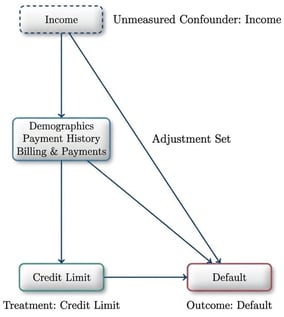
Directed acyclic graph representing the assumed causal structure for identifying the effect of credit limit on default. LIMIT_BAL is the treatment variable, default is the outcome, observed variables (demographics, payment history, billing information, payment amounts) are measured confounders, and income (shown in gray/dashed) is an unmeasured confounder.

The Impact of Financial Derivatives on European Bank Value and Performance

  • Bassam Al-Own,
  • Mohannad Obeid Al Shbail and
  • Ghaith N. Al-Eitan
  • + 1 author

Using a panel dataset of 385 European bank-year observations covering the 2012 to 2022 period, this study aimed to investigate the impact of derivatives on bank value and performance. We used bank-level panel data and conducted several multivariate statistical analyses, i.e., ordinary least squares (OLS), random-effects, and feasible generalized least squares (FGLS) regressions, to examine the ways in which using derivatives for different purposes influences bank value and performance. The regression results indicated a positive and significant association between hedging derivatives and bank performance, while trading derivatives had a negative effect on bank performance and value. Furthermore, the findings suggest that using such derivatives for hedging does not enhance value. Regarding the practical implications of this study and banking sector soundness, financial market regulators and policymakers should be cautious of the potential negative consequences of extensive trading derivative use. In particular, maintaining an acceptable level in this regard is essential to ensuring that the costs of engaging in derivative markets do not surpass their benefits. Hedging through derivatives may not translate into higher bank value, thus managers should justify to investors how such hedging derivatives enhance shareholder wealth. Additional research could focus on whether using derivatives in the banking industry offers any palpable advantage in the intermediate to long term; whether their use by non-financial organizations has different implications that than of financial firms; and the extent to which such financial instruments are useful for enhancing bank value.

12 February 2026

  • Feature Paper
  • Article
  • Open Access

In deregulated electricity markets, Generation Companies (GENCOs) are exposed to substantial financial risk due to volatile and uncertain electricity prices. Traditional generation asset valuation approaches, which rely primarily on expected profit, fail to adequately capture downside risk under market uncertainty. This study proposes an integrated risk-aware framework for generation asset valuation by embedding Value-at-Risk (VaR) into a Price-Based Unit Commitment (PBUC) model. VaR is employed to quantify potential profit losses at different confidence levels, enabling GENCOs to explicitly assess downside exposure associated with electricity price fluctuations. Spot price uncertainty is modeled using the Delta-Normal approach based on historical PJM market data. The resulting nonlinear mixed-integer optimization problem is solved using an Improved Immune Algorithm (IIA) enhanced with the Taguchi Method to improve convergence stability and solution diversity. Case studies on the IEEE 15-unit system demonstrate that the proposed IIA consistently outperforms conventional evolutionary algorithms in terms of profitability, robustness, and convergence reliability. The VaR analysis further reveals pronounced left-tail risk in profit distributions, particularly during peak-load periods, highlighting the importance of risk-adjusted commitment strategies. The proposed framework provides a practical decision-support tool for GENCOs to balance profitability and downside risk in competitive electricity markets.

11 February 2026

As global climate and sustainable challenges gain more attention, green finance has emerged as a significant focus of worldwide financial reform, with green bonds serving as a key indicator. Retail investors, as an important part of the financial market, have a significant impact on the development of green finance through their investment willingness. This study aims to explore the influencing factors and mechanisms on the investment willingness of China retail investors towards green bonds. Based on empirical analysis of data from 2219 valid respondents in China, carried out using the SEM method, the results suggest that perceived usefulness (PU), investment literacy (IL), and information transparency (IT) all positively influence retail investors’ willingness to invest in green bonds. Additionally, PU, IL, and IT contribute to fostering an open attitude toward change (OATC) among retail investors, which, in turn, significantly promotes their investment willingness. This study also identifies the mediation effect of OATC. The findings provide both theoretical and practical insights to promote the development of green finance, enhance market activity, and support policy frameworks.

11 February 2026

News & Conferences

Issues

Open for Submission

Editor's Choice

Reprints of Collections

Financial Analysis, Corporate Finance and Risk Management
Reprint

Financial Analysis, Corporate Finance and Risk Management

Editors: Eulália Mota Santos, Margarida Freitas Oliveira

Get Alerted

Add your email address to receive forthcoming issues of this journal.

XFacebookLinkedIn
Risks - ISSN 2227-9091