Skip to Content
You are currently on the new version of our website. Access the old version .

Publications

Publications is an international, peer-reviewed, open access journal on scholarly publishing, published quarterly online by MDPI. 

Quartile Ranking JCR - Q2 (Information Science and Library Science)

All Articles (562)

  • Systematic Review
  • Open Access

Through this qualitative systematic review, the authors ask the following: To what extent is the 300-word abstract fit for purpose in representing art and design practice-based research outputs on small and/or specialist institutional repositories? The abstract is an important part of the metadata when an Arts Practice-Based Output (APBO) is deposited on a repository. APBOs are non-traditional item types resulting from creative/artistic research processes. Examples include exhibitions, artefacts and digital videos. Little is known about how effectively these abstracts communicate research processes and insights across the art and design sector. This study aims to investigate how well the abstract communicates information about the arts practice-based research through a systematic review of APBOs. The eligibility criteria for inclusion in the review were as follows: APBOs must be from the date range January 2019 to January 2024, be an item type where the 300-word abstract is required, the abstract must be part of the publicly available metadata for the item, and outputs must be practice-based and from the art and design field. The date range (2019–2024) was employed because, during this time, APBOs had gained recognition in the wider research environment. APBOs from the reviewers’ institutional repository were not included in this study to avoid bias that could skew the results of the review. The data repositories from small and/or specialist Higher Education Institutions in the United Kingdom were searched for outputs which appeared to meet the eligibility criteria. These types of institution prioritise and produce more of these output types. A quality tool appropriate for creative/artistic research was applied to the identified dataset of APBOs. The resulting 27 APBOs’ 300-word abstracts were analysed using a thematic approach. Findings suggest that the 300-word abstracts contained information about the quality indicators such as whether the project got funding, the identities of prestigious collaborators and/or dissemination vehicles, and the international recognition of the research. Other identified themes were methodologies, contribution to knowledge, subject matter and item type.

12 February 2026
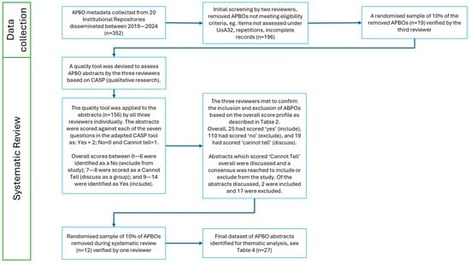
Diagram to show systematic review process.

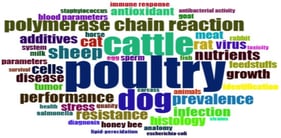
Background: The One Health framework emphasizes the interconnectedness of human, animal, and environmental health and is closely linked with the United Nations Sustainable Development Goals (SDGs). This study conducted a longitudinal bibliometric analysis of the Ankara Üniversitesi Veteriner Fakültesi Dergisi to assess how its scientific output from 2007 to 2024 reflects evolving One Health and sustainability-related research priorities. Methods: A total of 978 records covering the journal’s entire SCI-indexed period were retrieved from the Web of Science (WoS). Bibliometric analyses were conducted in R Studio (v4.5.1) using the Bibliometrix/Biblioshiny package. Keyword standardization, synonym harmonization, and clustering were applied to generate keyword co-occurrence networks, thematic maps, and multi-period thematic evolution analyses (2007–2013; 2014–2019; 2020–2024). WoS–SDG tagging was integrated and manually validated to evaluate alignment with sustainability and One Health domains. Results: The analysis revealed a clear thematic transition over time. Early publications focused on classical veterinary and production-oriented topics such as reproduction, physiology, nutrition, and livestock performance. During the mid-period, increasing emphasis was placed on epidemiology, pathogen detection, and antimicrobial resistance. In the most recent period, molecular diagnostics, infectious disease ecology, and environmental health emerged as central clusters. SDG 3 (Good Health and Well-Being) remained dominant but declined from approximately 79% of publications in 2007–2014 to 69% in 2020–2024, while SDG 13 (Climate Action) increased markedly after 2019, reaching mean values around 10%, indicating diversification toward environmental sustainability. The growing integration of diagnostic terms such as Polymerase Chain Reaction, cytokines, and histopathology reflects increasing research capacity and methodological modernization consistent with One Health priorities. Conclusions: The journal has undergone a substantial evolution from a predominantly traditional veterinary focus toward a more integrative, interdisciplinary, and sustainability-oriented research agenda aligned with One Health and SDG frameworks.

11 February 2026

Keyword co-occurrence word cloud representing dominant research themes in AUVFD (2007–2024).

Publication Patterns in Engineering: A Quantitative Comparison of Open Access and Subscription-Based Journals

  • Luís Eduardo Pilatti,
  • Luiz Alberto Pilatti and
  • Luis Mauricio Martins de Resende
  • + 1 author

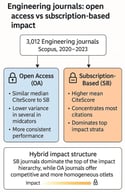
We compare the publication performance of open-access (OA) and subscription-based (SB) journals in Engineering using journal-level indicators from Scopus (CiteScore 2023 view; data collected on 2 December 2024). We analysed 3013 active Engineering journals with an assigned CiteScore quartile (Q1–Q4, where Q1 denotes the highest CiteScore quartile), of which 770 are labelled OA in Scopus; the remaining journals in each stratum were classified as SB. We stratified journals by CiteScore quartile and by the top 10% CiteScore percentile. We examined four indicators for 2020–2023: CiteScore 2023, total citations, number of published documents, and the percentage of cited articles. Because citation and publication counts are strongly right-skewed, we report medians and use Mann–Whitney tests with effect sizes (Cliff’s delta) and false discovery rate correction; Welch tests on log-transformed counts are used as sensitivity analyses. SB journals exhibit substantially higher citation and document medians across all quartiles and in the top 10% stratum, whereas CiteScore medians are very similar between access models. OA journals represent about one quarter of Engineering journals in Scopus, but remain underrepresented in the top 10% segment (125 of 484). Overall, OA provides a competitive level of impact, while SB titles still dominate accumulated visibility and editorial scale in Engineering.

10 February 2026

OA share (%) across CiteScore quartiles (Q1–Q4) and the top 10% CiteScore stratum in Engineering (Scopus).

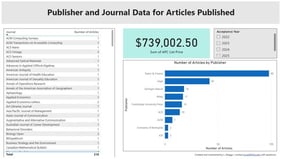
Academic libraries support the mission and vision of their institution; in the case of most universities, this means providing a variety of services and resources in support of the research enterprise. This case study documents one library’s support for open access publishing to explore how it directly supports the research mission of a Carnegie Research 2 university. By leveraging relationships and investing existing collections resources and workflows—the sequence of decisions and labor through which librarians make scholarly and artistic works discoverable, accessible, and support their preservation—in open access publishing, the library has materially increased the visibility of locally produced scholarship and become a more visible campus collaborator.

5 February 2026

Power-BI Dashboard created by Assistant Professor and Scholarly Communication Librarian Lindsey Skaggs.

News & Conferences

Issues

Open for Submission

Editor's Choice

Get Alerted

Add your email address to receive forthcoming issues of this journal.

XFacebookLinkedIn
Publications - ISSN 2304-6775