
Skip Content
You are currently on the new version of our website. Access the old version .

Poultry

Poultry is an international, peer-reviewed, open access journal on poultry health, welfare and productivity, published bimonthly online by MDPI. 

Quartile Ranking JCR - Q2 (Agriculture, Dairy and Animal Science)

All Articles (168)

Effects of Eimeria Challenge and Monensin Supplementation on Performance, Nutrient Digestibility, and Intestinal Health of Broilers

  • Pamella Pryscila de Alvarenga Bissoli Maciel de Lima,
  • José Andrew de Lira Barbosa and
  • Felipe Dilelis
  • + 5 authors

This study aimed to evaluate the performance, nutrient digestibility, intestinal health, and duodenum gene expression of broilers challenged with Eimeria spp. supplemented with or without monensin sodium. A total of 144 male chicks were used, distributed in a completely randomized design with three treatments: unchallenged control (UN), challenged control (CC), and CC + 100 mg/kg of monensin sodium (MON). Six replicates of eight birds each were used. At 14 days of age, the challenged groups were inoculated with a mixture of Eimeria oocysts, 12,500 E. maxima, 62,500 E. acervulina, and 12,500 E. tenella oocysts/chick. Coccidial challenge impaired growth performance and nutrient digestibility and induced intestinal damage, as evidenced by reduced body weight gain and feed intake (p < 0.001), lower apparent digestibility coefficients (p < 0.001), and altered intestinal morphometry and ISI score in the jejunum and cecum (p < 0.001). Monensin supplementation partially alleviated these negative effects, improving performance and nutrient digestibility (p < 0.001) and delaying oocyst excretion (p = 0.006) when compared with the CC group. However, the duodenal expression of tight junction-related genes, as well as intestinal integrity and health parameters, remained impaired despite monensin supplementation. It is concluded that monensin preserves nutrient digestibility and attenuates performance loss in broilers challenged with Eimeria spp. but not reduced intestinal damage.

3 February 2026
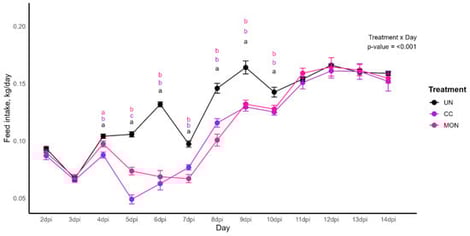
Daily feed intake from day 2 to day 14 post-challenge with Eimeria spp. Points within a dpi with different letters superscripts differ by Tukey test at p &lt; 0.05, sliced treatment at each day postinfection.

In most countries, male siblings of laying hybrids are culled immediately after hatching because their rearing is economically unfeasible due to low growth performance, poor feed efficiency, and a body composition unacceptable to consumers. In Germany, however, culling male day-old chicks has been prohibited for animal welfare reasons since 2022, making their rearing mandatory. Currently, no recommendations exist for protein and amino acid supply for these birds. This study aimed to determine the requirements for standardized ileal digestible (SID) methionine + cysteine (Met + Cys) and SID lysine (Lys) during the starter period (days 1–21) in male LSL Classic chicks by a dose–response approach. Two trials were conducted with 120 male chicks each, fed six diets containing SID Met + Cys concentrations ranging from 0.36% to 0.71% (Trial 1) or SID Lys concentrations ranging from 0.50% to 0.89% (Trial 2). Optimal concentrations were estimated using broken-line and exponential models based on body weight gain, feed intake, and feed conversion ratio. Considering all criteria, the optimal SID Met + Cys concentration was 0.58% (0.42 g/MJ AMEN), and the optimal SID Lys concentration was 0.74% (0.56 g/MJ AMEN). The calculated optimum SID Met + Cys:SID Lys ratio when standardized to an identical energy level was 74:100. These findings provide a basis for adjusting SID Met + Cys and SID Lys levels in starter diets for male chicks of a layer breed, supporting more efficient and sustainable rearing practices under current animal welfare regulations.

2 February 2026

This study evaluated the effect of rearing conditions with outdoor access on carcass traits, technological meat quality, and muscle fibre morphology in broiler chickens. Hubbard JA757 broilers were reared until 81 days of age under either control or experimental conditions. Both groups were housed indoors under identical management until day 35; thereafter, the experimental group had access to an outdoor paddock, while the control group remained indoors. At 81 days of age, birds were slaughtered, carcass composition was recorded, and breast (pectoralis major) and thigh (biceps femoris) muscles were analyzed for pH, colour, cooking loss, and shear force. Muscle fibre characteristics were assessed histochemically. Control birds showed higher slaughter and chilled carcass weights, whereas experimentally reared birds exhibited higher carcass yield, lower breast proportion, higher thigh proportion, and reduced abdominal fat. Experimental rearing was associated with higher L* values, higher shear force, and lower cooking loss in both muscles. In the pectoralis major, fibre density was higher in controls, while fibre diameter was higher in the experimental group. In the biceps femoris, the experimental group showed a higher proportion of oxidative βR fibres and larger fibre cross-sectional areas. These results demonstrate that the rearing system influences carcass composition, technological meat properties, and muscle fibre characteristics, leading to distinct phenotypic and technological differences between the groups.

2 February 2026

The experimental study was performed to determine the efficacy of a mycotoxin detoxification agent (MS) at a concentration of 0.2% in reducing the toxicity of aflatoxin B1 (AFB1) and ochratoxin A (OTA), alone or in combination, and to examine its effect on performance, pathohistological (PH) changes, and residues of these toxins in the tissues of broiler chicks. A total of 88 broilers were divided into eight equal groups: group C, the control group (fed a commercial diet without any additives); group MS, which received the mycotoxin detoxification agent (MS) (supplemented with 0.2%); group E I (0.2 mg AFB1/kg of diet); group E II (0.2 mg AFB1/kg of diet + MS 0.2%); group E III (1.5 mg OTA/kg of diet); group E IV (1.5 mg OTA/kg of diet + 0.2% MS); group E V (combination of 0.2 mg AFB1/kg, 1.5 mg OTA/kg of diet); and group E VI (combination of 0.2 mg AFB1/kg, 1.5 mg OTA toxin + 0.2% MS). Results show that feed containing AFB1 and OTA, individually or in combination, negatively affects health, production results, and PH changes in tissues, as well as the presence of mycotoxin residues in the liver and breast muscles of poultry. The addition of a new multicomponent preparation for the detoxification of MS mycotoxins in feed with AFB1 and OTA individually and in combination had a positive effect on TM (BW), growth (BWG), consumption and FCR conversion coefficient, and microscopic lesions in organs. The concentration of OTA residues in the liver and chest muscles was significantly lower in chickens fed a diet with the addition of 0.2% MS of the mycotoxin detoxification preparation.

19 January 2026

News & Conferences

Issues

Open for Submission

Editor's Choice

Get Alerted

Add your email address to receive forthcoming issues of this journal.

XFacebookLinkedIn
Poultry - ISSN 2674-1164