Skip to Content
  • 2.3
    Impact Factor
  • 24 days
    Time to First Decision

Physiologia

Physiologia is an international, peer-reviewed, open access journal on physiology published quarterly online by MDPI.

Quartile Ranking JCR - Q2 (Physiology)

All Articles (176)

Introduction: cigarette smoking is a major source of systemic oxidative stress and a well-established risk factor for cardiovascular disease. Heated tobacco products (HTPs) are increasingly promoted as reduced-risk alternatives, yet their cellular effects remain incompletely understood. Methods: this study compared the oxidative stress-mediated effects of conventional cigarette smoking and HTP use on human erythrocytes. Erythrocytes from healthy non-smokers, conventional smokers, and HTP users were analyzed using biochemical, functional, and cytological approaches to assess redox status, membrane and cytoskeletal organization, anion exchanger 1 (AE1) function, antioxidant response, and redox-sensitive signaling pathways. Results: conventional smokers exhibited higher intracellular reactive oxygen species (ROS) levels, thiol depletion, methemoglobin and hemichrome formation, whereas HTP users showed marked lipid peroxidation despite lower ROS availability. Both groups instead displayed altered expression and distribution of key membrane and cytoskeletal proteins, including glycophorin A, AE1, spectrin, ankyrin, and band 4.1, indicating impaired membrane–cytoskeleton interactions. Functional analyses revealed an accelerated AE1-mediated anion exchange in erythrocytes from conventional smokers, whereas cells from HTP users exhibited a reduced sulfate accumulation, indicating altered transport capacity. In both groups, G6PDH activity was significantly increased, and redox-sensitive signaling pathways involving ERK, AKT, and eNOS were activated, accompanied by sex-dependent alterations in estrogen receptor expression and distribution. Conclusions: collectively, these findings identify erythrocytes as sensitive biomarkers of tobacco-related systemic damage and indicate that smoking-induced erythrocyte dysfunction, including that associated with HTP use, may actively contribute to vascular impairment. This evidence challenges the assumption that heated tobacco products confer a substantially reduced cardiovascular risk compared with conventional cigarettes.

25 February 2026
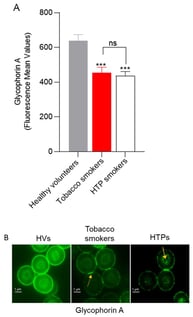
Detection of glycophorin A content and distribution. (A) Histogram reporting mean values of fluorescence intensity of glycophorin A. (B) Representative images of immunofluorescence show glycophorin A distribution in cells obtained from healthy or smoker (tobacco and HTP users) donors. Aggregates of glycophorin A are indicated by yellow arrows. Samples were observed with a 100× objective. ns, not statistically significant versus tobacco smokers; *** p < 0.001 versus control condition. One-way ANOVA followed by Bonferroni’s post-test; (n = 10). Scale bar = 1 µm.

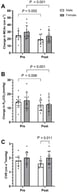
Background/Objectives: Despite increasing interest in high-intensity exercise and cerebrovascular function, the effects of maximal sprint exercise on cerebrovascular reactivity (CVR), a key indicator of vascular health, remain unclear. Methods: This study investigated the acute effects of a 30-s all-out cycling sprint (Wingate Anaerobic Test, WAnT), on CVR to hypocapnia in 24 healthy young adults (12 males). Following familiarisation and a V˙O2max test, participants completed an experimental session where CVR was assessed at rest and 30 min post-WAnT. CVR was evaluated using a 1-min voluntary hyperventilation protocol (25 breaths·min−1), with middle cerebral artery blood velocity (MCAv) measured via transcranial Doppler ultrasound and end-tidal CO2 (PETCO2) recorded breath-by-breath. CVR was calculated as the absolute change in MCAv per 1 mmHg change in PETCO2 from the final 10 s of hyperventilation. Results: Resting MCAv and PETCO2 were significantly reduced post-WAnT (p < 0.01 and p < 0.001 respectively). Consequently, the reductions in MCAv and PETCO2 during hyperventilation were attenuated after exercise in both males and females (p < 0.01 and p < 0.001 respectively). Despite these changes, CVR remained unaltered in both sexes following WAnT (males: 1.79 ± 0.35 vs. 1.59 ± 0.26 cm·s−1·mmHg−1, p = 0.09; females: 2.01 ± 0.44 vs. 2.01 ± 0.46 cm·s−1·mmHg−1, p = 0.97). However, post-exercise CVR was significantly lower in males than females, despite no baseline sex differences (p = 0.01). Conclusions: Cerebrovascular reactivity to hypocapnia is preserved 30 min after a single bout of maximal sprint exercise in healthy young adults. Notably, females demonstrated a more favorable maintenance of CVR post-exercise compared to males, suggesting potential sex differences in CVR following maximal sprint exercise.

14 February 2026

Individual and mean (±SD) physiological responses to 1 min of hyperventilation (i.e., hypocapnia) before and after the Wingate test in males (n = 12; white bars) and females (n = 12, grey bars). The change in MCAv (A) and PETCO2 (B) represent the difference between resting baseline and the final 10 s of the hyperventilation. (C), cerebrovascular reactivity. MCAv, middle cerebral artery blood velocity; PETCO2, end-tidal partial pressure of carbon dioxide; CVR, cerebrovascular reactivity.

Background: Anthropometric characteristics are known determinants of rowing performance, particularly during adolescence, when rapid physical growth affects strength, leverage, and movement efficiency. Understanding how body size and proportionality relate to rowing output is essential for contextualizing performance differences during youth rowing development. Objective: This study examined the associations between anthropometric variables and 2000 m ergometer performance in a multinational cohort of adolescent rowers, with separate analyses for males and females. Methods: A total of 126 youth rowers (65 males, 61 females) aged 14–16 years from eight countries participated. Standardized anthropometric measurements including body height, body mass, body fat (F%), relative muscle mass (M%), limb lengths, and body surface area (BSA) were assessed. Performance was assessed via maximal 2000 m ergometer testing, recording mean power output (W). Results: Significant anthropometric differences were observed between sexes. Performance outcomes mirrored these patterns: males produced substantially greater ergometer power (327.10 ± 48.65 W) compared to females (219.63 ± 30.96 W, p = 0.015). Across nations, anthropometric and performance means differed numerically but showed no statistically significant between-country differences (p > 0.05), despite small-to-moderate effect sizes. Correlation analyses revealed strong positive associations between ergometer power and body height (males: r = 0.70; females: r = 0.71), body mass (males: r = 0.75; females: r = 0.70), relative muscle mass (males: r = 0.62; females: r = 0.64) and body surface area (males: r = 0.78; females: r = 0.73). Relative fat mass showed a moderate-to-strong negative association with performance (males: r = −0.67; females: r = −0.64; p < 0.01). Conclusions: Anthropometric variables—particularly height, body mass, muscle mass, and body surface area—are strongly associated with rowing ergometer performance in adolescent athletes. These findings underscore the relevance of morphological profiling in youth rowing and provide descriptive insight into anthropometric–performance relationships during early junior rowing.

10 February 2026

Contrasting relationships between relative body fat (F%; %) and body surface area (BSA; m2) and performance (Ergo; W) (male group). Legend: The horizontal axis (x) shows the relationship of ergometer performance (Ergo (150–500 W)) with average relative body fat (F%) and body surface area (BSA m2). [Ergo (W): F%, r = −0.6682 (p = 0.008); BSA (m2), r = 0.7793 (p &lt; 0.001)].

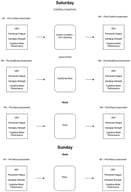
Background/Objectives: Competitive karting places high physiological and cognitive demands on drivers. This field study investigated the acute effects of racing on heart rate variability (HRV), perceived fatigue and neuromuscular function, and cognitive-motor performance during an official event held under persistent rain. Methods: Longitudinal, repeated-measures design across two conditions: control (race video viewing) and competition (qualifying and race). Four drivers (Junior, X30 Senior, X30 Super Shifter) were assessed pre/post-control and post-qualifying/race on Day 1 (Saturday) and pre/post-race only on Day 2 (Sunday). Measures included continuous heart rate, pre/post HRV (HRV4Training; rMSSD, SDNN), perceived fatigue (ROF), bilateral handgrip strength, and visuomotor performance (reaction times and accuracy). Results: On Day 1, SDNN and rMSSD decreased significantly after qualifying versus pre- and post-control (p < 0.05), remaining globally lower post-race; no changes emerged in frequency-domain indexes. Perceived fatigue, handgrip strength, and mean/max reaction times did not change significantly; an improvement in minimum reaction time was observed post-race versus post-control (p = 0.033). rMSSD consistently decreased after racing on both days (p < 0.05) with no day × time interaction observed, and accuracy improved on Sunday, reflected by more correct attempts (hits) and fewer failed attempts (errors) (p < 0.05). Conclusions: Racing was associated with lower time-domain HRV indices (rMSSD/SDNN), consistent with heightened autonomic activation without measurable decrements in handgrip-based neuromuscular function or cognitive-motor performance. The improved accuracy on Day 2 may be related to an increased level of physiological activation and readiness associated with race day. Routine HRV monitoring across race weekends is recommended to guide recovery decisions when subjective scales show limited immediate sensitivity. These findings are preliminary due to the small and heterogeneous sample and should be interpreted cautiously.

8 February 2026

Design of the study. M2 corresponds to both Post-Control and Pre-Qualifying assessments. M3 corresponds to both Post-Qualifying and Pre-Race assessments.

News & Conferences

Issues

Open for Submission

Editor's Choice

Get Alerted

Add your email address to receive forthcoming issues of this journal.

XFacebookLinkedIn
Physiologia - ISSN 2673-9488