Skip Content
You are currently on the new version of our website. Access the old version .
  • 2.3
    Impact Factor
  • 24 days
    Time to First Decision

Physiologia

Physiologia is an international, peer-reviewed, open access journal on physiology published quarterly online by MDPI.

Quartile Ranking JCR - Q2 (Physiology)

All Articles (171)

Background/Objectives: Cognitive impairment and sleep disturbances are highly prevalent in individuals with multiple sclerosis (MS), particularly during middle age, and negatively affect functional independence and quality of life. Although physical exercise has demonstrated cognitive and sleep-related benefits in MS, tolerance to high-intensity training is often limited. Blood flow restriction (BFR) training, which combines low-load resistance exercise with partial vascular occlusion, has emerged as a feasible alternative. This study aimed to evaluate the effects of a 12-week BFR training program on performance in specific cognitive domains and sleep quality in middle-aged adults with MS. Methods: A randomized controlled trial was conducted in 65 adults with relapsing–remitting multiple sclerosis (RRMS) aged 40–65 years and an Expanded Disability Status Scale score below 7. Participants were randomly assigned to a BFR training group or a usual-care control group. The intervention consisted of supervised low-load resistance training with BFR performed twice weekly for 12 weeks. Outcomes assessed before and after the intervention included processing speed (Symbol Digit Modalities Test), executive function (Trail Making Test A and B), verbal fluency (Isaacs Set Test), and self-reported sleep quality (Pittsburgh Sleep Quality Index). Results: Compared with controls, participants in the BFR group showed significant improvements in specific cognitive domains, including processing speed, executive function, and verbal fluency. Significant reductions were also observed in self-reported global sleep disturbance and daytime dysfunction. No adverse events were reported. Conclusions: A 12-week BFR training program improved performance in key cognitive domains and self-reported sleep quality in middle-aged adults with MS, supporting its feasibility and potential clinical relevance as an exercise-based intervention.

6 February 2026
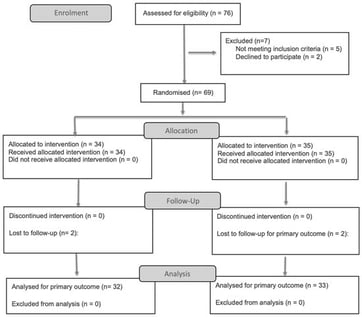
Flow diagram of participant recruitment, eligibility assessment, exclusions, randomization, and group allocation in the randomized controlled trial. A total of 76 individuals were assessed for eligibility, 69 met the inclusion criteria, and 65 participants were randomized to the experimental group (n = 32) or the control group (n = 33).
  • Systematic Review
  • Open Access

This meta-analysis investigates the acute (immediate) pre–post changes in the modulation of physiological tremor in healthy adults following physical exercise, including resistance-based protocols. Physiological tremor is characterized by low-amplitude, high-frequency oscillations during posture or movement and reflects transient changes in neuromuscular control. Background/Objectives: Quantify the pooled effect of physical exercise on physiological tremor amplitude in healthy adults using magnitude-based metrics (RMS, peak power). A secondary objective was to synthesize evidence from acute resistance-based protocols separately. Methods: This meta-analysis was conducted in accordance with the Preferred Reporting Items for Systematic Reviews and Meta-Analyses (PRISMA 2020) guidelines and followed the methodological framework outlined in the Cochrane Handbook for Systematic Reviews of Interventions. Thirteen experimental studies met the inclusion criteria, with eleven included in the general exercise analysis and eight in the acute resistance-based subset. Results: Random-effects models revealed a moderate reduction in tremor amplitude following acute exercise (Hedges’ g = −0.42, p < 0.001). The resistance-based synthesis was restricted to acute single-session protocols only and indicated a directionally consistent reduction in tremor amplitude. Conclusions: These findings suggest that physical exertion is associated with transient suppression of physiological tremor amplitude. Acute single-session resistance-based exercise protocols showed a consistent direction of effect, although pooled estimates should be interpreted cautiously due to heterogeneity. Overall, physiological tremor may serve as a sensitive, non-invasive outcome measure reflecting short-term neuromuscular state.

3 February 2026

Gender Differences in Autonomic Stress Status and Body Fat Percentage Among Teachers

  • Estela Álvarez-Gallardo,
  • Andrea Calderón García and
  • Vicente Javier Clemente-Suárez
  • + 2 authors

Background/Objectives: Teaching is a profession characterized by a high burden of stress. This study examined sex differences in autonomic regulation by analysing heart rate variability (HRV) and body fat percentage (BF%) in teachers, explicitly hypothesizing that the association between adiposity and autonomic modulation (HRV) would be more consistent in men. Methods: A cross-sectional study was conducted with 253 teachers from compulsory and university education during the 2022–2023 academic year. HRV was obtained from heart rate recordings, and body composition was assessed using bioelectrical impedance analysis. Analyses were stratified by sex and, in addition to comparisons based on the sex-specific median of fat mass (kg), ANCOVA models were performed and adjusted for age, teaching experience, and educational level. Results: Teachers with higher BF% were older (43.46 vs. 40.65 years; p = 0.007) and reported higher perceived stress (7.60 vs. 6.83; p = 0.034). In men, HRV was lower in the ≥p50 adiposity group, with reductions in RMSSD and pNN50 (p = 0.015–0.016). In women, RMSSD and pNN50 were not significant (p > 0.20; small effect sizes). In adjusted analyses (ANCOVA), no significant differences were found in men for any index; in women, HRmax and the LF/HF ratio were significant (small effects), whereas the remaining indices were not. Conclusions: Greater adiposity was associated with higher stress and lower HRV, particularly in men. In women, the pattern was more heterogeneous, and significance after adjustment was limited to HRmax and the LF/HF ratio, suggesting the need for sex-specific approaches to the assessment and promotion of psychophysiological well-being in teachers.

30 January 2026

Background: This study examines how contextual factors influence the match load experienced by U14 athletes. Methods: Ninety-six male players from eight Portuguese regional selection teams were monitored during three official matches each, using WIMU Pro™ inertial devices with ultra-wideband (UWB) tracking systems. Fifteen internal and external load variables were analyzed, including player load/min, high-speed running (HSR), maximum heart rate (HRmax), and high impacts/min. Mixed linear models revealed significant inter-individual variability in all variables, showing sensitivity to match context. Results: Losing teams exhibited higher player load/min. Balanced matches provoked greater cardiovascular and locomotor demands, particularly in HRmax and HSR metrics. Cluster analysis identified three match typologies based on score margin. Team level was strongly associated with final outcomes and quarter performance, reinforcing the predictive value of intra-match consistency. In contrast, match type (score margin) showed limited correlation with team quality or load distribution. Conclusions: These findings demonstrate the multifactorial nature of match load in youth basketball, supporting the implementation of individualized, context-aware training and recovery strategies while guiding long-term athlete development.

20 January 2026

News & Conferences

Issues

Open for Submission

Editor's Choice

Get Alerted

Add your email address to receive forthcoming issues of this journal.

XFacebookLinkedIn
Physiologia - ISSN 2673-9488