Skip Content
You are currently on the new version of our website. Access the old version .

Physics

Physics is an international, peer-reviewed, open access journal which presents latest researches on all aspects of physics.
It publishes original research articles, review articles, communications with no restriction on the length of the papers. Physics is published quarterly online by MDPI.
Quartile Ranking JCR - Q2 (Physics, Multidisciplinary)

All Articles (487)

Partially ionized plasma physics has attracted increased attention recently due to numerous technological applications made possible by the increased sophistication of computer modelling, the depth of the theoretical analysis, and the technological applications to a vast field of manufacturing for computer components. Partially ionized plasma is characterized by a significant presence of neutral particles in contrast to the fully ionized plasma. The theoretical analysis is based upon solutions of the kinetic Boltzmann equation, yielding the non-Maxwellian electron energy distribution function (EEDF), thereby emphasizing the difference with a fully ionized plasma. The impact of the effect on discharges in inert and molecular gases is described in detail, yielding the complex nonlinear phenomena resulting in plasma selforganization. A few examples of such phenomena are given, including the non-monotonic EEDFs in the discharge afterglow in a mixture of argon with the molecular gas NF3; the explosive generation of cold electron populations in capacitive discharges, hysteresis of EEDF in inductively coupled plasmas. Recently, highly advanced computer codes were developed in order to address the outstanding challenges in plasma technology. These developments are briefly described in general terms.

6 February 2026

(a) EEDFs evolution during afterglow of inductive RF discharge in Ar at a given pressure of 15 mTorr [30]. (b) Electron temperature decay as a function of time in plasma afterglow [30]. under copyright permission from Elsevier.
  • Communication
  • Open Access

Wave-Packet Transport in Graphene Under Asymmetric Electrostatic Arrays: Geometry-Tunable Confinement

  • Khakimjan Butanov,
  • Maksudbek Baydjanov and
  • Khamdam Rakhimov
  • + 4 authors

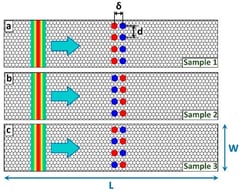
We investigate time-resolved wave-packet transport in monolayer graphene patterned with asymmetric arrays of circular electrostatic scatterers. Using the Dirac continuum model with a split-operator scheme, we track how transmission evolves with scatterer radius and polarity sequence. To this end, we consider three potential configurations (Samples 1–3). The results reveal a geometry-controlled crossover from near-ballistic propagation at small radii to interference-dominated backscattering at large radii. Sample 1, where the potential exhibit two parallel lines of circles, each line sharing the same potential sign, preserves the highest transmission. Conversely, in Sample 3, where potential signs are intercalated between circles of the same line, the dwell time increases, which produces stronger confinement. As the radius increases, pronounced temporal oscillations emerge due to repeated internal reflections (similar to Fabry–Pérot interferometer), and the radius dependence of the saturated transmission probability exhibits anti-resonant dips that are tunable by geometry and potential magnitude. These behaviors establish simple design rules for graphene nanodevices: small-radius Sample 1 for high-throughput transport, Sample 2 (with inverted potential signs as compared to Sample 1) for broadband suppression, and Sample 3 for finely tunable, interference-based confinement.

6 February 2026

Schematic representation of wave packet propagation (indicated by the rainbow-colored wave front and cyan arrow) across a monolayer graphene sheet subjected to artificial potential configurations. Red (blue) circles represent electrostatic potential barriers (wells). (a) Sample 1: a symmetric arrangement of circular potential barriers and wells. (b) Sample 2: similar to Sample 1 but with inverted potential signs. (c) Sample 3: an asymmetric configuration where, in one row, a potential barrier is followed by a potential well, while in the adjacent row their positions are reversed.

Kinetic Theory of Solitons and Quasi-Particles

  • José Tito Mendonça and
  • Kyriakos Hizanidis

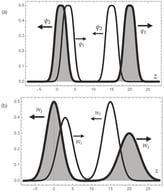
We compare two different approaches to turbulence: the kinetic theory of solitons and the kinetic theory of quasi-particles. Using the same model equation as the starting point of both descriptions, we compare their properties, advantages, and limitations. We also address the question of whether a gas of solitons be seen as a particular case of a gas of quasi-particles and propose possible strategies leading to a more general theoretical model of wave turbulence.

5 February 2026

Illustration of soliton collisions (a), as compared with Gaussian quasi-particle collisions (b). In (a), two solitons, 
  
    
      ψ
      j
    
    ≡
    
      ψ
      j
    
    
      (
      z
      ,
      t
      )
    
  
 with 
  
    j
    =
    1
    ,
    2
  
, emerge after collision with the same amplitudes but suffer a space shift in the direction of propagation. They are represented at two instants of time before and after the collision. In (b), two quasi-particles 
  
    
      W
      j
    
    ≡
    
      W
      j
    
    
      (
      z
      ,
      t
      )
    
  
 emerge with a different amplitude and shape but with no space shifts.

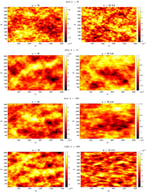
We employ a two-dimensional fluid simulation approach to study the nonlinear turbulent dynamics of internal gravity waves (IGWs) in the weakly ionized Earth’s ionospheric F-layer with the effects of Pedersen conductivity. We observe that the presence of Pedersen conductivity leads to the formation of intermediate-scale structures in the velocity potential, along with the development of small-scale density fluctuations. The characteristic turbulent energy spectrum exhibits a non-Kolmogorov scaling of k2.40 in the presence of Pedersen conductivity, while a Kolmogorov-like k5/3 scaling is observed when it is absent, where k denotes the wave number. Due to energy loss caused by Pedersen conductivity, the wave’s amplitude reduces gradually with time. The cross-field diffusion coefficient related to the velocity potential also reduces as Pedersen conductivity increases. The results in the F-layer are compared with those in the literature, where the Ampère force and hence the Pedersen conductivity effect were ignored compared to the pressure gradient and gravity forces, as relevant in the Earth’s D-layer.

1 February 2026

Spatial evolution of the potential function (
  ψ
) at times 
  
    t
    =
    0
    ,
    5
    ,
    10
  
, and 20 (top to bottom). Left: the emergence of large-scale structures with the normilised Pedersen conductivity 
  
    η
    =
    0
  
 (for instance, ionospheric D-layer) due to an inverse cascade process. Right: the development of intermediate-scale eddies with 
  
    η
    =
    0.14
  
 (for instance, ionospheric F-layer).

News & Conferences

Issues

Open for Submission

Editor's Choice

Reprints of Collections

Teaching and Learning Quantum Theory and Particle Physics
Reprint

Teaching and Learning Quantum Theory and Particle Physics

Editors: Oliver Passon, Gesche Pospiech, Thomas Zügge
In Honor of Professor Serge Galam for His 70th Birthday and Forty Years of Sociophysics
Reprint

In Honor of Professor Serge Galam for His 70th Birthday and Forty Years of Sociophysics

Editors: André Martins, Taksu Cheon, Xijin Tang, Bastien Chopard, Soumyajyoti Biswas

Get Alerted

Add your email address to receive forthcoming issues of this journal.

XFacebookLinkedIn
Physics - ISSN 2624-8174