Skip Content
You are currently on the new version of our website. Access the old version .

Physchem

Physchem is an international, peer-reviewed, open access journal on science and technology in physical chemistry published quarterly online by MDPI.

All Articles (183)

Focusing on PM6 as the electron-donating polymer and the non-fullerene acceptors Y12 and PY-IT, this study investigates their chemical, optical, and morphological properties, as well as their compatibility in bulk heterojunction (BHJ) architectures. All materials were characterized in thin-film form using Fourier transform infrared (FTIR), and Raman spectroscopy. Binary blends of PM6:Y12 and PM6:PY-IT, along with the ternary PM6:PY-IT:Y12 system, were dissolved in o-xylene and processed into active layers by blade coating under ambient conditions. Optical properties were analyzed in solution and in thin films, providing insights into light-absorption efficiency and spectral complementarity. Nanoscale morphology and molecular packing were examined using atomic force microscopy (AFM) and grazing-incidence wide-angle X-ray scattering (GIWAXS), revealing correlations between material organization and device performance. The results highlight the importance of optimizing material selection, ink formulation, and film morphology to maximize charge-generation efficiency. Power-conversion efficiencies (PCEs) of 13.95%, 12.04%, and 12.17% were achieved for PM6:Y12, PM6:PY-IT, and PM6:PY-IT:Y12 devices, respectively. The ternary PM6:PY-IT:Y12 system demonstrated performance comparable to PM6:PY-IT, with improved miscibility and nearly aggregate-free morphologies, suggesting potential for further efficiency gains. These findings offer valuable guidance for designing high-performance, sustainable active layers, contributing to the development of next-generation organic photovoltaic technologies.

9 February 2026
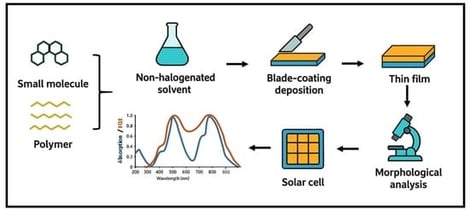
Chemical structure of PM6, PY-IT and Y12.

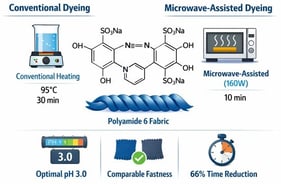
This study investigates the acid dyeing of Polyamide 6 (PA6) fabric by comparing conventional heating and microwave-assisted techniques. The influence of critical process parameters—namely pH, temperature, dyeing time, and dye concentration—on color strength (K/S) was systematically evaluated using C.I. Acid Blue 324. Results indicated an inverse correlation between pH and K/S for both methods, with the maximum color yield achieved at pH 3.0. While dye uptake improved with increasing temperature, time, and concentration in both systems, the microwave-assisted approach (160 W) significantly accelerated the process. Optimal conditions for conventional dyeing were established at pH 3, 95 °C, and a 30 min reaction time with 1.5% dye concentration. In contrast, the microwave-assisted process reached equivalent exhaustion levels in only 10 min under otherwise identical conditions. The findings confirm that microwave-assisted dyeing is a rapid, energy-efficient, and sustainable alternative for PA6 processing, offering substantial reductions in production time.

5 February 2026

Chemical structure of Telon Blue M-2R (C.I. Acid Blue 324).

Critical Review of Cp Calculation Within the Fluidized Bed of Cement Rotary Kilns

  • Evanthia Kostarellou,
  • Evdokia Gkagkari and
  • Ioannis N. Tsimpanogiannis
  • + 11 authors

One thermodynamic parameter that is crucial to heat transport within the fluidized bed inside the rotary kiln, during clinker production, is the specific heat capacity. The particular parameter is often considered constant in the open literature, while, in reality, it strongly depends on the fluidized bed’s temperature and composition, considering that the temperature inside the kiln ranges from approx. 800 K up to 2000 K. For the current study, a mixing rule reported in the literature was applied in order to calculate the Cp of the fluidized bed, utilizing temperature and composition profiles available in the literature. An in-house code was developed for the comparison of the literature-reported Cps and those resulting from the mixing rule. It was discovered that the Cp of the fluidized bed had a proportional increase with the increase in the temperature along the length of the kiln. The deviation between the two values (calculated and literature) is relatively small in some cases, whereas, in others, it is quite significant, ranging from 1.56% to 52.49%, thus making the adoption of the temperature-dependence of Cp necessary. Establishing a more accurate relation for the specific heat capacity leads to a better energy balance inside the kiln, which, along with other improvements, can lead to a decrease in the energy consumed and a significant reduction in greenhouse gas emissions.

4 February 2026

Clinker thermal energy intensity in EU27 and at global level (MJ/ton clinker) [19] along with key indicators in the RTS (Reference Technology Scenario) and the roadmap vision (2DS).

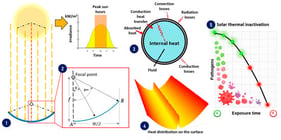
In regions with abundant solar energy, solar water disinfection (SODIS) offers a sustainable strategy to improve drinking water access, especially in rural, off-grid communities. This study presents a numerical modeling approach to assess the thermal and microbial disinfection performance of glass-free parabolic trough collectors (PTCs). The model integrates geometric sizing, one-dimensional thermal energy balance, and first-order microbial inactivation kinetics, supported by optical simulations in SolTRACE 3.0. Simulations applied to a representative case in the Colombian Caribbean (Gambote, Bolívar) highlight the influence of rim angle, focal length, and optical properties on system efficiency. Results show that compact PTCs can achieve fluid temperatures above 70 °C and effective pathogen inactivation within short exposure times. Sensitivity analysis identifies key geometric and environmental factors that optimize performance under variable conditions. The model provides a practical tool for guiding the design and local adaptation of SODIS systems, supporting decentralized, low-cost water treatment solutions aligned with sustainable development goals. Furthermore, it offers a framework for future assessments of PTC implementations in different climatic scenarios.

2 February 2026

Heat transfer mechanisms in a glass-free parabolic trough solar collector. (1) Solar rays incident on the collector surface, (2) Distribution of solar irradiance and peak sun hours throughout the day, (3) Cross-sectional view of the receiver and one-dimensional heat transfer balance.

News & Conferences

Issues

Open for Submission

Editor's Choice

Get Alerted

Add your email address to receive forthcoming issues of this journal.

XFacebookLinkedIn
Physchem - ISSN 2673-7167