
Skip Content
You are currently on the new version of our website. Access the old version .
  • 26 days
    Time to First Decision

Osteology

Osteology is an international, peer-reviewed, open access journal on the basic and clinical research of bone science published quarterly online by MDPI.

All Articles (109)

Background/Objectives: To determine whether patients under 30 years of age who have experienced symptoms for a duration of less than 1 year before undergoing hip arthroscopy (HA) for femoracetabular impingement (FAI) have better patient-reported outcomes than patients aged 40 years or older who have experienced symptoms for a duration of more than 1 year. Methods: This is a single-center, single-surgeon, retrospective analysis performed between August 2007 and May 2023 analyzing patients who underwent hip arthroscopy. Patients were divided into those who were 18 to 30 years old and patients that were 40 years and older. All patients who underwent primary hip arthroscopy for FAI and had completed mHHS or NAHS surveys prior to surgery with at least a 2-year follow-up were initially included in the study. Patients were excluded if they had no symptom duration information documented in their electronic medical record, a history of inflammatory arthritis, previous ipsilateral hip surgery, or future conversion to total hip arthroplasty (THA) before final follow-up. Results: A total of 236 hip arthroscopies were analyzed, including 147 patients ≥40 years and 89 patients 18–30 years, with symptom duration being significantly longer in the older cohort (28.4 vs. 17.5 months, p < 0.001). At 2 years, there was no difference in mHHS or NAHS between groups; however, younger patients with shorter symptom duration were more likely to achieve PASS for NAHS (87.5% vs. 58.7%, p = 0.036). At 5 years, the older cohort showed greater improvement in mHHS (33.1 vs. 22.9, p = 0.048), while patients 18–30 years continued to demonstrate higher absolute mHHS and NAHS at both 2 and 5 years. Regression analysis confirmed that increasing age was associated with lower PROs at follow-up. Conclusions: There was a significantly greater number of patients who achieved PASS for NAHS at 2-year follow-up for patients who were 18–30 years old with symptom duration ≤ 1 year compared to those aged 40+ years old with symptom duration ≥ 1 year. Additionally, patients ≥40 years old experienced a significantly longer symptom duration before surgery and had worse outcomes for mHHS and NAHS at 2- and 5-year follow-up compared to the 18–30 year cohort.

10 December 2025
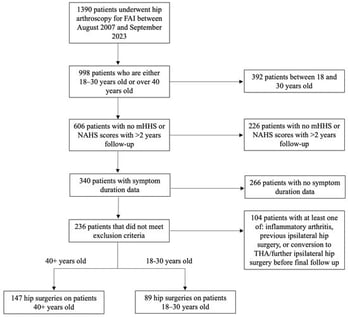
Strengthening the Reporting of Observational Studies in Epidemiology (STROBE) diagram of included patients.

Background: Low peak bone mass (PBM) is a major contributor to later osteoporosis risk. This study sought to understand young people’s knowledge of factors associated with bone health. Methods: Young people in Aotearoa New Zealand were approached. Eight focus groups (26 participants in total, aged 11 to 17 years) were conducted using a semi-structured approach with open-ended questions and prompts. Transcripts were thematically coded using an inductive content analysis approach. Results: Knowledge of factors associated with good bone health was limited. There was a general awareness of the positive and negative impacts of many lifestyle behaviours on health generally, but not specifically PBM. Dairy intake was commonly mentioned as being beneficial for bone health. Some participants reported potential benefits of sport, but most did not know that weight bearing activity specifically was beneficial. Conclusions: Knowledge of osteoporosis and lifestyle factors that impact PBM was limited. Educational interventions involving promotion of bone health knowledge and supporting weight bearing physical activity in adolescents may be an important contributor to public health strategies.

14 January 2026

  • Systematic Review
  • Open Access

Background/Objectives: Charcot-Marie-Tooth (CMT) disease, the most common hereditary peripheral neuropathy, often causes cavovarus foot deformity in children. Surgical interventions to correct deformity or improve function can involve either primary fusion or reconstruction. However, the optimal surgical approach remains contested. This systematic review aims to present and evaluate existing data on both fusion and reconstruction surgical interventions in treating pediatric CMT cavus foot. Methods: A PRISMA-guided search of five electronic databases was conducted (from inception to 17 February 2025). Studies were eligible if they reported surgical outcomes for CMT pediatric patients (18 years) with cavovarus foot treated by primary fusion or reconstruction. Titles, abstracts and full texts were screened by four independent reviewers, and data were extracted on patient demographics, procedures, follow-up, functional scores, radiographic correction and complications. Results: Fourteen studies met inclusion criteria, encompassing 169 patients and 276 feet, with a mean age at surgery of ~13.5 years. Nine studies evaluated joint-sparing reconstruction, three assessed primary fusion, and two combined both reconstruction and fusion. Both interventions yielded improved outcomes post-operatively. Reconstruction generally produced high patient satisfaction and near-normal radiographic parameters but carried recurrence or reoperation rates of 10–40%. Fusion provided durable correction of rigid deformities but was associated with nonunion, adjacent joint arthritis and higher revision rates. Conclusions: Joint-sparing reconstruction is an effective first-line approach for flexible cavovarus deformities in pediatric CMT patients, while fusion should be reserved for severe, rigid or recurrent cases. A patient-specific staged approach is recommended, and higher-quality comparative studies are needed to refine surgical decision-making.

9 December 2025

Background: Risk factors, including Joint Index Vector (JIV), a new disease activity indicator based on three-axis coordinates, and a pain score using a visual analog scale (PS-VAS), were evaluated for incident bone fragility fractures (inc-BFF) in patients with rheumatoid arthritis (RA) in a retrospective case–control study. Methods: RA patients who were followed for at least two consecutive years (RA) and a control group consisting of patients without RA but with similar background demographics (non-RA) were recruited and monitored. The prevalence of inc-BFF was compared between the two groups. Common potential risk factors in both groups and RA-specific factors within the RA group regarding inc-BFF were analyzed statistically. Results: A total of 278 patients were studied in each group. There was no significant difference in the prevalence of inc-BFF between the two groups. Presenting RA was not a major factor in developing inc-BFF. Higher Vz in the JIV, which reflects the difference in the involvement ratio between large and small joints, and higher PS-VAS showed significantly higher hazard ratios in a univariate model. Vz > 0.01, PS-VAS ≥ 25.5, and simplified disease activity index ≥ 2.11 at follow-up, along with PS-VAS at baseline > 21.0, are the key cutoff indices for RA-specific risk factors. When two of these factors were combined, the combination of Vz and PS-VAS at follow-up resulted in the highest hazard ratio (4.25; p < 0.001). Conclusions: These results suggest that combining Vz and PS-VAS is the key risk indicator for inc-BFF.

20 November 2025

News & Conferences

Issues

Open for Submission

Editor's Choice

Get Alerted

Add your email address to receive forthcoming issues of this journal.

XFacebookLinkedIn
Osteology - ISSN 2673-4036