

- Article

The Role of Bacterial Lysates in Tissue Regeneration and Modulation of the Inflammatory Response in Experimental Periodontitis: An Integrative Analysis
- Cristin Coman,
- Gheorghiu Petronica and
- Diana-Larisa Ancuța
- + 1 author
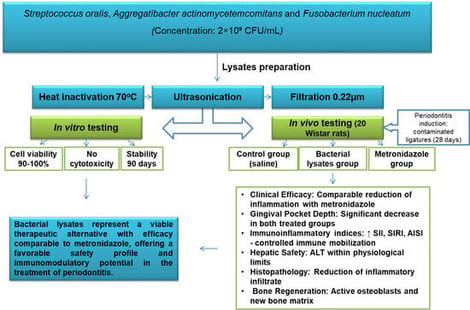
Objectives: The present study evaluated the efficacy of a preparation based on bacterial lysates of Streptococcus oralis, Aggregatibacter actinomycetemcomitans and Fusobacterium nucleatum in the treatment of experimental periodontitis in rats, compared to metronidazole. Methods: Twenty female Wistar rats were used, divided into three groups: control, bacterial lysates and metronidazole, administered for 10 days by oral lavage/gavage. Periodontitis was induced by ligatures contaminated with bacterial suspensions (109 CFU/mL) for 4 weeks. Lysates were obtained by culturing bacterial strains, centrifugation, washing, heat inactivation, ultrasonication and filtration. The evaluations included biocompatibility on HGF-1 fibroblasts, microbiological stability, clinical parameters, hematological, biochemical and histopathological analyses. Results: The lysates demonstrated the absence of cytotoxicity (cell viability 90–100%) and significant antimicrobial effect at the optimal concentration (2 × 10⁹ CFU/mL equivalent). Both treatments significantly reduced periodontal inflammation, with no statistical differences between them. Systemic immunoinflammatory indices (SII, SIRI, AISI) increased comparably, demonstrating controlled immune mobilization, and ALT was maintained within physiological limits. Histopathological examination revealed a reduction in inflammatory infiltrate, connective tissue reorganization and bone regeneration in both treated groups. Conclusions: Bacterial lysates represent a viable therapeutic alternative with comparable efficacy to metronidazole, favorable safety profile and immunomodulatory potential in the treatment of periodontitis.
15 February 2026