
Need Help?
Announcements
6 November 2025
MDPI Launches the Michele Parrinello Award for Pioneering Contributions in Computational Physical Science
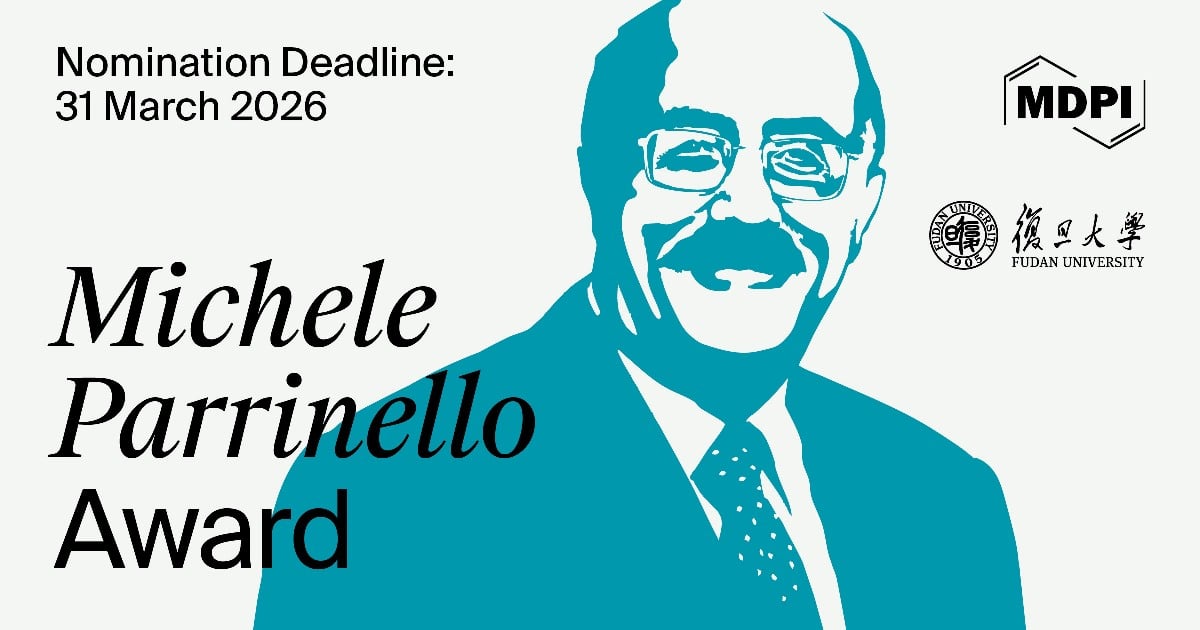
MDPI is delighted to announce the establishment of the Michele Parrinello Award. Named in honor of Professor Michele Parrinello, the award celebrates his exceptional contributions and his profound impact on the field of computational physical science research.
The award will be presented biennially to distinguished scientists who have made outstanding achievements and contributions in the field of computational physical science—spanning physics, chemistry, and materials science.
About Professor Michele Parrinello
"Do not be afraid of new things. I see it many times when we discuss a new thing that young people are scared to go against the mainstream a little bit, thinking what is going to happen to me and so on. Be confident that what you do is meaningful, and do not be afraid, do not listen too much to what other people have to say.”
——Professor Michele Parrinello
 |
Born in Messina in 1945, he received his degree from the University of Bologna and is currently affiliated with the Italian Institute of Technology. Professor Parrinello is known for his many technical innovations in the field of atomistic simulations and for a wealth of interdisciplinary applications ranging from materials science to chemistry and biology. Together with Roberto Car, he introduced ab initio molecular dynamics, also known as the Car–Parrinello method, marking the beginning of a new era both in the area of electronic structure calculations and in molecular dynamics simulations. He is also known for the Parrinello–Rahman method, which allows crystalline phase transitions to be studied by molecular dynamics. More recently, he has introduced metadynamics for the study of rare events and the calculation of free energies. |
For his work, he has been awarded many prizes and honorary degrees. He is a member of numerous academies and learned societies, including the German Berlin-Brandenburgische Akademie der Wissenschaften, the British Royal Society, and the Italian Accademia Nazionale dei Lincei, which is the major academy in his home country of Italy.
Award Committee
 |
The award committee will be chaired by Professor Xin-Gao Gong, a computational condensed matter physicist, academician of the Chinese Academy of Sciences, and professor at the Department of Physics, Fudan University. Professor Xin-Gao Gong will lead a panel of several senior experts in the field to oversee the evaluation and selection process. The Institute for Computational Physical Sciences at Fudan University (Shanghai, China), led by Professor Xin-Gao Gong, will serve as the supporting institute for the award. |
"We hope the Michele Parrinello Award will recognize scientists who have made significant contributions to the field of computational condensed matter physics and at the same time set a benchmark for the younger generation, providing clear direction for their pursuit—this is precisely the original intention behind establishing the award."
——Professor Xin-Gao Gong
The first edition of the award was officially launched on 1 November 2025. Nominations will be accepted before the end of March 2026. For further details, please visit mparrinelloaward.org.
About the MDPI Sustainability Foundation and MDPI Awards 
The Michele Parrinello Award is part of the MDPI Sustainability Foundation, which is dedicated to advancing sustainable development through scientific progress and global collaboration. The foundation also oversees the World Sustainability Award, the Emerging Sustainability Leader Award, and the Tu Youyou Award. The establishment of the Michele Parrinello Award will further enrich the existing award portfolio, providing continued and diversified financial support to outstanding professionals across various fields.
In addition to these foundation-level awards, MDPI journals also recognize outstanding contributions through a range of honors, including Best Paper Awards, Outstanding Reviewer Awards, Young Investigator Awards, Travel Awards, Best PhD Thesis Awards, Editor of Distinction Awards, and others. These initiatives aim to recognize excellence across disciplines and career stages, contributing to the long-term vitality and sustainability of scientific research.
Find more information on awards here.
5 March 2026
MDPI World Water Day Webinar | Water for All People – Governance, Security, and Access, 23 March 2026

This webinar focuses on the themes of World Water Day 2026, water and gender, and the 2026 World Water Development Report, “Water for all people: Equal rights and opportunities”. After Dr. Laura Imburgia provides an overview of the World Water Development Report, three experts in water law, security, and public health will engage in a panel discussion to share their insights about ensuring water access for all. The program will end with a moderated question and answer session.
Keywords: water equity; water governance; water and gender; water security; public health; human rights; sustainable development; water law; gender equality
Date: 23 March 2026
Time: 5:00 p.m. CET | 12:00 p.m. EDT | 12:00 a.m. CST (Asia)
Webinar ID: 819 5040 4453
Webinar Secretariat: journal.webinar@mdpi.com
Register now for free!

After registering, you will receive a confirmation email with instructions on how to join the webinar. Registrations with academic institutional email addresses will be prioritized.
Unable to attend? Register anyway and we will let you know when the recording is available to view.
Webinar Speakers:
- Prof. Dr. Sharon B. Megdal, Water Resource Research Center, The University of Arizona, Arizona, USA;
- Dr. Laura Imburgia, UNESCO World Water Assessment Programme (WWAP), Perugia, Italy;
- Dr. Róisín Burke, Public International Law, Utrecht University, Utrecht, the Netherlands;
- Dr. Heather Tanana, University of Denver Sturm College of Law, Colorado, USA;
- Prof. Dr. Corinne Schuster-Wallace, Global Institute for Water Security, University of Saskatchewan, Saskatchewan, Canada.
4 March 2026
Meet Us at the American Geophysical Union (AGU) Annual Meeting 2026, 7–11 December 2026, San Francisco, USA

Conference: American Geophysical Union (AGU) Annual Meeting 2026
Organization: American Geophysical Union
Date: 7–11 December 2026
Place: San Francisco, USA
Booth: #330
MDPI journals will be attending the American Geophysical Union (AGU) Annual Meeting 2026 as an exhibitor. AGU’s annual meeting, the largest gathering of Earth and space scientists, convenes 25,000+ attendees from 100+ countries to share research and connect with friends and colleagues. Scientists, educators, policymakers, journalists and communicators attend AGU26 to better understand our planet and environment, opening pathways to discovery, opening greater awareness to address climate change, opening greater collaborations to lead to solutions and opening the fields and professions of science to a whole new age of justice equity, diversity, inclusion and belonging.
The following MDPI journals will be represented:
- Remote Sensing;
- Water;
- Atmosphere;
- Geosciences;
- World;
- Hydrology;
- Environments;
- Coasts;
- Land;
- Biosphere;
- Fire;
- Earth;
- GeoHazards;
- Glacies;
- Geomatics;
- Meteorology;
- Mining;
- Minerals;
- Oceans;
- Quaternary;
- Stratigraphy and Sedimentology.
If you plan on attending this conference, feel free to stop by our booth, #330. Our delegates look forward to meeting you in person to answer any questions you may have.
For more information about the conference, please visit the following link: https://www.agu.org/annual-meeting.
28 February 2026
MDPI INSIGHTS: The CEO’s Letter #32 - MDPI China and Thailand, China Science Daily, 1,000 Partnerships, R2R

Welcome to the MDPI Insights: The CEO's Letter.
In these monthly letters, I will showcase two key aspects of our work at MDPI: our commitment to empowering researchers and our determination to facilitating open scientific exchange.
Opening Thoughts

Reflections from China: Year-End-Celebrations and Open Access Publishing
In February, I had the pleasure of joining over a thousand colleagues from our Tongzhou and Haidian offices at their end-of-year annual celebration in Beijing.
Spending time with our teams in China is also a powerful reminder of the scale and complexity of MDPI as a global organization. Our colleagues in Beijing, Wuhan, and across the country play a significant role in our day-to-day operations and long-term development. I’m grateful for the hospitality, collaboration, and commitment shown by our managers and teams in China, alongside colleagues worldwide, who have helped steadily build MDPI, brick by brick, over the years.
Below are some data on Open Access (OA) publishing in China and our collaboration in this important research market.
Open Access Publishing in China
China has been the world’s leading country in research and review article publication volume since 2019, exceeding one million publications in 2025. Over the past five years, the gap between China and the second-ranked country, the United States, has continued to widen.
In 2025:
- 47% of China’s research output was published Open Access
- Of those OA publications, 76% were Gold Open Access (approximately 382,930 articles)
- The overall OA distribution remained stable compared with 2024, with Gold OA increasing by 1%
Over the past five years (2021–2025):
- China published 4,398,050 research and review articles
- Approximately 48% of this output was OA
According to Dimensions, when comparing the top 20 countries by publication volume (2021–2025):
- China ranks 1st worldwide in publication volume
- China ranks 9th in citation performance within this group (for comparison, the US ranks 2nd in publication volume and 10th in citation ranking)
- Average citations per article: 12.51
Among the top 10 universities globally by publication volume, six are Chinese institutions, alongside Harvard University (USA), the University of São Paulo (Brazil), the University of Toronto (Canada), and the University of Oxford (UK).

MDPI and China
China is an important and long-standing part of MDPI’s global publishing ecosystem:
- In 2025, MDPI was the largest fully Open Access publisher in China
- MDPI published 22% of China’s Gold Open Access output (82,133 papers)
- We received 290,999 submissions from China-affiliated authors and published 82,133 articles
- There are 8,500+ active Editorial Board Members based in China
- 64% (5,438) have an H-index above 26
- MDPI works with:
- 117 Editors-in-Chief
- 103 Section Editors-in-Chief
- 71 China-based institutions currently hold IOAP agreements with MDPI, seven of which rank among the top 10 Chinese institutions by publication volume
China's scale in research output means that the publishing platforms chosen by Chinese scholars will continue to influence the direction of scholarly publishing. At the same time, MDPI’s strength comes from its international collaboration, with colleagues, editors, reviewers, and authors working together across regions and disciplines.
Thank you to all our colleagues in China, and around the world, who support MDPI’s publishing activities across departments and help advance open access research every day.
Impactful Research

“Progress in open science is built through trust, dialogue, and relationships”
Behind the Scenes: A Conversation with China Science Daily
During my trip to Beijing, I also had the opportunity to visit China Science Daily and take part in an interview and broader exchange with their team in Beijing. Visits like this matter because progress in open science is built not only through platforms and infrastructure, but also through trust, dialogue, and relationships across research communities and regions.
China Science Daily: History Museum
As part of the visit, I was given a tour of their History Museum, which offers a thorough perspective on the evolution of China’s first science and technology newspaper, established in 1959. The exhibition highlights how the organization developed into a trusted institution connecting research with the public and policymakers. It was a helpful reminder that at the core of publishing is stewardship, credibility, and long-term public engagement with science.

An Open Exchange on Open Science
During the visit, I met with Dr. Zhao Yan, Editor-in-Chief of ScienceNet. We had an open and engaging conversation about MDPI’s role in Open Access, the evolution of open science globally, and the potential for more collaboration going forward. He especially appreciated the candid and personal nature of our exchange, noting that this kind of dialogue feels important in a landscape where trust and transparency matter.

Interview on Open Access
I also participated in an interview with Ms. Yan Jie, from the Online Media Center and Editor-in-Chief of ScienceNet, China Science Daily. Our discussion covered the growth of Open Access over the past 30 years, MDPI’s mission and values, academic integrity, collaboration with the Chinese research community, and MDPI’s own 30th anniversary milestone. It was a great opportunity to reflect on how open science has matured, and where shared responsibility across publishers, institutions, and researchers continues to matter most.
“Progress in open science is built by more than scale and infrastructure”
I’m sharing a few photos from the visit as a glimpse behind the scenes. The full interview will be published by China Science Daily in due course, and I look forward to sharing it when it is available.

More broadly, visits like this reinforce something I’ve always believed in: progress in open science is built not only through scale and infrastructure, but also through continued dialogue, mutual respect, collaboration, and a willingness to listen across regions and perspectives. That remains central to our work, especially as MDPI reflects on 30 years of publishing, built together.
Inside MDPI

Bangkok Visit: Growth, Partnership, and Local Impact
In February, I also had the opportunity to visit our Bangkok office for the second time in two years to support their local meetings and deliver a training session on how we present MDPI at a corporate level.
It’s easy to spend time with our colleagues in Thailand. From Editorial and Production to Conferences, Marketing, Design, and our Regional Journal Relations Specialist (RJRS), the team continues to grow in scale and professionalism. I’d also like to recognize our local management and admin teams, who have been steadily expanding our office and supporting more than 500 colleagues on the ground.
Academic Partnerships
During the visit, we met with the Engineering Department at King Mongkut’s Institute of Technology Ladkrabang (KMITL). Our discussion focused on the recent MDPI developments, Institutional Open Access Program (IOAP) opportunities, Author Publishing Workshops (APW), and the potential use of JAMS to support their institutional journal.

“MDPI is the third-largest OA publisher in Thailand”
We also shared insights into the growth of Open Access (OA) in Thailand and KMITL’s own publishing trends. These conversations matter because institutions are looking for sustainable ways to support their researchers. Our IOAP agreements are one simple example of how we can provide value in this area while maintaining accessibility for authors.
Thailand and MDPI: 2025 Snapshot
Our Bangkok office, officially launched in 2022, has been growing to support over 500 staff members while continuing to expand its engagement in scholar visits, workshops, and conference collaborations. As at 2025, Thailand submissions to MDPI have increased about 21% and publications by about 25%, maintaining a rejection rate close to the company average. MDPI is the third-largest OA publisher in Thailand, publishing 15% of all Gold OA output in 2025.
Representing MDPI Externally
During the visit, I delivered a training session on how we present MDPI at external events.

This session covered topics related to:
- Our aim and guiding principles
- High-level company milestones and Indexing facts and figures
- Industry partnerships and collaborations
- Market trends in OA and subscription publishing
- Country-specific publishing data and collaborations with MDPI
- Insights from our Voice of Community report
I find that while many colleagues are very familiar with the specific journal for which they have responsibility, fewer have visibility into the broader MDPI ecosystem and the company’s global positioning. These sessions help build alignment, confidence, and consistency in how we represent the company.
What stands out most is that MDPI’s growth is not abstract: it’s visible in the people, the partnerships, and the professionalism developing across our offices.
Coming Together for Science

1,000 Institutional Partners: A Milestone Built on Trust
This month, we reached an important milestone: more than 1,000 institutions worldwide are now part of MDPI’s Institutional Open Access Program (IOAP). On paper, that is a number. In practice, it represents trust.
This milestone symbolizes thousands of conversations with libraries and institutions. It stands for negotiations, renewals, consortium expansions, and, most importantly, relationships built over time. It reflects the work of colleagues across publishing, institutional partnerships, marketing, editorial, finance, and many other teams who contribute to making these agreements operational.
In 2025 alone, more than 61,300 research articles benefited from article processing charge (APC) discounts through IOAP agreements. Tens of thousands of authors were able to publish through a simplified and structured process. At the same time, institutional administrators gained clearer oversight and streamlined workflows.

Why IOAP Matters
When we launched IOAP, the objective was straightforward: to reduce barriers for researchers while supporting institutions in navigating the evolving OA landscape. Over the past decade, the research ecosystem has changed. Funder mandates, national policies, and Plan S–aligned requirements have accelerated the transition to OA.
Institutions need publishing partners who provide transparency, scalability, and operational efficiency. IOAP was designed to support that reality.
For colleagues who would like to better understand the program, this blog-post overview of MDPI’s IOAP provides additional context, including common questions around the transition to OA and how our institutional partnerships are structured.
“Institutions need publishing partners who provide transparency, scalability, and operational efficiency”
Recent Examples
Our agreements continue to evolve across regions:
- In Sweden, MDPI signed a national Open Access publishing agreement with 96 institutions, enabling affiliated researchers to publish without managing individual APC payments.
- In Spain, we extended our flat-fee agreement with Universidad Católica de Valencia, reinforcing institutional support for OA publishing.
These examples show that institutions seek structured, predictable models that support their researchers at scale.
Looking Ahead
Crossing the threshold of 1,000 partners tells us that institutions see MDPI not just as a publisher but as a reliable operational partner in advancing open science. This milestone is not a finish line. It is a reminder that the work continues.
Thank you to the entire IOAP team and to all colleagues who contributed to reaching this achievement.
P.S. You can read about this milestone across industry outlets, including STM Publishing News, ALPSP, Research Information, EurekAlert, Brightsurf, among others. You can also read about the coverage in Poland (e.g., media-room, bomega) Korea (newstap), and Romania (EduLike).
Closing Thoughts

Reflections from the Researcher to Reader Conference
During 24–25 February, I attended the 2026 Researcher to Reader Conference in London, UK. Leaders from across scholarly publishing, research infrastructure, libraries, and technology gathered to discuss AI and research integrity, peer review reform, metadata and infrastructure, community engagement, open research policy, and the evolving role of publishers in a rapidly shifting ecosystem.
The conversations were open and honest, and at times uncomfortable – exactly what we need at times. Below are a few reflections that stayed with me.
The Battle for Knowledge: What Becomes Accepted as ‘True’?
One recurring theme was not whether science evolves but whether our infrastructure is resilient enough to sustain trust at scale. Science does not promise certainty: it promises process. As publishing systems grow more complex and become more technologically mediated, the question is how intentionally we design, monitor, and strengthen that process.
Peer Review: Speed, Credentials, and Structural Loops
Researchers consistently call for faster peer review. At the same time, reviewer credentials are often tied to publication records. This creates a structural loop. Publishing history opens reviewing opportunities, reviewing strengthens credentials, and those without early access remain outside the cycle.
There is a need for us to reflect on how opportunity circulates within our systems: we should ask how we create more inclusive pathways for researchers globally to participate in peer review.
Community Engagement Workshop
One of the highlights of R2R was the workshop format, whereby small groups met repeatedly over two days and moved from ideas to tangible strategies.
I joined the Community Engagement workshop led by Lou Peck (CEO at The International Bunch) and Godwyns Onwuchekwa (Principal Consultant at Global Tapestry Consulting). We explored two deceptively simple questions: What is a community? and What does engagement truly mean?
“Engagement requires shared design and shared responsibility”
Too often, organizations equate communication with engagement. The framework discussed mapped a maturity spectrum – from enablement (broadcasting, informing and consulting) to true engagement (collaborating and co-creating).
It was a useful reminder of the fact that if we want trust and loyalty, engagement must go beyond announcements and surveys. It requires shared design and shared responsibility.
AI: Democratization or Digital Colonialism?
I especially enjoyed the thought-provoking presentation from Nikesh Gosalia (Chief Partnership Officer at Cactus Communications), which highlighted an uncomfortable reality:

- 93% of AI-generated content is in English
- Approximately 2% is in French
- Approximately 2% is in German
- More than 7,000 languages are represented in less than 5% of the content within large AI systems
The implications are profound. Is AI democratizing access to scholarly publishing (making it easier for researchers everywhere to participate in global knowledge production)? Or are we encoding colonialism at scale (entrenching linguistic and structural hierarchies, and making it harder for voices from the Global South to be heard)?
AI is already reshaping how research is created, reviewed, discovered, and shared. Its potential is enormous. But its impact depends not only on capability, but on governance, design, and intentionality. Publishers, funders, and researchers all share responsibility in shaping how these systems evolve.
Ethicality in practice (Lightening Talk)

It was also great to have our colleague Dr Miloš Čučulović (Head of Technology Innovation at MDPI) present MDPI’s Ethicality platform during a lightning talk.
“Technology alone is not the answer”
Ethicality embeds AI-driven checks directly into the submission workflow, supporting editors proactively rather than reacting after publication. As we scale, tools like this help balance trust, efficiency, and research integrity.
This goes back into the underlying theme of the conference that technology alone is not the answer. However, technology embedded thoughtfully within clear governance frameworks can strengthen confidence in the editorial process.
Final thought
The question is no longer whether technology will transform research infrastructure: it is already doing so. The real question is what role each of us will play in shaping that transformation deliberately, with structural maturity, inclusive governance, and engagement that moves from informing to co-creating.
Science needs to evolve, responsibly. And that responsibility extends not only to what we publish, but also to how the systems behind publication are designed. Some important topics to continue reflecting on both internally and within our broader community.
Chief Executive Officer
MDPI AG
20 February 2026
MDPI Virtual Academic Publishing Workshop (New Harvest), 25 February 2026
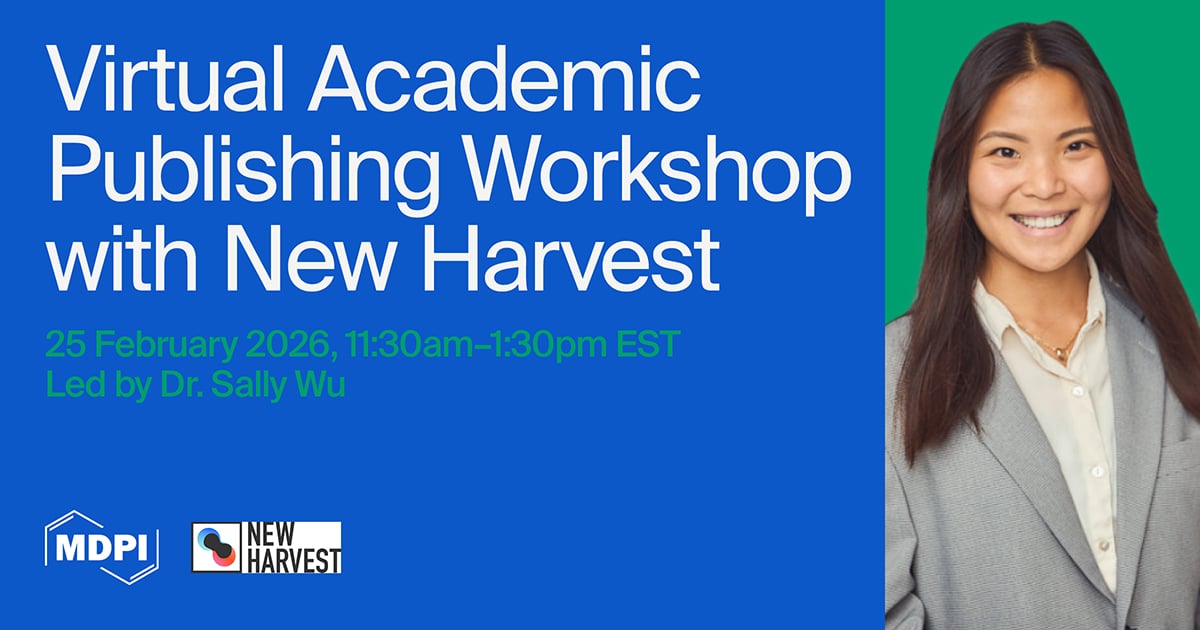
This Academic Publishing Workshop will be led by MDPI Regional Journal Relations Specialist, Dr. Sally Wu, on “Author Training”. Participants will receive practical advice on essential aspects of writing academic articles. Participants will leave with a clearer understanding of the academic publishing landscape and how to successfully contribute to it.
Date: 25 February 2026
Time: 11:30 a.m.–1:30 p.m. EST
Schedule:
|
Speaker |
Program |
Time in EST |
|
Dr. Sally Wu |
Introduction |
11:30–11:40 a.m. |
|
Dr. Sally Wu |
Tips for Writing Great Research Papers
|
11:40 a.m.–12:15 p.m. |
|
Dr. Sally Wu |
How to Respond to Peer Reviewers
|
12:15–12:50 p.m. |
|
Dr. Sally Wu |
AI in Publishing: Challenges and Opportunities
|
12:50–13:30 p.m. |
Speakers:
|
|
Dr. Sally Wu received a PhD in medical science from the University of Toronto in the fall of 2025. She joined MDPI in February 2025 as an Assistant Editor for Cells. She was recently promoted to Regional Journal Relations Specialist position in August. In this role, she works with many journals, liaising with authors, board members, and EiCs. She has attended several conferences across North America, hosted scholar visits, and taken part in other outreach events. |

18 February 2026
MDPI’s Open Access Program Reaches 1,000 Institutions Worldwide

MDPI has surpassed the milestone of 1,000 partners within the Institutional Open Access Program (IOAP). The agreements span 59 countries, covering North and South America, Europe, Asia, Africa, and Oceania.
Last year alone, more than 150 new libraries and academic institutions joined MDPI’s IOAP. With the expansion of an existing consortium deal in Sweden we welcomed a further 75 partners to the program in January 2026, enabling us to surpass the 1,000-partners milestone.
The IOAP supports affiliated researchers by streamlining submission processes, reducing administrative burdens, and offering discounted Article Processing Charges (APCs). Through IOAP membership, more than 61,300 research articles received APC discounts in 2025, driving greater visibility and accessibility for partner institutions and global research communities alike.
"This milestone marks a significant step towards expanding MDPI’s global impact," said Stefan Tochev, MDPI's CEO. "Reaching 1,000 IOAP partnerships is a true testament to the growing trust and collaboration we’ve built with universities, libraries, and research organizations worldwide. We are proud to lead the way in Open Access publishing, ensuring researchers have the support they need to reach global audiences." "The success of our program is reflected in the growing global demand for Open Science and quality publishing services," said Becky Castellon, MDPI institutional partnerships manager. "Equally, institutions are increasingly seeking Open Access publishing options that support funder and national mandates. Joining the IOAP makes compliance simple."
6 February 2026
Acknowledgment to the Reviewers of Oceans in 2025

The editorial office of Oceans would like to extend its sincere gratitude to all reviewers who contributed to the improvement of the journal quality by providing their expert opinion and evaluation of the submitted research.
We appreciate that thorough peer review demands considerable time and intellectual investment from our reviewers. In 2025, Oceans received 532 review reports from contributors across 54 countries and territories, demonstrating the breadth of international expertise and scholarly engagement that has strengthened our publication standards.
The reviewers who agreed to have their names published this year are listed below in alphabetical order by first name. The editorial team acknowledges with gratitude all reviewers, named and anonymous alike, for their vital role in maintaining the scholarly standards of Oceans.
| Adam K. Smith | Juan Luis Gómez Pinchetti |
| Adriaan Albert Markus | Julia Parrish |
| Adrián Casanova | Junmin Li |
| Ahmad Umar | Just T. Bayle-Sempere |
| Alan Giraldo | Kae-Kyoung Kwon |
| Alasdair Edwards | Karl J. Wittmann |
| Alberta Mandich | Kate Larkin |
| Alberto Gambelli | Katharina Kniesz |
| Albrey D. Arrington | Katrina Bornt |
| Aleksey V. Troitsky | Ken Ikehara |
| Alen Soldo | Konstantin Belyaev |
| Alexander Dvoretsky | Kristina Čižiūnienė |
| Alexander G. Dvoretsky | Kristine White |
| Alexandr Sergeevich Zapevalov | Krzysztof Kupren |
| Alexandra Alexandrovna Ershova | Lars Robert Hole |
| Alexey Smirnov | Leonel Pereira |
| Alexey V. Golikov | Libor Ansorge |
| Ali Alkhabbaz | Lodewijk Abspoel |
| Ali Haghi Vayghan | Lóránd Silye |
| Alicia L. Sutton | Loukia-Maria Fratsea |
| Aman Kataria | Luca Polimene |
| Amit Ranjan | Ludovic Hoarau |
| Ana B. Ruescas | Luis Alfonso Díaz-Secades |
| Ana Bianca Pavel | Lyubka Pashova |
| Ana Bratoš Cetinić | Madon Bénédicte |
| Ana Virginia Filgueiras | Malcolm Jobling |
| Anabela Oliveira | Manolo Vargas-Yañez |
| Andrés Fernando Barajas Solano | Mantravadi Venkata Subrahmanyam |
| Andrey Ivantsov | Manuel Arias |
| Andrii Murdza | Manuela R. Bizzozzero |
| Angela Baldanza | Marc Hanke |
| Anna Leśniewicz | Marek Chalecki |
| Anne Helene Tandberg | Marek Roman Lipinski |
| Anqing Xuan | María Ana Fernández-Álamo |
| Antonela Paladin | Maria Grazia Mazzocchi |
| Antonina Kremenetskaia | Maria Rajska |
| Apostolos Apostolou | Mariusz Ptak |
| Argyro Zenetos | Massimiliano Marino |
| Arkadiusz Nędzarek | Matteo Selci |
| Arnulfo Alanis | Michael Baldauf |
| Arthur Zhou | Michael J Risk |
| Asim Yaqub | Michael Noonan |
| Balaji Prasath Barathan | Michalis Diakakis |
| Balakrishnan Manikandan | Michelangelo Bisconti |
| Barbara Calcinai | Miguel Guerreiro |
| Behbood Issa-Zadeh | Mikhail Salin |
| Bektaş Sönmez | Mohamed El Amine Ben Seghier |
| Bérenger Colsoul | Mohamed Elnabwy |
| Bert Hoeksema | Mohamed Samy-Kamal |
| Bharat S. Chaudhari | Monwadee Wonglapsuwan |
| Binxin Liu | Mridula Srinivasan |
| Bogdan Gherman | Muhammad Usman |
| Bordbar Amir | Murat Sirin |
| Bowen Xing | Nadav Shashar |
| Brendan J. Runde | Nakita Câmara |
| Bryan John Subong | Nam Thang Ha |
| Burak Ali Çiçek | Nguyen Dinh-Hung |
| C. J. Underwood | Nhung Nguyen |
| Candace J. Grimes | Niel L. Bruce |
| Carlos Pérez-Collazo | Nikolay Natchev |
| Carmen Rubio Armendariz | Ning Li |
| Charles-Francois Boudouresque | Nuzzo Genoveffa |
| Chiara Favaretto | Oliver Wurl |
| Chris Frid | Oumar Sadio |
| Chris Lowe | Ove Pärn |
| Christos Makris | Patricio De Los Rios-Escalante |
| Chryssanthi Antoniadou | Paulo Vale |
| Corinne Corbau | Peng Tian |
| Cornel Dumitru Ilinca | Pengjun Zheng |
| Cotas João | Pere Ferriol |
| Cristina Brito | Petras Prakas |
| Dallas L. Flickinger | Pierre-Marie Poulain |
| Damiano Spagnuolo | Po-Chun Hsu |
| Denis Abessa | Pranaya Kumar Parida |
| Dilek Koc-San | R. Heath Kelsey |
| Dimitrios Klaoudatos | Rachel Joy Harris |
| Dimitrios Moutopoulos | Rachel L. Coppock |
| Dmitry Sharapov | Rafael E. Vásquez |
| Dora Bjedov | Rainer Amon |
| Dorka Cobián-Rojas | René M. Van Westen |
| Douglas Fenner | Richard Smardon |
| Douglas Wartzok | Rigers Bakiu |
| Dušan Nikolić | Roberto Simonini |
| Elena Bisinicu | Roger Chong |
| Elena Quintanilla | Ruey-Syan Shih |
| Elena Елена | Sahar Chebaane |
| Elisa Baldrighi | Sarah Reynolds |
| Elizabeth Jones | Sarat Chandra Mohapatra |
| Emilio Sperone | Sasha Marie Woods |
| Erhan Mutlu | Saskia Esselborn |
| Eric Mortenson | Scott Pegau |
| Erin L. Murphy | Sebastian Holmes |
| Esti Winter | Seo-Yeol Choi |
| Etige Nishchitha Sandeepana Silva | Sergei Turanov |
| Evan K. D'Alessandro | Sergey Dobretsov |
| Evgeny Aleksandrovich Morozov | Sergey Stanichny |
| F. Xavier Martínez De Osés | Shalini Verma |
| Farkhod Akhmedov | Shapour Kakoolaki |
| Fatima El Asri | Shaun Deyzel |
| Fatima Guedes Abrantes | Shawn Larson |
| Federica Montesanto | Sigurd Solheim Pettersen |
| Fengwei Wang | Simon Berrow |
| Fernando Rubino | Simone Cosoli |
| Florin Valentin Rusca | Simone Sanfilippo |
| Francisco Morales-Serna | Sinan Mavruk |
| François Bignalet-Cazalet | Slawomir Blonski |
| Frédéric Muttin | Smirnov Alexander |
| Fulko Van Westrenen | Song Hu |
| Gary M. Wessel | Sook-Jin Jang |
| Gay E. Marsden | Spase Shumka |
| Geena Prasad | Stacy Warren |
| Gerhard Schmidt | Steve Archer |
| Giovanni Coletti | Steven G. Hall |
| Gisela V. Giardino | Steven W. Purcell |
| Giulio Dubbioso | Susan E. Hartman |
| Giuseppe Ciaburro | Svein Vagle |
| Giuseppe Denti | Takanori Horii |
| Gonzalo Saldias | Takashi Miwa |
| Gorana Jelić Mrčelić | Taner Yıldız |
| Gregory Lane-Serff | Tatyana V. Belonenko |
| Gregory Naoki Nishihara | Theodora Boubonari |
| Guang Gao | Theodora Pinou |
| Guido Pietroluongo | Tim Gray |
| Gustavious Paul Williams | Tony Miskiewicz |
| Haijun Yang | V. Sanil Kumar |
| Haitham M. Ayyad | Vaibhav Mantri |
| Heriberto Vazquez | Valente Hernández-Pérez |
| Hermann Kudrass | Valentina Fagiano |
| Hitoshi Tanaka | Valerio Manfrini |
| Hongju Chen | Vanessa Pirotta |
| Hsien-Kuo Chang | Vasily Smolyanitsky |
| Huawei Wang | Veljko Srzic |
| Hudson Robert DeYoe | Viktor Zamshin |
| Hyun Soo Rho | Vitalii A. Sheremet |
| Ignatius Rigor | Vladimir Dvoretsky |
| Ilana Rosental Zalmon | Vyacheslav Lobanov |
| Imed Jribi | Waleed Raza |
| Imran Ali | Wan Zakiah Wan Ismail |
| Ioan Munteanu | Wendy Ermold |
| Iris Segura-Garcia | Wenjin Sun |
| Iwona Wrobel-Niedzwiecka | Won-bae Na |
| James Conder | Wongyu Park |
| Jan Bocianowski | Xavier Carton |
| Javier Tovar-Ávila | XinZheng Li |
| Jean-François Mangot | Xiubao Li |
| Jelena Svorcan | Yannis Hatzonikolakis |
| Jens J. Currie | Yen-Chiang Chang |
| Jesús M. Mercado | Yiqing Song |
| Jian-Yu Hu | Yu Yan |
| Jibiao Zhang | Yulia Gubelit |
| Jie Tian | Yulianto Suteja |
| Jing Yu | Yumeng Pang |
| Jingwen Qi | Yun-Chih Chiang |
| Joan Cartes | Yuya Kumagai |
| John E. Gatesy | Zaloa Sanchez Varela |
| John M. Huthnance | Zhaoshan Zhong |
| Joonho Lee | Zhenhua Zhang |
| Jorge A. Ruiz-Vanoye | Zhenjun Zheng |
| Jorge Chavez-Villalba | Zhou Xing |
| José Iannacone Oliver | Živana Ninčević Gladan |
| José Lino Costa | Zizheng Guo |
| Juan Jose Muñoz | Zohaib Noor |
2 February 2026
MDPI INSIGHTS: The CEO's Letter #31 - MDPI 30 Years, 500 Journals, UK Summit, Z-Forum Conference, APE
Welcome to the MDPI Insights: The CEO's Letter.
In these monthly letters, I will showcase two key aspects of our work at MDPI: our commitment to empowering researchers and our determination to facilitating open scientific exchange.
Opening Thoughts

MDPI at 30: Three Decades of Open Science, Built Together
As we begin 2026, we approach a meaningful milestone in MDPI’s history: 30 years of advancing Open Science.
What began in 1996 as a small, researcher-driven initiative has grown into a global open-access publisher, supporting hundreds of journals, millions of researchers, and a shared belief that scientific knowledge should be openly available to all. Over these three decades, Open Access has moved from the margins to the mainstream, and MDPI has been proud to help shape that transformation.
To mark this anniversary year, we are pleased to share our MDPI 30th Anniversary logo.
The Anniversary logo is intentionally simple, confident, and enduring, designed to work across cultures, disciplines, and digital environments. It reflects both continuity and progress, honouring MDPI’s established identity while representing the company we are today. The green accent symbolizes our connection to the research communities we serve and the collaborative nature of Open Science itself.
Alongside the visual identity, we are also introducing our 30th Anniversary tagline:
30 Years of Open Science, Built Together.

This phrase captures what has always defined MDPI. Open Science is not the work of a single organization: it is a collective effort shaped by researchers, editors, reviewers, institutions, and the many teams who support the publishing process every day. MDPI’s role has been to provide the infrastructure and commitment that allow this collaboration to thrive.
Throughout 2026, we will mark this anniversary through regional events, global conversations, and editorial initiatives that reflect on MDPI’s evolution, its impact across disciplines, and the communities that make this work possible.
“Open Science is a collective effort”
Whether you have been part of MDPI’s journey for decades or are engaging with us for the first time this year, this milestone belongs to all of us. The past 30 years have shown what is possible when openness, trust, and collaboration are placed at the centre of scholarly communication.
As we look ahead, our focus remains clear: continuing to strengthen quality, integrity, and partnership – so that Open Science can keep moving forward, together.
Impactful Research

A Shared Milestone: MDPI’s Journal Portfolio Reaches 500 Titles
MDPI has reached an important milestone: our journal portfolio grew to more than 500 academic journals last year, spanning the fields of chemistry, engineering, biology, medicine, environmental sciences, the social sciences, and beyond.
The number itself is significant, but what matters more is what supports it: hundreds of scholarly communities that have chosen to collaborate, grow, and publish with MDPI.
From our beginnings nearly 30 years ago with a single Open Access journal (Molecules), MDPI has been guided by a simple aim: advancing Open Science. Reaching 500 journals is not an endpoint. It reflects the diversity of disciplines, ideas, and research cultures that now form part of our shared ecosystem.
Growth with Purpose
Every journal exists because a specific community believes there is a need for focus, visibility, and dialogue in a particular field. As our portfolio has expanded, so has our responsibility to ensure that scale is matched with strong editorial standards, robust research integrity practices, and meaningful academic leadership.
This milestone comes as we enter MDPI’s 30th anniversary year, a fitting moment to reflect on what scale in scholarly publishing truly requires: not only reach, but also dedicated long-term stewardship.
New Journals, New Communities
In December 2025 alone, MDPI welcomed eight newly launched journals and three journal transfers (details below), all of which published their inaugural issues by year-end.

Each of these journals is shaped by its Editors-in-Chief, Associate Editors, and Editorial Board Members, who define its scope, standards, and direction. We are grateful for the time, expertise, and commitment they bring to building these new communities.
Welcoming Transferred and Acquired Journals
We were pleased to publish the first MDPI issues of three recently transferred or acquired journals:
- Cardiovascular Medicine – advancing research on the prevention, diagnosis, and treatment of cardiovascular disease
- Germs – addressing infectious diseases through clinical, public health, and translational perspectives
- Romanian Journal of Preventive Medicine (RJPM) – supporting population health, early detection, and preventive care in collaboration with the Romanian Society of Preventive Medicine
Each of these journals brings an established identity and legacy. Our role is to support their continued development with the same editorial rigor, transparency, and Open Access principles that guide our broader portfolio.
A Collective Achievement
Reaching more than 500 journals is not the achievement of any single team or individual. It is the result of collaboration across the entire scholarly ecosystem. As such, I would like to thank our authors, reviewers, academic editors, and Editorial Board Members, as well as our colleagues across MDPI, who support these communities every day.
As we look ahead, we will continue to expand the breadth and depth of our publishing activities while remaining attentive to the evolving expectations of Open Science, research integrity, and responsible growth.
This milestone is a reminder that Open Access publishing is not only about making research available. It is about building platforms where knowledge can be shared, challenged, improved, and trusted, at scale, and with care.
Inside Research

MDPI UK Summit 2026 in Manchester (21–22 January)
On 21–22 January, we had the pleasure of hosting the MDPI UK Summit 2026 in Manchester. Over two days, we welcomed more than 20 Editors-in-Chief (EiC), Section Editors-in-Chief (SEiC), and Associate Editors for an open, in-depth conversations about how MDPI supports Open Science, editorial independence, and research standards across our journals.
What stood out most was not just the quality of the discussions, but the openness, curiosity, and mutual respect that shaped every session.
|
|
|
|
|
|
|
|


What We Covered
The programme was designed to give insight into how MDPI works behind the scenes and how different teams collaborate to support our journals and editors. Topics included:
- MDPI overview and the evolving Open Access market
- MDPI–UK collaboration and local engagement
- Editorial and peer-review processes
- Research integrity and publication ethics
- Institutional partnerships
- Indexing, journal development, and academic community engagement
Sessions were led by MDPI colleagues across editorial, research integrity, indexing, partnerships, and UK operations, showing how cross-functional our work truly is.
What We Heard
The feedback from editors was both encouraging and grounding:
- 92% rated the Summit Excellent (8% Good)
- 100% said their understanding of MDPI’s values, editorial processes, and local collaborations had significantly improved
- 69% attended primarily to stay informed about academic publishing and research integrity
- 85% felt fully heard and engaged
A few comments that stayed with me:
- “Today’s event truly gave me the opportunity to see the heart of MDPI UK.”
- “The summit was very informative – I really enjoyed seeing the behind-the-scenes operations.”
- “Keep being open to discussions and making editors feel part of the MDPI family.”
These reflections remind us that transparency, listening, and dialogue are not nice-to-haves: they are foundational to trust.
|
|
|
|


Looking Ahead
The UK Summit is one of more than 10 MDPI Summits we are organizing this year across North America, Europe, and APAC. Each one is an investment in relationships, shared understanding, and improvement.
Thank you to the MDPI UK team and supporting colleagues across departments who made this event possible. This was a positive step in strengthening our editorial engagement and kicking off a year of MDPI Summits.
Coming Together for Science

Recapping the Z-Forum 2026 Conference on Sustainability and Innovation (15–16 January 2026)
In January, MDPI supported and participated in the Z-Forum on Sustainability and Innovation, held across Zurich (ETH Zurich) and the city of Baden. With 96 participants and more than 30 speakers and panellists, the forum brought together leaders from government, academia, industry, and innovation ecosystems to explore how sustainability, Open Science, and innovation intersect in practice.
Why this mattered for MDPI
As a Swiss-based publisher with global reach, our investment in Z-Forum reflects a strategic intent: to anchor MDPI more deeply within Swiss research networks while contributing to national and international conversations on sustainability and innovation.
This was not only about visibility; it was also about relationship-building and long-term engagement with institutions shaping research policy and practice in Switzerland.
|
|
|
|
|
|
|
|
|
|


High-level participation and credibility
The forum was supported and sponsored by several key Swiss institutions, including:
- The Swiss National Science Foundation (SNSF) – Switzerland’s central research funding body
- ETH Zurich
- The University of Zurich
- The University of Basel
- Swiss Innovation Park Central
The sponsorship of SNSF lent the forum strong institutional credibility and signalled the relevance of the themes discussed, especially around sustainability, innovation frameworks, and responsible research practices.
|
|
|


Beyond the Room: Extending the Conversation
While attendance was intentionally focused to encourage dialogue, the forum’s reach extended well beyond the venue. Multiple LinkedIn posts before and during the event (e.g., Link 1, Link 2, Link 3, and more) built on the discussions and helped position MDPI as an active and credible contributor within Switzerland’s research and innovation landscape.
A Broader Strategic Signal
Z-Forum is part of a wider effort to:
- Build on MDPI’s Swiss institutional relationships
- Reinforce our leadership in Open Science and sustainability
- Engage proactively with funders, universities, and innovation bodies
- Ensure MDPI remains a visible and constructive partner in the ecosystems where research policy and practice are shaped
Thank you to our Conference team and everyone involved in supporting this event, both behind the scenes and on the ground. These moments of engagement may be small in scale, but they are foundational in impact.

Closing Thoughts

Reflections from the Academic Publishing in Europe Conference
During 13-14 January, I attended the Academic Publishing in Europe (APE) Conference in Berlin, a long-standing forum for discussing scholarly publishing and the deeper principles that support it.

MDPI was proud to be a Gold Sponsor of the 20th Anniversary of the APE conference, reflecting our continued commitment to supporting the scholarly community to engage in critical industry discussions.
This year’s program covered a range of topics, from AI and research integrity to policy, infrastructure, and trust, but one theme stood out clearly for me: academic freedom, and what it means to protect the conditions under which knowledge can be produced, evaluated, and shared responsibly.
Before turning to that, I would like to highlight the opening keynote by Carolin Sutton (CEO, STM), which helped set the tone for the conference.
An Independent Publishing Industry: The Case for Checks and Balances
In her opening remarks, Carolin focused on the importance of continually evolving systems of checks and balances, both operationally and at the marketplace level, to prevent any single actor from dominating knowledge production. Her framing emphasized shared responsibility across publishers, institutions, and research communities, rather than placing the burden on any one group.
As part of this, she revisited the work of sociologist Robert K. Merton, and his CUDOS norms of scientific ethos, first articulated in his 1942 work, The Normative Structure of Science.

Merton outlined four ideals that support healthy scientific systems:
- Communalism – knowledge as a public good
- Universalism – evaluation based on merit, not status or identity
- Disinterestedness – orientation toward truth over personal or financial gain
- Organized Skepticism – systematic, critical scrutiny of claims
While these are ideals, and not guarantees that are perfectly lived up to, they remain powerful reference points today for research systems and organizations as they aim to grow and scale.
It was interesting to see how closely these norms align with foundational principles of Open Access. For example, making research openly available supports communalism. Transparent peer review and editorial processes reinforce universalism and organized skepticism. Strong ethics frameworks and governance help counter conflicts of interest and support disinterestedness.
“Merton’s ideals remain powerful reference points today”
Safeguarding Research: Academic Freedom
Several of the conference sessions touched on the pressures faced by researchers, editors, and institutions: geopolitical tensions, online harassment, misinformation, reputational risk, shrinking resources, and politicized narratives around science.

“Integrity is not static. It must be actively maintained as systems grow.”
A particularly timely presentation came from Ilyas Saliba, who talked about academic freedom. His remarks resonated strongly and underlined the fact that safety in academia is not only physical or digital, but also intellectual.
Academic freedom means safeguarding the ability to ask difficult questions, challenge consensus, publish negative or unexpected results, and participate in scholarly debate without fear of undue personal, political, or commercial consequences. These discussions were a reminder that publishers play an important role in supporting the integrity, accessibility, and credibility of scholarly knowledge, particularly as researchers and institutions face mounting external pressures.
Looking Ahead
The discussions at APE reminded me that integrity is not static. It must be actively maintained as systems grow, expectations evolve, and pressures increase. This applies equally to research integrity, academic freedom, and the broader trust placed in scholarly communication.
I left APE encouraged by the openness of the dialogue and the willingness across publishers, institutions, and communities to engage with difficult questions rather than avoid them. Forums like this play a pivotal role in helping our industry pause, reflect, and recalibrate.
As MDPI continues to grow and as we enter our 30th anniversary, these conversations remind me of the core purpose of science: advancing knowledge for the benefit of society.
Chief Executive Officer
MDPI AG
23 January 2026
Meet Us at the Ocean Sciences Meeting 2026, 22–27 Febuary 2026, Glasgow, UK

Conference: Ocean Sciences Meeting 2026
Date: 22–27 Febuary 2026
Location: Glasgow, UK
MDPI will attend the Ocean Sciences Meeting 2026 as an exhibitor. This meeting will be held in Glasgow, UK, from 22 to 27 Febuary 2026.
The Ocean Sciences Meeting (OSM) is a unique gathering, designed to foster connection and collaboration among researchers and solution scientists in the greater ocean-connected community. Every two years, scientists from across the globe gather to share the latest research findings, collaborate on solutions, and establish lasting partnerships, with the goal of advancing scientific knowledge and impacts.
The Ocean Sciences Meeting is an Endorsed Decade Action program with the United Nations Decade of Ocean Science for Sustainable Development. Co-sponsored by the American Geophysical Union (AGU), the Association for the Sciences of Limnology and Oceanography (ASLO), and The Oceanography Society (TOS), we welcome a diverse community of scientists, students, journalists, policymakers, educators, and organizations who are working toward a world where scientific discovery leads to scientific solutions, and where our global collaborations and partnerships can carry us into a sustainable future.
The following open access journals will be represented:
- JMSE;
- Climate;
- Oceans;
- Conservation;
- Ecologies;
- Fishes;
- Hydrobiology;
- Phycology;
- Coasts;
- Environments;
- Geographies;
- Geosciences;
- Remote Sensing;
- Hydrology;
- Marine Drugs.
If you are attending this conference, please feel free to start an online conversation with us. Our delegates look forward to meeting you in person at booth #71 and answering any questions that you may have. For more information about the conference, please visit the following website: https://www.agu.org/ocean-sciences-meeting.
22 January 2026
Meet Us at the Aquaculture America 2026, 16–19 February 2026, Las Vegas, USA

Aquaculture America 2026 returns to one of the favorite entertainment spots in the world for the only major national aquaculture conference and exposition held in the U.S. The U.S. Aquaculture Society joins the National Aquaculture Association and the Aquaculture Suppliers Association to produce the annual Aquaculture America meetings.
Aquaculture America is known for the high quality of its producer program organized by NAA. Aquaculture America 2026 will continue to expand the size and scope of the producer program to address all of the issues facing producers in the U.S. as well as around the world.
Topics include the following:
- Federal Agency Town Hall Meeting;
- Aquatic Animal Health;
- Environmental Issues;
- Offshore Aquaculture;
- Farm Energy Cost Reduction;
- Aquatic Animal Drug Approvals;
- Regulatory Costs;
- Start Up Aquaculture;
- Marketing and Promotion;
- Science and Public Policy;
- Women in Aquaculture;
- Federal Regulation Reform;
- New Technologies.
MDPI will be attending the conference as an exhibitor; we welcome researchers from different backgrounds to visit and share their latest ideas with us.
The following MDPI journals will be represented:
If you are planning to attend the above conference, we encourage you to visit our booth at #18 and speak to our representatives. We are eager to meet you in person and assist you with any queries that you may have. For more information about the conference, please visit the official website at https://was.org/meeting/code/AA2026.