
Skip Content
You are currently on the new version of our website. Access the old version .

All Articles (36,883)

Background/Objectives: Obesity is characterized by dysregulated hypothalamic energy homeostasis and reduced central responsiveness to the anorexigenic hormones leptin and insulin. β-Hydroxybutyrate (β-HB), a major ketone body, has recently garnered attention as a signaling metabolite. However, its effects on hypothalamic leptin and insulin responsiveness remain unclear. This study aimed to investigate the effects of β-HB on hypothalamic hormone responsiveness and the associated molecular mechanisms, primarily using a high-fat diet (HFD)-induced obese mouse model. Methods: Male mice were fed an HFD to induce obesity and treated with β-HB via oral or intracerebroventricular (ICV) administration. Feeding behavior following leptin and insulin administration was evaluated, and activation of hypothalamic leptin-induced STAT3 signaling and insulin-induced Akt signaling was analyzed. In addition, mRNA expression of inflammation-related and appetite-regulating genes was assessed by quantitative PCR. Normal mice also received chronic ICV administration of β-HB from the onset of HFD feeding, and changes in body weight and cumulative food intake were measured. Results: Both oral and ICV administration of β-HB significantly enhanced the anorexigenic responses to leptin and insulin in HFD-induced obese mice. At the molecular level, leptin-induced STAT3 phosphorylation and insulin-induced Akt phosphorylation were enhanced in the hypothalamus. Gene expression analysis revealed reduced SOCS3 and TNFα expression and increased POMC expression. Furthermore, chronic ICV administration of β-HB from the onset of HFD feeding significantly suppressed body weight gain and the increase in cumulative food intake. Conclusions: This study demonstrates that β-HB improves hypothalamic leptin and insulin responsiveness in obese mice and modulates the associated molecular environment. These findings suggest that β-HB acts as a metabolically responsive signaling molecule regulating hypothalamic function, providing a basis for novel metabolic intervention strategies against obesity.

10 February 2026
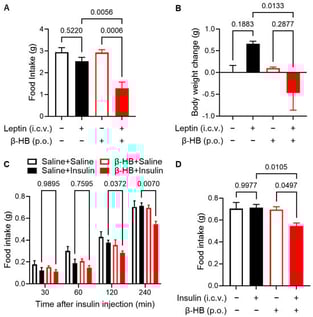
(A,B) Central leptin sensitivity test in HFD-induced obese mice (n = 4/group, fed an HFD for 3 months). Mice received oral administration of β-HB (300 mg/kg body weight) or saline once daily for three consecutive days. The same animals then received ICV injections of saline followed by leptin (0.5 µg/mouse). (A) Cumulative food intake and (B) body weight change during the 24 h period after saline or leptin ICV injection. (C,D) Central insulin sensitivity (refeeding) test after oral β-HB administration in HFD-induced obese mice (n = 4–7/group, fed an HFD for 3 months) that received oral β-HB (300 mg/kg body weight) or saline once daily for three doses. Two hours after the third oral administration, insulin (1.5 mU/mouse) or saline was administered via ICV injection at the onset of refeeding. (C) Time course of cumulative food intake after refeeding and (D) cumulative food intake at 240 min. Statistical analyses were performed using one-way ANOVA followed by Tukey’s multiple comparisons test in (A,B,D), and two-way ANOVA followed by Tukey’s multiple comparisons test in (C). Exact p-values are shown in the figures. Data are presented as mean ± SEM.

Background/Objectives: Multiple micronutrient supplements (MMS) are more effective in improving maternal and birth outcomes compared to iron and folic acid (IFA) supplementation during pregnancy. High adherence to MMS is critical to achieving all the anticipated health benefits. Therefore, to ensure successful program implementation of transitioning to MMS in Cambodia, implementation research has been prioritized. The objective of this study was to assess the relevance, acceptability, utility and short-term, exploratory adherence outcomes of three behavioral interventions designed to support adherence to daily MMS intake and to promote healthy pregnancy practices. Methods: This mixed-methods study, conducted in four provinces in Cambodia, involved 12 focus group discussions (FGD) with 36 pregnant women who were exposed to three distinct behavioral interventions (family support, a tracking calendar, and educational videos). FGDs were held after three weeks of exposure to each intervention. Data was analyzed using a COM-B model, with inductive codes added to capture emerging themes. Results: Family support emerged as the most preferred and perceived as the most effective intervention, with participants consistently valuing the presence, encouragement, and practical assistance offered by husbands and other close family members. The second most preferred were educational videos, which were perceived to effectively convey key messages in an engaging, relatable way, overcoming literacy barriers. Finally, the calendar supported habit formation and appealed to first-time mothers but posed challenges for low-literacy users. Across interventions, findings reflect participants’ perceived effectiveness and preferences rather than comparative efficacy. Conclusions: This study provided insights into Cambodian women’s preferences and experiences with three distinct interventions designed to improve adherence over a short-term, 3-week exposure period per intervention. An integrated, multilevel approach that combines family-focused, educational, and system-level strategies is recommended for further piloting and scale-up, with longer-term studies needed to assess comparative efficacy for adherence and health outcomes.

10 February 2026

Background/Objectives: Increasing fruit and vegetable (F&V) intake may benefit children’s neurobehavioral development, but randomized evidence remains limited. We evaluated whether F&V-enriched breakfast improves cognition, attention and mood in primary school children. Methods: We conducted a 12-week class-randomized controlled trial in Shanghai, China. A total of 251 children aged 7–11 years received either a daily F&V-enriched breakfast or a standardized control breakfast with comparable energy provision, both centrally prepared and home-delivered. The primary outcome was change in Full-Scale IQ (FSIQ) measured by the Wechsler Intelligence Scale for Children—Fourth Edition (WISC-IV). Secondary outcomes included WISC-IV composite indices, attention-related behavioral symptoms assessed by the Parent Symptom Questionnaire, and mood by the Profile of Mood States—Brief. Analyses followed the intention-to-treat principle with multiple imputation. Results: Among 282 children screened, 251 were randomized, with 243 completing post-intervention assessments and 230 completing follow-up. The adjusted mean change in FSIQ did not differ between groups (mean difference = −0.63; 95% CI −5.15~3.89; p = 0.807). No statistically significant between-group differences in change were observed for other cognitive indices, behavioral symptoms, or overall mood disturbance. Exploratory analyses suggested a greater reduction in fatigue scores among children aged ≤8 years in the intervention group compared with controls. Dietary assessment confirmed higher dietary fiber and carotene intakes in the intervention group at week 12. No intervention-related adverse events were reported. Conclusions: An F&V-enriched breakfast improved dietary quality but did not produce measurable between-group improvements in cognitive or neurobehavioral outcomes over 12 weeks. Exploratory age-specific findings warrant further investigation.

10 February 2026

Rheumatoid arthritis (RA) is a systemic and chronic autoimmune disease affecting about 1% of the global population, with a higher prevalence in women. Its treatment has been improved greatly over the past 30 years but there is no definitive cure available, and another unmet need exists for transitional hormonal stages such as pregnancy or menopause, which spurs the need to research new therapy options. In recent years, dietary interventions, particularly fasting and plant-based nutrition, have gained attention for their potential to alleviate RA symptoms. Fasting has been shown to reduce systemic inflammation, promote autophagy, and modulate immune cell activity, possibly leading to decreased joint pain and swelling. Nutritional strategies, such as anti-inflammatory and plant-based diets, have been shown to impact the gut microbiome and potentially support weight management, improve metabolic health, and reduce oxidative stress, all of which might contribute to better RA disease outcomes. Although the precise mechanisms remain under investigation, these approaches offer promising complementary strategies for enhancing RA management and improving patients’ quality of life. This review explores the preventive and therapeutic potential of fasting and nutrition in RA, and their possible application in the context of hormonal fluctuations and transitional stages during a women’s life.

10 February 2026

News & Conferences

Issues

Open for Submission

Editor's Choice

Reprints of Collections

Dietary Supplements in Human Health and Disease
Reprint

Dietary Supplements in Human Health and Disease

Editors: Elisa Benetti, Valentina Boscaro
The Effect of Nutrients on Neurological Disorders
Reprint

The Effect of Nutrients on Neurological Disorders

Editors: Lorena Perrone, William B. Grant

Get Alerted

Add your email address to receive forthcoming issues of this journal.

XFacebookLinkedIn
Nutrients - ISSN 2072-6643