Skip Content
You are currently on the new version of our website. Access the old version .
  • Indexed in
    Scopus
  • 22 days
    Time to First Decision

Nutraceuticals

Nutraceuticals is an international, peer-reviewed, open access journal on research and development of nutraceuticals, published quarterly online by MDPI.

All Articles (172)

Evidence suggests that gut dysbiosis may contribute to acute myocardial infarction (AMI) and its complications, including reduced physical performance and muscle weakness. We hypothesized that probiotic supplementation could improve muscle strength during post-AMI recovery. In a randomized, controlled, triple-blind clinical trial, adults and older adults undergoing myocardial revascularization received either a multistrain probiotic formulation (Lacticaseibacillus paracasei, Lacticaseibacillus rhamnosus, Lacticaseibacillus acidophilus, and Bifidobacterium lactis) or placebo for 90 days. The primary outcome was handgrip strength (HGS). Forty-five participants completed the study. No significant between-group differences were observed in the main analysis. However, in an exploratory subgroup of men aged 50 years and older with low baseline HGS (n = 30), probiotic supplementation led to a greater improvement in non-dominant HGS after 90 days compared with placebo (mean difference: +4.6 kg/f; p = 0.04). A baseline-adjusted ANCOVA confirmed a significant baseline-by-treatment interaction for the non-dominant hand (β = +0.33; 95% CI: +0.02 to +0.62; p = 0.038), indicating greater improvements among participants with lower initial strength. Although the primary analysis yielded null results, these exploratory findings indicate a potential benefit of probiotic supplementation in a clinically vulnerable subgroup of revascularized men with low baseline strength. Larger and prospectively powered trials are warranted to confirm these observations. Trial registration: RBR-6ztyb7.

11 February 2026
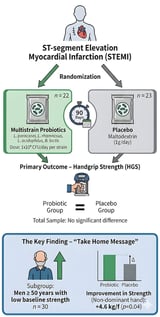
Study flowchart.

Background: Nutraceuticals are increasingly used in clinical practice for their anti-inflammatory, antiproliferative, and antioxidant properties. This study aimed to evaluate the safety and efficacy of a fixed nutraceutical combination containing chondroitin sulfate, α-lipoic acid, astaxanthin, lycopene, escin, and omega-3 fatty acids (eicosapentaenoic acid and docosahexaenoic acid) in improving pain and quality of life in patients with chronic knee osteoarthritis (OA). Methods: This observational study included patients with chronic knee OA who were referred to the ambulatory pain clinic at Dulbecco University Hospital, Catanzaro, Italy. Participants received one tablet daily for three months. Quality of life was assessed using the 36-Item Short Form Health Survey (SF-36), and adverse drug reactions (ADRs) were evaluated using the Naranjo scale. Results: Fifty patients (20 men and 30 women; mean age, 63.6 ± 11.4 years; range, 26–88 years; mean body mass index, 26.9 ± 3.7 kg/m2) were enrolled. Pain symptoms demonstrated a statistically significant improvement over time (p < 0.01). No ADRs were reported during the study period. Conclusions: The fixed nutraceutical combination improved pain and quality of life in patients with chronic knee OA and demonstrated an excellent safety profile.

5 February 2026

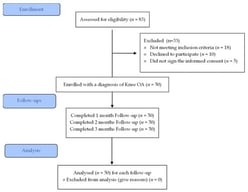
STROBE flow chart. STROBE, Strengthening the Reporting of Observational Studies in Epidemiology.

Morus alba Calli: A Sustainable Source of Phytochemicals and Nutritive Supplements

  • Vanessa Dalla Costa,
  • Anna Piovan and
  • Raffaella Filippini
  • + 1 author

Morus alba L., a member of the Moraceae family, is known for its positive effects on human health, linked to the presence of different classes of secondary metabolites, including flavonoids, stilbenoids, and alkaloids, found in different parts of the plant. Stilbenoids, in particular, are mainly present at the root cortex level and, owing to their valuable activities, have attracted scientific interest in recent years. Since roots are a non-renewable source, in this study, M. alba in vitro callus cultures were established. The biomass with the appropriate growth and texture was selected for juice extraction, and the total phenol, flavonoid, and proanthocyanidin contents, along with the antioxidant activity, were estimated in the juices. The analyses throughout the callus growth cycle revealed the juice of 14-day-old calli to be the richest, resulting in the most active. In this juice, the LC-MS/MS-DAD analysis unveiled the presence of seventeen stilbenoids. Together with the data obtained by the nutritional analysis, the results showed that M. alba cell cultures have the potential to be utilised for producing innovative healthy food materials, bridging the gap between the ever-increasing natural-based-product demand and the need for more environmental, social, and economic development.

2 February 2026

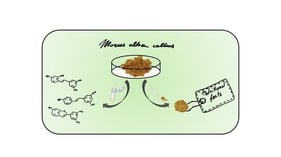
Callogenesis of leaf, stem, and root explants in LTV, B5, WPM, and MS media after one month of in vitro cultivation.

The objective of this study was to investigate the effect of reactive extrusion (thermomechanical and chemical process) on the chemical composition, techno-functional properties, glucose and cholesterol adsorption capacity, and bioactive compound profile of spent coffee grounds (SCG). SCG was extruded using citric acid or alkaline hydrogen peroxide as reagents, and a control sample was extruded without reagents. Treatment with citric acid resulted in the highest levels of total dietary fiber (79.6 g/100 g) and insoluble fiber (76.2 g/100 g), especially cellulose, and significantly improved glucose (32.7 mmol/L) and cholesterol (4.5 mg/g) adsorption at neutral pH. Treatment with alkaline hydrogen peroxide increased water retention capacity (3.9 g/g). Although chemical treatments reduced total polyphenol and antioxidant activity, they effectively broke down the lignocellulosic matrix, thereby increasing fiber availability and functionality. Extrusion without reagents (processes induced by mechanical and thermal factors) favored the retention of caffeine and chlorogenic acids, increasing soluble fiber and maintaining antioxidant capacity. Therefore, reactive extrusion is a technological strategy that aligns with the principles of the circular economy, offering an environmentally friendly alternative to landfill disposal and adding value to spent coffee grounds by transforming lignocellulosic residue into functional ingredients with broad application potential.

2 February 2026

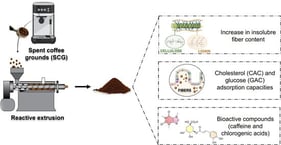
Flowchart of the reactive extrusion process with SCG and different reagents.

News & Conferences

Issues

Open for Submission

Editor's Choice

Reprints of Collections

Functional Foods as a New Therapeutic Strategy 2.0
Reprint

Functional Foods as a New Therapeutic Strategy 2.0

Editors: Ivan Cruz-Chamorro, Guillermo Santos Sánchez
Functional Foods as a New Therapeutic Strategy
Reprint

Functional Foods as a New Therapeutic Strategy

Editors: Ivan Cruz-Chamorro

Get Alerted

Add your email address to receive forthcoming issues of this journal.

XFacebookLinkedIn
Nutraceuticals - ISSN 1661-3821