

- Article

Inflammatory Mediators of Alzheimer’s Disease Characterized in a Mouse Model (APP/PS1)
- Adrian Jorda,
- Kenia Alvarez-Gamez and
- Soraya L. Valles
- + 7 authors
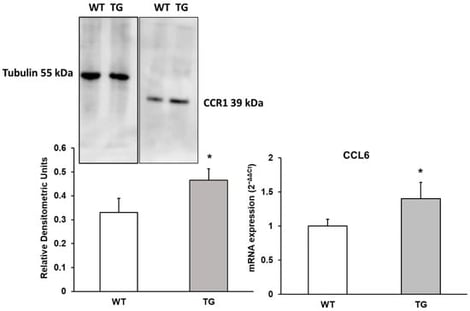
Alzheimer’s disease (AD) is marked by amyloid plaques, hyperphosphorylated TAU proteins, and neuroinflammation. The APP/PS1 mouse model is widely used to study AD pathogenesis. In this study, we investigated the expression of chemokines and their receptors, which may play a role in AD’s pathological mechanisms, using brain cortex tissue from female APP/PS1 mice aged 20–21 months. We analyzed several chemokine receptors (CCR1, CCR2, CCR3, CCR4, CCR6, CCR7, CCR9, and CCR10) by Western blot and focused on CCR6, CCR7, and CCR10 using RT-PCR. Additionally, we quantified the levels of chemokines (CCL6, CCL8, CCL19, CCL20, CCL24, and CCL27) by RT-PCR. Our results showed a significant decrease in CCL8 and CCL19, along with their respective receptors, in the APP/PS1 mice compared to controls. On the other hand, we observed a notable increase in CCL6, CCL24, CCL20, CCL27, and their receptors. Chemokines like CCL8 and CCL20, involved in inflammatory responses, may reveal how neuroinflammation contributes to AD. CCL19 and CCL27 are linked to immune cell trafficking, which may help explain immune cell interactions with amyloid plaques and TAU tangles in the CNS. Overall, the altered expression of chemokines such as CCL24 could serve as biomarkers for early AD detection and monitoring disease progression. These findings suggest potential therapeutic targets to modulate immune responses and reduce neuroinflammation in AD.
6 February 2026