

- Review

ADMET-Guided Design and In Silico Planning of Boron Delivery Systems for BNCT: From Transport and Biodistribution to PBPK-Informed Irradiation Windows
- Karolina Ewa Wójciuk,
- Emilia Balcer and
- Marcin Zieliński
- + 5 authors
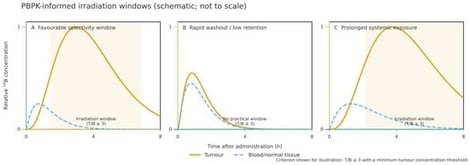
BNCT (Boron Neutron Capture Therapy) is a binary radiotherapeutic modality in which high LET (Linear Energy Transfer) particles are generated from 10B(n,α)7Li reaction, ideally within boron-loaded tumour cells, so the therapeutic outcome depends critically on the pharmacokinetics and biodistribution of boron carriers. In this review, boron-containing agents for BNCT, with a focus on ADMET (absorption, distribution, metabolism, excretion and toxicity) and model-informed design, were examined. Low-MW (low-molecular-weight) compounds, peptide conjugates, polymeric and nanostructured platforms and cell-based vectors were surveyed and how physicochemical properties, transporter engagement and nano–bio interactions govern tumour uptake, subcellular localisation and normal tissue exposure were discussed. A shift from maximising boron content towards optimising exposure profiles using PET (Positron Emission Tomography), PBK (physiologically based pharmacokinetic) modelling and in silico ADMET tools to define irradiation windows was also discussed. Classical agents such as BPA (Boronophenylalanine) and BSH (Sodium Borocaptate) are contrasted with newer polymeric and metallacarborane-based carriers, with attention to brain penetration, endosomal escape, linker stability, biodegradation and elimination routes, as well as platform-specific toxicities. Incontestably, further progress in BNCT will highly depend on integrating imaging-derived kinetics with PBPK-informed dose planning and engineering subcellularly precise yet degradable carriers, and that ADMET-guided design and spatiotemporal coordination are central to achieving reproducible clinical benefit from BNCT’s spatial selectivity.
10 February 2026