Skip to Content
You are currently on the new version of our website. Access the old version .

Molbank

Molbank is an international, peer-reviewed, open access journal comprised of a unique collection of one-compound-per-paper short notes on synthetic compounds and natural products published bimonthly online by MDPI.

All Articles (1,863)

  • Short Note
  • Open Access

Diisopropyl(6-(phenyl(phenylthio)arsaneyl)-1,2-dihydroacenaphthylen-5-yl)phosphane

  • Laurence J. Taylor,
  • Philip Pickett and
  • Petr Kilian
  • + 1 author

Peri-substituted bis(tertiary) phosphine-arsine Acenap(PiPr2)(As(SPh)Ph) (4, Acenap = acenaphthene-5,6-diyl) was synthesized by the reaction of the chloroarsine (PiPr2)(AsPhCl) with PhSLi. The X-ray crystal structure of this compound reveals an intramolecular P∙∙∙As–Cl pnictogen bond, with the phosphorus lone pair donating into the As–S σ* orbital.

10 February 2026
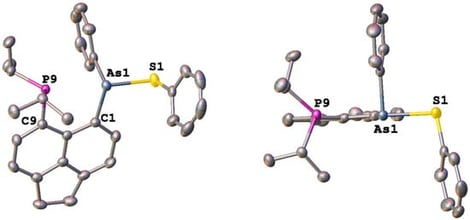
Structure of 4 in the solid state, shown from two different angles. (Left): View approximately perpendicular to the acenaphthene ring. (Right): View along the acenaphthene ring, highlighting the near-linear arrangement of the P9∙∙∙As1-S1 motif. Hydrogen atoms are omitted for clarity. Thermal ellipsoids are drawn at 50% probability.
  • Communication
  • Open Access

Crystal Structure of [1046127-79-0], 3,3′-(n-Hexane-1,6-diyl)bis(1-vinylimidazolium) Bromide

  • Thomas Gelbrich,
  • Johanna Freilinger and
  • Sven Nerdinger
  • + 4 authors

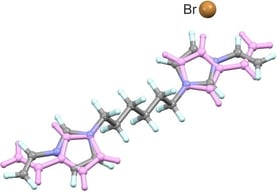
Vinylimidazolium salts constitute a highly relevant class of polymerizable heterocycles, especially in the field of so-called polymer ionic liquids (PILs), and they are frequently used as components of polyelectrolytes. Therefore, crystallographic characterizations, in particular studies of charge distribution and conformational features, can provide fundamental insights concerning ion–ion and ion–dipole interactions. The structure of the title compound [1046127-79-0] has the space group symmetry P21/c. Its asymmetric unit contains one formula unit, consisting of two bromide anions and the halves of two cation moieties. The cation units possess inversion symmetry, and their C6H12 chains adopt an all-trans conformation.

10 February 2026

Molecular structure with non-H atoms depicted as ellipsoids at the 50% probability level and H atoms drawn as blue circles of random size (disorder omitted for clarity). Symmetry operations: (i) 1 − x, 1 − y, 2 − z (ii) −x, −y, −z.
  • Short Note
  • Open Access

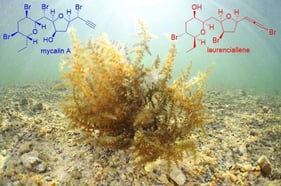
As a part of an SAR study aimed at testing the antitumor activity of some C15 acetogenins related to mycalin A, we report here the synthesis of the C-1 debromo-derivative of laurenciallene, a substance recently isolated from the red alga Laurencia obtusa. This new substance has been obtained by the selective, reductive debromination of the terminal bromoallene moiety of laurenciallene with Zn/AcOH. Its structure has been fully characterized by spectral methods, including 2D-NMR spectra.

9 February 2026

Comparison of the structure of mycalin A and laurenciallene, a substance structurally related to mycalin A.
  • Short Note
  • Open Access

2,3,4,6-Tetra(9H-carbazol-9-yl)benzonitrile

  • Qing-Qing Wan and
  • Zhi-Cheng Fu

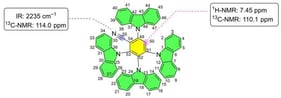
Here, we synthesized 2,3,4,6-tetra(9H-carbazol-9-yl)benzonitrile (4CzHPN) via visible-light-driven photocatalytic monodecyanation using the versatile metal-free catalyst 4CzIPN. Characterized by NMR, IR, X-ray diffraction, and DFT calculations, it features a 3.49 eV HOMO-LUMO gap and shows blue-shifted absorption/emission, emerging as a promising advanced metal-free photoredox catalyst.

6 February 2026

Key characteristic data of 4CzHPN.

News & Conferences

Issues

Open for Submission

Editor's Choice

Reprints of Collections

Molecules from Side Reactions II
Reprint

Molecules from Side Reactions II

Editors: Stefano D’Errico, Annalisa Guaragna

Get Alerted

Add your email address to receive forthcoming issues of this journal.

XFacebookLinkedIn
Molbank - ISSN 1422-8599