

- Article

Integrated Physical and Numerical Assessment of the Formation of Water-Conducting Fracture Zones in Deep Ore Mines with Structural Faults
- Egor Odintsov,
- Zidong Zhao and
- Wenwei Wang
- + 2 authors
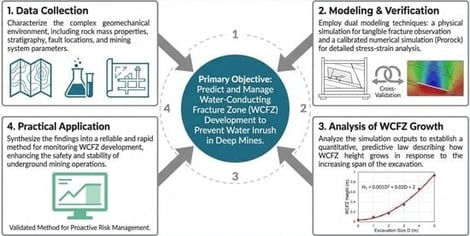
Mining operations conducted beneath water-bearing strata pose significant risks associated with the development of water-conducting fracture zones in the overburden. The height criterion for this parameter is critical to ensuring the stability of underground mine workings and preventing the risk of water inrush incidents. The research is based on physical and numerical simulations and aims to forecast the development of the water-conducting fracture zone. The methodology is based on in situ hydrogeology data, geotechnical boreholes, physical 2D modeling of rock strata, discrete element modeling using UDEC, and finite–discrete element modeling using Prorock software. A physical model of layered rock mass is constructed to simulate unfilled excavation areas induced deformation under real polymetallic ore field conditions. Based on the results, relationships between vertical subsidence, layer curvature, inclination, and the height of the water-conducting fracture zone were obtained. Particular attention is given to the effects of tectonic discontinuities, chamber geometry, and backfilling on fracture development. A stepwise excavation sequence is simulated to reproduce field conditions and assess the evolution of stress and deformation fields in the overburden. The study reveals that the propagation of the fracture zone around a mine excavation adheres to a polynomial law, characterized by an increase in height concurrent with the expansion of the excavation. This approach enables the design of safe extraction strategies beneath aquifers or surface water bodies. The proposed framework is expected to enhance prediction accuracy and reduce uncertainties.
3 February 2026