

- Article

A Temporal Investigation of Microplastics’ Distribution and Sediment Characteristics in Saltmarshes of the Adriatic Coast of Croatia
- Stamatia Galata,
- Pero Tutman and
- Jason R. Kirby
- + 4 authors
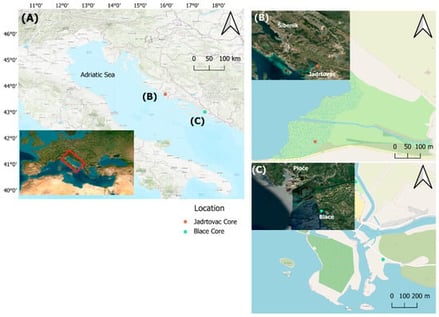
Saltmarshes have emerged as important sinks for microplastic (MP) pollution, yet little is known about the long-term accumulation and retention mechanisms of MPs in these environments. This study presents the first chronological record of MPs in Mediterranean saltmarsh sediments, using sediment cores dated via a combination of AMS radiocarbon (14C) and radionuclide (210Pb, 137Cs, 241Am) from two saltmarshes located on the Adriatic Sea coast of Croatia (Blace and Jadrtovac). MPs were extracted and analysed across core depths and assessed in relation to geochemical parameters (organic matter (OM), carbonates, organic carbon (C-org), total nitrogen (TN), phosphorus (P) forms’ content, and grain size distribution). Results show that MPs first appear in sediments dated to 1950 in Jadrtovac and post-1960 in Blace, with concentrations increasing markedly in more recent surface layers. Jadrtovac exhibited higher MP concentrations (up to 0.5 MPs g−1), dominated by fibres (86%) associated with urban and maritime sources, while Blace showed lower concentrations, dominated by fragments (60%), likely from localised sources such as agriculture or single-use packaging. Polymer analysis confirmed contrasting source profiles, with rayon and cellophane dominating in Jadrtovac, and polypropylene and olefin in Blace. MPs positively correlated with OM, C-org, P, TN and sand content, and negatively with clay and carbonate content. Principal component analysis (PCA) confirmed that MPs were associated with organic-rich, sandy sediments. These findings demonstrate that OM composition and sediment texture significantly influence MP retention and highlight the role of saltmarshes as long-term archives of plastic pollution in low-energy coastal settings.
9 February 2026