
Skip Content
You are currently on the new version of our website. Access the old version .

Microorganisms

Microorganisms is a scientific, peer-reviewed, open access journal of microbiology, published monthly online by MDPI. 
The Hellenic Society Mikrobiokosmos (MBK), the Spanish Society for Nitrogen Fixation (SEFIN) and the Society for Microbial Ecology and Disease (SOMED) are affiliated with Microorganisms, and their members receive a discount on the article processing charges.
Indexed in PubMed | Quartile Ranking JCR - Q2 (Microbiology)

All Articles (17,203)

The objective of this study was to evaluate the individual and synergistic antimicrobial efficacy of Juniperus excelsa berry essential oil (JEO) and the cell-free supernatant (CFS) from Streptococcus thermophilus against Escherichia coli (ATCC 43888), Staphylococcus aureus (ATCC 25923), and multidrug-resistant Salmonella enterica serovar Infantis S2 isolated from chicken meat. In vitro antimicrobial effects were assessed using the agar well diffusion and microdilution methods (MIC and MBC assays). The in vivo antimicrobial effect of these natural bioactive substances in controlling microbial growth in chicken meat stored at 4 °C for 48 h was also evaluated. Bioactive components of JEO were determined via GC–MS, identifying alpha-pinene (84.56%) as the primary compound. In vitro assays revealed that JEO showed high antimicrobial activity against Gram-positive S. aureus with a zone diameter of 35.50 mm (p < 0.05). JEOCFS treatment, which is the combination of CFS and JEO, demonstrated a significant synergistic interaction against S. aureus, resulting in an MIC value of 25 mg/mL. CFS alone exerted a measurable inhibitory effect on S. aureus, with an MIC of 50 mg/mL, indicating its potential antimicrobial capability. Further evaluation of the in vivo antimicrobial efficacy using chicken meat stored at 4 °C revealed that the JEOCFS treatment significantly inhibited microbial growth (p < 0.05). After 48 h of storage under refrigerated conditions, the number of psychrophilic bacteria in the control group reached 8.40 log cfu/g, while it remained significantly lower at 6.44, 5.37, and 6.74 log cfu/g in the JEO, JEOCFS, and CFS treatments, respectively. These results indicate that the synergistic application of JEO and CFS effectively suppresses foodborne pathogens, particularly S. aureus, and extends the microbiological shelf life of refrigerated chicken meat.

7 February 2026
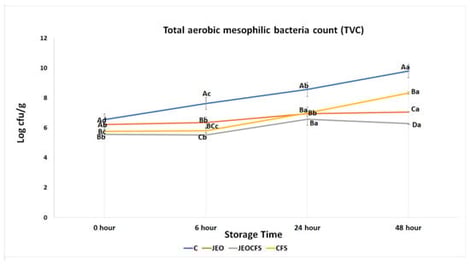
Total aerobic mesophilic bacterial count in chicken meat stored at 4 °C for 48 h. Values represent mean ± SD (n = 3). There is a significant difference (p &lt; 0.05) between the groups (A–C) and bacteria (a–c) for the values indicated by different letters in the same row and column.

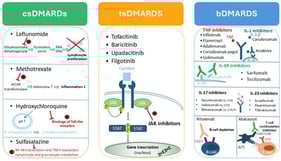
The perioperative management of biologic and immunomodulatory therapies in patients undergoing orthopedic surgery poses a clinical challenge, primarily due to the increased risk of postoperative infections. Biologic agents, particularly TNF inhibitors and interleukin-targeting drugs, may impair host immune responses, potentially increasing the risk of surgical site infections (SSIs), delayed wound healing, and systemic infections. However, abrupt discontinuation of these therapies can lead to disease flare-ups, which themselves may complicate recovery and rehabilitation. In addition, discontinuation of biologics can lead to drug tolerance and unresponsiveness when they are restarted and thereby need switching to another biologic. Recent studies suggest that the infection risk is particularly elevated with ongoing biologic therapy during major surgeries, especially in procedures involving prosthetic implants. Guidelines generally recommend withholding biological disease-modifying antirheumatic drugs (bDMARDs) for at least one dosing cycle prior to surgery, when feasible, while maintaining non-biologic DMARDs in most cases. The decision must be individualized, taking into account the pharmacokinetics of each drug, the type of surgery, the patient’s comorbidities, and the activity of the underlying disease. Close coordination among rheumatologists, orthopedic surgeons, and infectious disease specialists is essential to minimize perioperative complications and optimize patient outcomes.

7 February 2026

Classification and overview of the mechanisms of action of DMARDs used in rheumatic conditions.

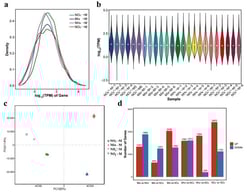
While intensive aquaculture has developed rapidly, the consequent buildup of nitrogenous compounds, poses a critical threat to aquatic organisms. Microbial degradation offers an environmentally sustainable solution. We investigated the metabolic regulatory capacity of Priestia megaterium BZ-95 under four nitrogen regimes—ammonium (NH4+-N), nitrite (NO2-N), nitrate (NO3-N), and a mixture of them (Mix)—using comparative transcriptomics. We revealed that BZ-95 in NH4+-N activated a direct assimilation program prioritizing branched-chain amino acid biosynthesis. Conversely, under nitrate, BZ-95 enhanced membrane transport and 2-oxocarboxylic acid metabolism to facilitate the rapid incorporation of nitrate-derived ammonium into biomass. Nitrite stress triggered a coordinated response involving the assimilatory nir module (nirC-nirB-nirD) and enhanced energy metabolism to meet the heightened demand for reducing power during its rapid reduction. Under mixed nitrogen sources, BZ-95 established a highly synergistic carbon-nitrogen network, simultaneously processing multiple nitrogen inputs without a hierarchical preference, highlighting its remarkable metabolic plasticity. Intersection analysis defined a refined core of 692 nitrite-specific DEGs and revealed broad transcriptional activation under nitrite stress. Analysis of the NO2-specific core identified enhanced transmembrane transport capacity, coupled with auxiliary metabolic tuning, as central adaptive strategies for nitrite processing. Collectively, these findings provide crucial insights into the molecular basis of nitrogen coordination in P. megaterium BZ-95.

6 February 2026

Global gene expression profiling and differential expression analysis under different nitrogen source treatments. (a) Density curves illustrating the distribution of gene expression levels across the four treatment groups. (b) Violin plots displaying the distribution ranges and density of gene expression profiles for individual samples. (c) Principal component analysis (PCA) based on global gene expression, revealing distinct intra-group clustering and inter-group separation. (d) Statistical summary of up-regulated and down-regulated differentially expressed genes (DEGs) identified in pairwise comparisons between treatment groups.

Molecular Evolution of the Fusion (F) Genes in Human Metapneumovirus Genotype B

  • Tatsuya Shirai,
  • Fuminori Mizukoshi and
  • Hirokazu Kimura
  • + 7 authors

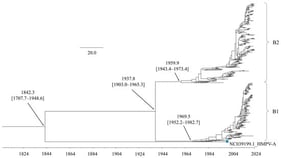
Human metapneumovirus genotype B (HMPV-B) is an important respiratory pathogen, requiring detailed elucidation of the evolutionary and antigenic features of its fusion (F) gene. Using 500 sequences collected between 1982 and 2024, we investigated the molecular evolution, phylodynamics, and structural epitope landscape of the HMPV-B F gene. Time-scaled phylogeny dated the divergence of sublineages B1 and B2 to around 1937, and Bayesian Skyline Plot analysis showed that these sublineages exhibited distinct demographic trajectories over time. The F gene evolved at a rate of 1.01 × 10⁻³ substitutions/site/year; however, amino acid variation remained limited, consistent with pervasive purifying selection, with 39% of codons under strong negative selection and little consensus evidence for positive selection. Conformational B-cell epitope prediction demonstrated a high degree of conservation across neutralizing antibody binding regions (sites Ø and I–V), and amino acid substitutions occurring within these sites were not predicted to substantially alter epitope architecture. Together, these findings indicate that the HMPV-B F gene evolves under strong evolutionary constraint while maintaining stable antigenic features, supporting the potential for antibody-based strategies that target neutralizing antibody binding regions of the F protein.

6 February 2026

Time-scaled phylogenetic tree of the HMPV-B F gene inferred using the BMCMC method. The scale bar indicates time (in years). Numbers in parentheses denote the 95% HPD interval.

News & Conferences

Issues

Open for Submission

Editor's Choice

Get Alerted

Add your email address to receive forthcoming issues of this journal.

XFacebookLinkedIn
Microorganisms - ISSN 2076-2607