Skip Content
You are currently on the new version of our website. Access the old version .

Micromachines

Micromachines is a peer-reviewed, open access journal on the science and technology of small structures, devices and systems, published monthly online by MDPI.
The Chinese Society of Micro-Nano Technology (CSMNT) and AES Electrophoresis Society are affiliated with Micromachines and their members receive a discount on the article processing charges.
Indexed in PubMed | Quartile Ranking JCR - Q2 (Instruments and Instrumentation | Physics, Applied | Chemistry, Analytical)

All Articles (12,943)

Al/Ti stacks are widely used in aerospace manufacturing due to their heterogeneous and multi-property material characteristics. However, during integrated hole-making processes, the significant differences in material properties often induce abrupt variations in cutting force, leading to uneven loading along the cutting edge and non-uniform tool wear. These issues complicate the drilling process and severely hinder the advancement of manufacturing and assembly technologies for aerospace components. To address these issues, longitudinal–torsional ultrasonic vibration drilling (LTUVD) is implemented in drilling of Al/Ti stacks, which superimposes high-frequency axial and tangential vibrations onto conventional drilling, enabling a spatial elliptical cutting trajectory and periodic material separation. A spatial kinematic model of LTUVD is developed to analyze the effects of key parameters on the tool motion trajectory and chip variations. Drilling experiments are conducted on Al/Ti stacks at a defined cutting condition (30 m/min, 0.1 mm/rev) to compare the performance of conventional drilling (CD), ultrasonic vibration-assisted drilling (UVAD), and LTUVD under various conditions. The results show that LTUVD can significantly outperform the other two methods in reducing thrust force, chip breaking (especially in the titanium layer), mitigating tool wear, and improving hole wall surface quality. In addition, scanning electron microscopy (SEM) and energy-dispersive spectroscopy (EDS) analyses further reveal that LTUVD can effectively suppress thermal and adhesive wear, thereby extending tool life.

10 February 2026
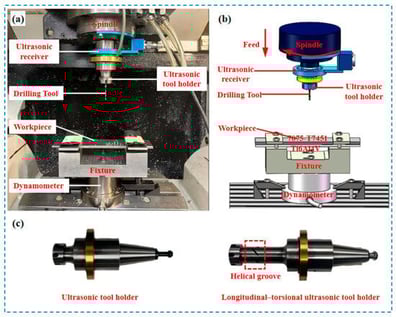
Experimental setup diagram.  (a) Experimental setup; (b) Schematic diagram of the experimental setup; (c) Tool holder.

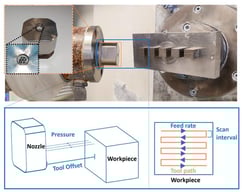
The multi-jet polishing process (MJP) demonstrates high shape accuracy and surface quality in the machining of nonlinear and complex surfaces, and it achieves precise and adjustable material removal rates through computer control. However, there are still challenges in terms of machining efficiency, system complexity, and stability. In particular, maintaining the polishing quality presents a greater challenge when working conditions change. To overcome these issues, this paper conceptually proposes a digital twin (DT)-driven, human-centric design framework that integrates key factors of MJP, such as jet kinetic energy, nozzle structure, abrasive type, and machining path. Within this framework, a feature-encoded transfer learning-based model is introduced to enhance surface roughness prediction accuracy and robustness under varying working conditions. The effectiveness of the proposed model was verified by conducting experiments on 3D printed workpieces under two different MJP working conditions. The results show that our proposed method yields better predictive performance and cross-condition adaptability. Overall, this work provides a predictive modeling component that supports DT-driven process design, offering a practical and extensible perspective for optimizing complex ultra-precision manufacturing processes under data-scarce and uncertainty-dominated conditions.

10 February 2026

Mechanism of MJP.

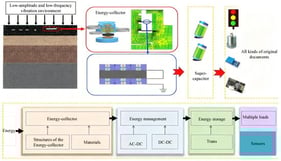
In low-amplitude and low-frequency vibration environments, the energy harvesting efficiency of self-powered wireless sensor nodes is insufficient, limiting their long-term autonomous operation. To address this issue, a micro piezoelectric–electromagnetic hybrid energy harvester is designed, aiming to enhance energy capture efficiency through structural integration and parameter optimization. The study is conducted entirely through numerical simulations. A coaxial integrated architecture is adopted, combining a piezoelectric cantilever beam array with an electromagnetic induction module. The piezoelectric layer uses lead magnesium niobate–lead titanate (PMN-PT) solid solution material with a thickness of 0.2 mm. The electromagnetic module employs copper wire coils with a diameter of 0.08 mm, winding 1500–3000 turns, paired with N52-type neodymium–iron–boron (NdFeB) permanent magnets. To improve energy conversion efficiency, the optimization parameters include the length-to-thickness ratio of the cantilever beam, the mass of the tip mass, the number of coil turns, and the spacing of the permanent magnets. Each parameter is set at four levels for orthogonal experiments. A multi-physics coupling model is established using ANSYS Workbench 2023, covering structural dynamics, piezoelectric effects, and the electromagnetic induction module. The mesh size is set to 0.1 mm. The energy output characteristics are analyzed under vibration frequencies of 0.3–12 Hz and amplitudes of 0.2–1.0 mm. Simulation results show that the optimized hybrid harvester achieves 45% higher energy conversion efficiency than a single piezoelectric structure and 31% higher than a traditional separated hybrid structure within the 0.3–12 Hz low-frequency range. Under a 6 Hz frequency and 0.6 mm amplitude, the output power density reaches 3.5 mW/cm3, the peak open-circuit voltage is 4.1 V, and the peak short-circuit current is 1.3 mA. Under environmental conditions of 20–88% humidity and −15–65 °C temperature, the device maintains over 94% stability in energy output. After 1.2 million vibration cycles, structural integrity remains above 96%, and energy conversion efficiency decreases by no more than 5%. The proposed coaxial hybrid structure and multi-parameter orthogonal optimization method effectively enhance energy harvesting performance in low-amplitude, low-frequency environments. The simulation design parameters and analysis procedures provide a reference for the development of similar micro hybrid energy harvesters and support the performance optimization of self-powered wireless sensor nodes.

9 February 2026

Structure of the energy harvester.

Zn(HQ)2-Phenanthroline/PEDOT:PSS Hybrid Film Engineering as a Promising Active Layer in Organic Photoconductive Devices

  • María Elena Sánchez Vergara,
  • Omar Jimenez Correa and
  • Monserrat Bizarro
  • + 2 authors

Zinc(II) bis(8-hydroxyquinolinate) (Zn(HQ)2) and 1,10-phenanthroline (phen) were combined to fabricate an organic semiconductor in a bulk heterojunction architecture and subsequently embedded in a poly 3,4-ethylene dioxythiophene–polystyrene sulfonate (PEDOT–PSS) matrix. The resulting Zn(HQ)2-phen/PEDOT–PSS was deposited as a film upon tin-oxide-coated glass and graphite-covered Tetra Pak (TP)-recycled substrates for the manufacture of organic photoconductive devices. The topographical and micromechanical characteristics of the hybrid films were assessed by atomic force microscopy, with an average roughness of 5.6 nm, maximum tensile strength of 7.95 MPa, and Knoop microhardness of 14.7. The fundamental energy gap (Eg) was determined employing the Kubelka–Munk function, with Eg of 3.5–3.8 eV. These results were complemented with a computational DFT molecular orbital analysis of the species involved in the hybrid semiconductor. The devices were electrically characterized under UV irradiation conditions, obtaining the current–voltage and power–voltage relationships. The maximum current in the TP–graphite device is 1.8 × 10⁻² A and 1.1 × 10⁻² A in the device on glass–ITO. Zn(HQ)2-phen/PEDOT–PSS film presents its own operating regimes relating to a photoconductor or flexible photoresistor. The power in the device on glass–ITO is 120 mW and 113 mW for shortwave and longwave, respectively, and in the device on TP–graphite, it is 198 mW and 139 mW.

8 February 2026

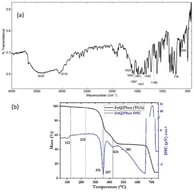
(a) IR spectrum and (b) TGA and DSC curves of the dispersed heterojunction Zn(HQ)2-phen BHJ.

News & Conferences

Issues

Open for Submission

Editor's Choice

Get Alerted

Add your email address to receive forthcoming issues of this journal.

XFacebookLinkedIn
Micromachines - ISSN 2072-666X