Skip to Content
You are currently on the new version of our website. Access the old version .

Microbiology Research

Microbiology Research is an international, peer-reviewed, open access journal published monthly online by MDPI (from Volume 11, Issue 2 - 2020).

All Articles (902)

Fish are nutritionally valuable foods but are also highly perishable, representing a major research focus for the development of effective preservation strategies to delay spoilage while maintaining microbiological acceptability. In this context, edible coatings have gained increasing attention as clean-label tools to extend the shelf life of perishable foods. In this study, an alginate-based emulsion containing oregano essential oil (OEO) was applied to commercial frozen–thawed ready-to-cook (RTC) hake fillets, intentionally selected as a reproducible model system to evaluate coating performance under refrigerated conditions. Coated and uncoated fillets, stored at 4 °C for up to 7 days, were monitored over time for microbiological and physicochemical parameters, including microbial loads, pH, weight loss, and lipid oxidation (TBARS). Compared to uncoated samples, fillets treated with the alginate–OEO emulsion exhibited a marked delay in spoilage-related microbial growth, with a consistent inhibition of Pseudomonas spp. throughout the experimental period, while maintaining microbiological acceptability. Emulsion-based coated fillets also exhibited reduced lipid oxidation, a more uniform surface appearance with only minor visible color changes, and the absence of unpleasant off odors during the refrigerated storage. Overall, the results demonstrate that the alginate–OEO coating could represent an effective strategy for improving the microbiological and oxidative stability of RTC fish fillets under refrigerated conditions, with potential implications for extended shelf life and a reduction in food waste.

14 February 2026
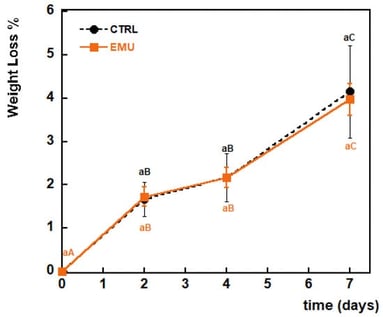
Weight loss (%) of fish fillets during refrigerated experimental conditions at 4 °C for uncoated (CTRL—black) and coated (EMU—orange) samples. Means with the same letters (lowercase: under different treatments for the same time; uppercase: under the same treatment during different storage times) are not significantly different (p > 0.05). Vertical bars indicate standard deviation.

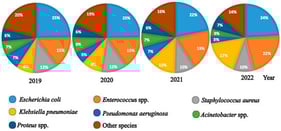
Antimicrobial resistance (AMR) is accelerating and driven by antimicrobial use. Hospital consumption and resistance data remain scarce in Serbia. This retrospective study assessed the prevalence of infectious agents among hospitalized patients (2019–2022), distribution and AMR rates of Escherichia coli and Klebsiella pneumoniae, antimicrobial consumption, and associations between AMR and antibiotic use (Spearman’s correlation). All bacterial isolates were included for species-frequency analyses. For AMR and specimen distribution, repeat isolates of E. coli and K. pneumoniae per patient were excluded. Among 10,780 isolates, E. coli remained most frequent (24.7% in 2019; 24.3% in 2022), whereas K. pneumoniae increased from 7.7% to 16.9% (p < 0.001). E. coli resistance to cephalosporins, fluoroquinolones, and piperacillin/tazobactam increased significantly from 2019 to 2022 (p < 0.05). K. pneumoniae resistance increased to most agents (p < 0.001), with meropenem resistance rising from 11.7% to 52.0%. Multidrug resistance rose from 27.3% to 35.4% for E. coli (2020–2022; p = 0.006) and from 62.4% to 82.9% for K. pneumoniae (2019–2022; p < 0.001). Total hospital antibiotic consumption nearly doubled from 57 to 111.8 Defined Daily Doses per 100 bed days (2019–2021) and decreased to 52.0 (2022). Temporal concurrence of increased antimicrobial use during COVID-19 and escalating resistance underscores the need for strengthened surveillance and stewardship.

14 February 2026

Distribution of the most frequently isolated bacterial species among all isolates, 2019–2022.
  • Communication
  • Open Access

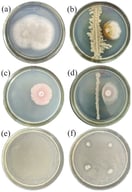
The search for antagonistic microorganisms as alternatives to chemical pesticides is an urgent priority in sustainable agriculture. Previously, we isolated several bacterial isolates from spruce plants, and one of them, identified as Bacillus atrophaeus R7PjV2-12, showed strong antagonistic properties against plant pathogens such as Magnaporthe oryzae, Fusarium avenaceum, and Erwinia billingiae. Given its strong fungicidal properties, we decided to sequence the complete genome of this bacterium to determine how it can inhibit fungal growth. The whole genome size of B. atrophaeus R7PjV2-12 was 4,127,644 bp with 4032 open reading frames. B. atrophaeus R7PjV2-12 genome possessed clusters of secondary metabolites with a complete set of genes with 100% similarity representing clusters of biosynthesis of bacillin, bacillibactin, subtilosin A, and fungicin, which indicates the studied strain’s ability to synthesize these substances. Thus, this paper has shown and discussed the potential importance of B. atrophaeus R7PjV2-12 for biocontrol of pathogenic microorganisms in agriculture.

11 February 2026

Antagonism of bacteria strain R7PjV2-12 against phytopathogenic fungi Magnaporthe oryzae, Fusarium avenaceum, and bacterium Erwinia billingiae. (a) Control (M. oryzae without R7PjV2-12); (b) cultivation of the M. oryzae with R7PjV2-12; (c) control (F. avenaceum without R7PjV2-12); (d) cultivation of the F. avenaceum with R7PjV2-12; (e) control (E. billingia without R7PjV2-12); (f) cultivation of the E. billingia with R7PjV2-12.

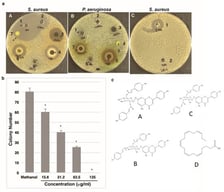
Thuja arborvitae are widely grown in North America and East Asia for their ornamental value, and their leaf oil extracts have been used to treat bacterial infections. This study aimed to identify antibacterial compounds from Thuja leaves. The methanol extract of Thuja leaves exhibited strong antibacterial activity against Gram-positive (Staphylococcus aureus and Streptococcus mutans) and Gram-negative (Acinetobacter baumannii, Pseudomonas aeruginosa) bacteria. The major compounds in the active fractions were isolated and identified as apigenin-7-di-p-coumarylglucoside and eicosapentaenoic acid. The identified compounds showed potent antibacterial activity against the four tested microorganisms with IC50 values of 10 to 50 µg/mL. More importantly, these compounds showed potent inhibitory activity (IC50: 10 μg/mL) against the multidrug-resistant bacterial strain Acinetobacter baumannii. Two antibacterial compounds are now being reported for the first time in Thuja arborvitae, and they may have potential for the treatment of bacterial infections.

10 February 2026

(a) The zone of inhibition assay performed to detect antibacterial activity. The zone of inhibition assay was performed with plant extracts against S. aureus (ATCC 49775) (A,C) and A. baumannii (B). 1, ampicillin (5 µg); 2, chloramphenicol (1.25 µg); 3, M. grandiflora extract (5 mg); 4, T. radicans extract (5 mg); 5, G. biloba extract, (5 mg); 6, T. arborvitae extract (5 mg); and 7, F. vulgare extract (5 mg). The zone of inhibition assay was performed with EPA (0.5 mg) and Oleic acid (OA) (0.5 mg) against S. aureus (ATCC 49775) (C). (b) Antibacterial effects of T. arborvitae extract on colony-forming ability. The y-axis shows the colony numbers of S. aureus (ATCC 49775). The x-axis shows the concentrations of T. arborvitae extract. Methanol was used as a solvent to dissolve the extract. Data are represented as the mean ± SD of three independent tests. * Significantly different (p &lt; 0.05) compared to the methanol control. (c) Chemical structures of identified antibacterial compounds. (A): apigenin-7-(2″,6″-di-p-coumarylglucoside); (B): apigenin-7-(4″,6″-di-p-coumarylglucoside); (C): apigenin-7-(3″,6″-di-p-coumarylglucoside), (D): EPA.

News & Conferences

Issues

Open for Submission

Editor's Choice

Get Alerted

Add your email address to receive forthcoming issues of this journal.

XFacebookLinkedIn
Microbiol. Res. - ISSN 2036-7481