Skip Content
You are currently on the new version of our website. Access the old version .

Microbiology Research

Microbiology Research is an international, peer-reviewed, open access journal published monthly online by MDPI (from Volume 11, Issue 2 - 2020).

All Articles (895)

Caseous lymphadenitis (CLA), an infectious disease caused by Corynebacterium pseudotuberculosis (C. pseudotuberculosis), poses a significant economic burden to the global small ruminant industry. This study aimed to investigate genetic variations in the CP40 gene of C. pseudotuberculosis and to develop a rapid detection assay for enhanced pathogen identification. Homology analysis was performed to compare the CP40 gene sequence of the FJ-PN strain with other Corynebacterium species. Specific primers targeting CP40 were designed, and a SYBR Green I-based real-time PCR protocol was optimized. The assay’s specificity, sensitivity, and reproducibility were subsequently validated. The FJ-PN strain exhibited ≥99.65% nucleotide identity and ≥98.94% amino acid identity with C. pseudotuberculosis biovar ovi reference strains, showing 90.18–91.84% nucleotide identity and 88.63–90.77% amino acid identity with C. pseudotuberculosis biovar equi, and ≤82.71% nucleotide identity and ≤78.63% amino acid identity with other Corynebacterium species. The established qPCR assay demonstrated high specificity, the limit of detection was 52 copies/μL, and it demonstrated good reproducibility (intra- and inter-assay CV < 1.0%). Clinical sample testing revealed 18.8% positivity rates in nasal swabs, which was higher than that detected by conventional PCR (16.3%). These results indicate that the CP40 gene is evolutionarily conserved and represents a specific molecular marker for the identification of C. pseudotuberculosis biovar ovis. The developed SYBR Green I real-time PCR assay enables the efficient detection of C. pseudotuberculosis and provides technical support for CLA surveillance and control.

6 February 2026

Multiple sequence alignment was performed using BioEdit software (Version 7.2.6), with sequences retrieved from NCBI. The boxed regions denote primer binding sites, where black indicates complete primer–sequence complementarity (Corynebacterium pseudotuberculosis biovar ovi), red indicates downstream primer–sequence mismatches (Corynebacterium pseudotuberculosis biovar equi), and green indicates mismatches in both upstream and downstream primers (other Corynebacterium species). Note: Red letter: T base; blue letter: C base; green letter: A base; black letter: G base, identical bases are represented by color-coded dots.

The global rise of multidrug resistance (MDR) across bacterial pathogens poses a severe threat to public health, with the food chain serving as a critical reservoir and transmission route for resistant clones. This study investigated the genomic epidemiology of Staphylococcus aureus in retail pork from Beijing, China, and Copenhagen, Denmark, with a focus on MDR patterns and associated genetic elements. Among 134 isolates, the livestock-associated clonal complex CC398 was the dominant lineage (24.63%) and exhibited a high burden of MDR (48.48%), carrying resistance genes to β-lactams (blaZ and mecA), tetracyclines (tetM and tetK), and aminoglycosides. Notably, MRSA isolates displayed a significantly higher MDR prevalence (73.53%) compared to MSSA isolates (18.00%), underscoring methicillin resistance as a key marker for broader resistance phenotypes. Phylogenetic analysis revealed the segregation of CC398 into distinct sub-lineages, with the livestock-associated branch consistently linked to a characteristic tetracycline–β-lactam MDR profile. Furthermore, high frequencies of mobile genetic elements, such as the rep16 plasmid, were associated with MDR dissemination in CC398. These findings highlight retail meat as an important reservoir for MDR S. aureus and illustrate how livestock-adapted clones contribute to the environmental burden of antimicrobial resistance. This study underscores the need for integrated One Health surveillance that connects veterinary, food safety, and human health sectors to monitor and contain the spread of MDR bacteria across ecological niches.

5 February 2026

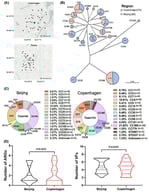
(A) The sampling sites in the cities of Beijing and Copenhagen in this study. (B) Minimal spanning tree based on the multi-locus sequence types of 134 S. aureus isolates collected in this study. Each circle represents a sequence type, and circle sizes represent the number of isolates. (C) Distribution of CC types in two cities. The star means the dominant CC type. (D) Violin plots represent the number of antimicrobial resistance genes and virulence factors of S. aureus strains in two cities.

Determining Selenomonas Species Subclusters in Periodontal Samples by FISH

  • Monika Gothwal,
  • Flurina Suter and
  • Thomas Thurnheer
  • + 2 authors

The highly destructive pathogenic processes in patients with periodontitis are attributed to the presence of subgingival biofilms comprising key periodontal pathogens, such as Porphyromonas gingivalis, Treponema denticola, and Tannerella forsythia, as well as other periodontopathogens including Fusobacterium nucleatum, Selenomonas spp., Centipeda spp., and Campylobacter spp. Considering the vast microbial diversity in periodontitis, we aimed to analyze the presence of various bacterial species in subgingival dental plaque, with a special focus on Selenomonas spp. We first developed a phylogenetic tree for Selenomonas–Veillonella clusters, using in silico analysis followed by fluorescence in situ hybridization (FISH) on subgingival dental plaque samples from 22 patients with a history of chronic periodontitis, by using specific 16S rRNA oligonucleotide probes. These oligonucleotide probes’ specificity and hybridization conditions were determined on previously characterized bacterial strains. Qualitative and quantitative analysis of FISH slides was carried out by using an epifluorescence microscope. The majority of the patient samples showed high fluorescence signals with the oligonucleotide probes SEL1150, Sspu439, and SEL1469 (specific for Selenomonas spp.), ACI623 (identifying Selenomonas, Veillonella, and Dialister spp.), Tfor127 (T. forsythia) and L-Pgin1006-23 (P. gingivalis). SEL1150 showed specificity for bacterial species in the subclusters A, B, and C, namely S. dianae, S. infelix, S. flueggei, C. periodontii, S. artemidis, S. noxia, and S. sputigena; Sspu439 for S. sputigena; SEL1469 for subclusters A and B, and for S. sputigena; ACI623 for bacterial species in subclusters C and F, namely the S. sputigena and Veillonella species. The experimentally observed specificities of the oligonucleotide probes corresponded with our in silico analysis. Selenomonas spp. may play a role in the subgingival microbiome of periodontitis and contribute to the disease process. Targeting Selenomonas spp. with specific therapeutic strategies could offer new insights into the management of periodontitis. However, further studies are needed to determine a definite functional significance.

3 February 2026

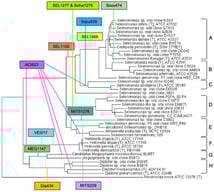
Phylogenetic tree for Selenomonas–Veillonella clusters and in silico analysis for the 16S rRNA oligonucleotide probes. The details on the oligonucleotide probes are presented in Appendix A.1 and in Materials and Methods. Colored boxes represent 16S rRNA probes; the colored lines depict the subclusters which the oligonucleotide probes detect, and are as follows: SEL1150: A, B, C; SEL1277: D; SEL1469: A, B; Sspu439: C; Snox474: B; MITS1276: E; MITS209: E; ACI623: C, E, F, G, H; SCHW1276: D; VEI217: Veillonella spp.; MEG1147: Megasphaera spp.; and Dia434: Dialister spp. The subclusters A–H are depicted on the right. Details on probe specificity for bacterial species are presented in Appendix A.1 and described in detail in the text as well. The probes VEI217, MEG1147, and DIA434 are included to demonstrate their broad reactivity across clusters, but they lack specificity.

Biotechnological Potential of Sweet Sorghum as a Substrate in the Production of Xylanases and Cellulases by Actinobacteria

  • Renata Danielle de Souza Bartolomeu,
  • Ederson da Conceição Jesus and
  • Maria Lúcia Ferreira Simeone
  • + 2 authors

Obtaining enzymes through bioconversion depends on a complex relationship between the microorganisms and the biomass used. Here, we evaluate xylanase production by diverse actinobacterial species, cultivated using xylan as the sole carbon source and complex media containing sorghum as the substrate. Fifty-three actinobacteria were tested for xylanase production in a solid medium. Seventeen strains produced xylanase and were tested for their ability to produce xylanase, total cellulases (filter paper activity, FPase), and endoglycanase in submerged culture using a defined liquid medium. The best xylanase-producing species was Streptomyces capoamus, yielding 24 IU·mL−1. For FPase, Streptomyces sp. showed the highest yield (1.12 IU·mL−1); for endoglycanase, the best producer was Streptomyces ossamyceticus (0.99 IU·mL−1). When sweet sorghum was used alone, S. curacoi, S. ossamyceticus, and S. capoamus showed xylanase activities of 4.5 IU·mL−1, 4.4 IU·mL−1, and 0.8 IU·mL−1, respectively. However, FPase activity was not detected under the assay conditions. The results showed that there is an intraspecific difference in xylanase, endoglucanase, and FPase production by actinobacteria, with the species S. curacoi, S. ossamyceticus, and S. capoamus able to use sorghum as a carbon source, demonstrating biotechnological potential.

31 January 2026

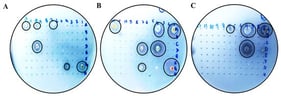
Hydrolysis halos in solid media containing xylan as the sole carbon source. Actinobacteria grown in Petri dishes on a solid medium containing xylan as the sole carbon source (1%) to reveal a hydrolysis halo. (A–C) Visualization of halos. Highlighted in a black circle for better visualization. The strains (A505) Streptomyces sp., (AMSJ45) Streptomyces curacoi, (ARLJ49) Amycolatopsis rhabdoformis, (ACSL1) Streptomyces seymenliensis, (A404) Streptomyces chartreusis, (A465) Streptomyces sp., (ARLJ51) Streptomyces griseoruber, (ARLJ55) Streptomyces sp., (ACJ1) Streptomyces ossamyceticus, (ACJ26) Streptomyces capoamus, (ARLJ48) Streptomyces chiangmaiensis, (A509) Streptomyces deserti, (ACT115) Streptomyces thioluteus, (AE3J64) Streptomyces sp., (A402) Streptomyces sp., (AEPFSRII31) Streptomyces phaeopurpureus, (K18A18) Streptomyces sp. were able to meet the criterion of EI &gt; 2.5.

News & Conferences

Issues

Open for Submission

Editor's Choice

Get Alerted

Add your email address to receive forthcoming issues of this journal.

XFacebookLinkedIn
Microbiol. Res. - ISSN 2036-7481