Skip Content
You are currently on the new version of our website. Access the old version .
  • 19 days
    Time to First Decision

All Articles (130)

This paper investigates the different relaxation channels of a single symmetric top NH3 and a spherical top CH4 molecule trapped at low temperature in a clathrate hydrate nano-cage in the infrared absorption domain of their vibrational degrees of freedom. The approach utilizes the Born–Oppenheimer approximation and the extended site inclusion model applied to CO2 in a previous work, which was based on pairwise atom–atom effective interaction potentials. The calculations show that trapping the methane or ammonia molecule is energetically more favorable in a type sI clathrate structure than in an sII one, and entropic considerations show that methane can be released much more easily than ammonia from clathrate hydrate nano-cages. In the small (s) and large (l) nano-cages with the sI structure, the CH4 molecule exhibits a more or less perturbed rotational motion, while the NH3 molecule shows a strongly hindered orientational motion that tends to a three-dimension librational motion (oscillation motion) around its orientational equilibrium configuration. The calculated orientational energy level schemes are quite different from those of the molecular free rotation. In the static field inside the cage, degenerate ν3 and ν4 vibrational modes of methane and ammonia molecules are shifted and split. Moreover, for ammonia molecules, the ν1 and ν2 modes are shifted, and the inversion motion is no longer allowed. The non-radiative and radiative relaxation channels of CH4, NH3 and CO2 in clathrate nano-cages are discussed with reference to the matrix isolation spectroscopic results. Upon laser excitation, then, from the energy levels calculated for the different degrees of freedom, NH3 and CO2 are expected to fluoresce, while for CH4, non-radiative relaxation should lead to evaporation at the surface of clathrates. Experimental setups are suggested to localize and study these species underneath ice surfaces on distant planets or planetesimals from mobile detectors such as drones or CubeSats equipped with appropriate laser sources and telescopes with 2D imaging detectors.

5 February 2026
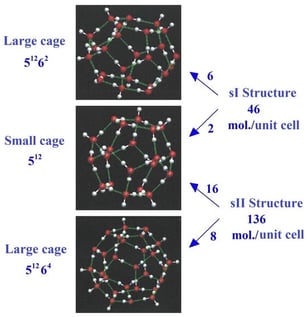
Small and large cavities which form the sI and sII structures of the clathrate hydrate matrices.

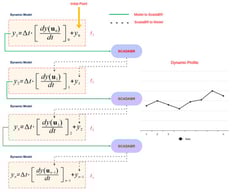
A digital twin (DT) is an automation strategy that integrates a physical plant with an adaptive, real-time simulation environment, with bidirectional communication between them. In process engineering, DTs promise real-time monitoring, prediction of future conditions, predictive maintenance, process optimization, and control. Dashboards for process monitoring are becoming increasingly relevant for tracking key metrics and supervising industrial units in real time. Supervisory Control and Data Acquisition (SCADA) systems are widely used for process automation, with ScadaBR, an open-source, freely licensed platform. This work presents the development of a computational tool that integrates the Aspen HYSYS/Python with the ScadaBR system for real-time monitoring and supervision of dynamic models. The virtual plant, which replicates the system’s physical behavior, was connected to the SCADA platform via the Modbus protocol, enabling bidirectional data exchange between the simulated model and the supervisory interface. The system supports operational analysis and control strategy validation. Two case studies were analyzed: (i) a simplified catalytic hydrocracking process, implemented in the Python environment, and (ii) a heat exchanger networks process, simulated using the HYSYS simulator. In the second case, the process was dynamically simulated, with real-time monitoring of a simple dynamic indicator that correlates the feed methane concentration with heat transfer fluids. The results demonstrate the feasibility and applicability of the proposed approach for educational purposes, operator training, and process engineering validation, fostering a more realistic and interactive simulation environment. Furthermore, the results show that the tool is promising for dynamic monitoring of environmental and energy indices, demonstrating that methane consumption relative to process feed can be evaluated and controlled over time.

5 February 2026

Simplified flowchart of the algorithm used to link ScadaBR and Python (
  
    y
  
: output variables; 
  
    u
  
: input variables).

Livestock operations significantly contribute to global methane (CH4) emissions, a potent greenhouse gas. This occurs primarily through enteric fermentation (a digestive process in ruminant animals that produce methane) and manure management. This review synthesizes the current understanding of the sources of methane within livestock farming systems. It focuses on the primary drivers of these emissions, namely methane production during ruminant digestion and emissions from manure handling. The review also explores the concept of methane sinks, highlighting the processes that remove methane from the atmosphere and their role in the global methane cycle. While natural methane sinks exist, their capacity to offset methane emissions from livestock operations is limited. This review therefore discusses a range of mitigation approaches, categorized into animal and feed management, diet manipulation, rumen manipulation, and advanced technologies. Synthesizing these elements provides a clear understanding of the challenges and opportunities in addressing livestock-related methane emissions. Effective strategies should aim to reduce methane production without negatively impacting animal productivity and health. This emphasizes that addressing sustainable livestock production requires integrated approaches that simultaneously tackle climate change mitigation.

1 February 2026

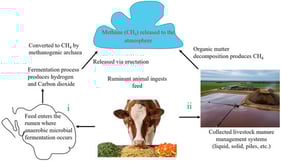
Methane emission pathways in livestock operations. (i) Begins with a ruminant animal ingesting feed, which then enters the rumen where anaerobic microbial fermentation occurs producing H2 and CO2 that methanogenic archaea convert into CH4. (ii) Manure excreted by livestock collected and stored as liquid (lagoons, slurry pits) or solid (piles) decomposes leading to CH4 production.

This study evaluated the effects of ammonium sulfate [(NH4)2SO4] addition and land-use history on greenhouse gas emissions (CH4, CO2, N2O) and inorganic nitrogen dynamics (NH4+ and NO3) in Brazilian Cerrado soils. The objective was to determine how fertilization interacts with native and agricultural soils to regulate key biogeochemical processes. Soil samples from native and agricultural areas were collected in four regions (Araras, Sorocaba, Itirapina, and Brasília), representing contrasting pedoclimatic conditions and soil textures under different cropping systems. Samples were incubated under controlled conditions, with greenhouse gas fluxes analyzed by gas chromatography and inorganic nitrogen concentrations determined by colorimetric methods. Nitrogen fertilization inhibited CH4 consumption in native and agricultural soils and reversed fluxes to emissions in sandy soils. CO2 emissions increased in native soils but decreased in agricultural soils, suggesting effects of soil fertility and carbon stocks. N2O emissions increased mainly in native soils, reflecting intensified nitrification and denitrification, whereas agricultural soils responded heterogeneously. Nitrogen addition altered NH4+ and NO3 consumption, indicating enhanced oxidation and microbial assimilation. These results demonstrate that land-use history influences soil biogeochemical responses to nitrogen, underscoring the importance of site-specific fertilization in mitigating emissions and promoting sustainability in the Cerrado.

30 January 2026

Methane (CH4) fluxes in agricultural (a) and natural (b) soils from four Cerrado sites (Araras, Brasília, Itirapina, Sorocaba) in response to ammonium sulfate [(NH4)2SO4] addition. Boxplots represent mean values (box) and confidence intervals (lines), with points indicating outliers. “No” indicates the absence of nitrogen, and “yes” indicates nitrogen addition. Values are expressed in µg CH4 m−2 h−1, with scales adjusted for agricultural (a) and natural (b) soils. Significant differences (p < 0.05) between treatments are indicated by asterisks (*), while “ns” denotes no significant difference.

News & Conferences

Issues

Open for Submission

Editor's Choice

Get Alerted

Add your email address to receive forthcoming issues of this journal.

XFacebookLinkedIn
Methane - ISSN 2674-0389