Skip to Content
You are currently on the new version of our website. Access the old version .

Metals

Metals is an international, peer-reviewed, open access journal published monthly online by MDPI.
The Spanish Materials Society (SOCIEMAT) is affiliated with Metals and their members receive discounts on the article processing charges.
Quartile Ranking JCR - Q2 (Metallurgy and Metallurgical Engineering)

All Articles (14,673)

AISI 904L stainless steel (904L SS) is a promising material for nuclear power plant primary circuits due to its superior corrosion resistance, but its corrosion behavior under simulated high-temperature and high-pressure water environments with different microstructures remains poorly understood. In order to systematically investigate and clarify the electrochemical behavior and corrosion behavior under stress of 904L SS with three different microstructures (as-received, sensitized, and solution-treated) in a simulated primary circuit water environment of a nuclear power plant, experiments are conducted using dynamic polarization, electrochemical impedance spectroscopy (EIS), and U-bend immersion methods. The results show that temperature has a significant effect on corrosion resistance. As the temperature increases, the impedance of all microstructures decreases significantly, the passivation zone narrows, and the corrosion current density increases. Under high-temperature and high-pressure conditions, the corrosion resistance of the sensitized samples is the worst, while the samples treated with solution have the best overall performance. That is, microstructural optimization through solution treatment can effectively enhance the high-temperature and high-stress corrosion resistance of 904LSS in the primary circuit water environment.

14 February 2026
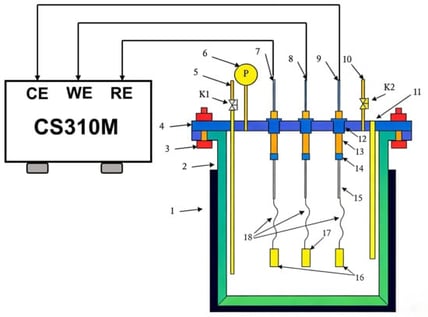
Schematic diagram of high-temperature and high-pressure electrochemical testing apparatus. 1. Autoclave heating jacket, 2. Autoclave body, 3. Fastening bolts, 4. Autoclave end cap, 5. Inlet port, 6. Pressure gauge, 7. Reference electrode, 8. Working electrode, 9. Auxiliary electrode, 10. Exhaust port, 11. Thermocouple insertion port, 12. Electrode outer screw sleeve, 13. Electrode glass tube, 14. Electrode lower end cap, 15. Wire post, 16. Platinum sheet and Ag/AgCl high-temperature electrode, 17. Test electrode sheet, 18. Wire filament.

To explore the improvement of the corrosion resistance of the inner bottom plate of corrosion-resistant storage tank steel and the effects and underlying mechanisms of varying molybdenum (Mo) contents (0Mo, 0.15 wt.%Mo, 0.30 wt.%Mo, and 0.60 wt.%Mo), a systematic study is conducted on the corrosion performance of the steel in a simulated environment (10 wt.% NaCl solution, 30 ± 1 °C). The findings reveal that the steel containing 0.3 wt.% Mo possesses superior corrosion resistance. An optimal dosage of Mo refines corrosion products and fills voids via the formation of nano-scale MoO2/MoO3 particles, mediates the evolution of γ-FeOOH towards α-FeOOH, and improves the protective capability and electrochemical stability of the rust layer. Nevertheless, excessive Mo leads to the residual of elemental Mo arising from incomplete oxidation, which constructs a galvanic cell with Fe, thereby accelerating corrosion. Additionally, an excessively high proportion of MoO3 triggers elevated internal stress and structural degradation of the rust layer.

14 February 2026

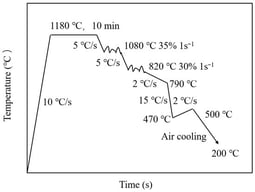
The TMCP used during the preparation of the test steel.

FEM numerical analyses can be indicated as a common and basic tool used in the design of processes based on the plastic forming of metals. In such simulations, the accuracy of the results strongly depends on the quality of the material constitutive data used as the input. Good understanding of metals and their alloys’ deformation behavior, especially at hot working temperatures, is the key to developing or optimizing proper and economical processes. To provide reliable FEM simulation results, it is crucial to select an appropriate experimental method describing material behavior at elevated deformation temperatures. The most commonly method used for this is hot torsion tests, which can effectively provide a basis for developing constitutive models (for example, the Hensel–Spittel equation), but also produce the material constants needed to fully describe the behavior of the metal. This paper analyzes three experimental methods, compression testing, torsion testing, and spherical probe pressing, for determining material flow stress characteristics required for FEM simulations. The study focuses on the EN AW-7075 alloy, a high-strength aluminum alloy with limited hot workability. The methods were validated by comparing FEM predictions of extrusion force and profile temperature with results from industrial extrusion trials conducted on a 5 MN horizontal press.

14 February 2026

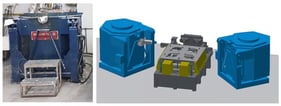
Monometer resistance furnace and semi-continuous casting line.

Magnesium alloys’ poor corrosion resistance limits their applications as biodegradable bone repair materials. Alloying tailors Mg alloys’ microstructure and properties. The present study investigates the effect of 2 wt.% Ag addition on the microstructure and initial corrosion behavior of hot-rolled Mg-1Ca alloy. Mg-1Ca and Mg-1Ca-2Ag alloys were prepared by melting using Mg-2Ca and Mg-4Ag master alloys, followed by homogenization at 400 °C for 2 h, hot rolling, and stress-relief annealing at 400 °C for 6 h. The alloys were systematically characterized using field-emission scanning electron microscopy (FESEM), transmission electron microscopy (TEM), electron backscatter diffraction (EBSD), and X-ray diffraction (XRD). Initial corrosion behavior was evaluated via 3 h immersion tests in simulated body fluid (SBF). Results reveal Ag’s high thermal diffusivity promotes segregation at tensile twin boundaries, forming Ag3Mg nanoparticles. These nanoparticles hinder grain boundary migration and, with increased deformation, facilitate grain rotation and high-angle grain boundary formation, weakening texture. Internal stress accumulation near twin boundaries—driven by grain orientation variation and nanoparticles—induces ~86° rotation of {10–12} tensile twins around the c-axis, forming double twins. During corrosion, nanoparticles and double twins synergistically promote dense protective film formation, significantly reducing corrosion rates.

13 February 2026

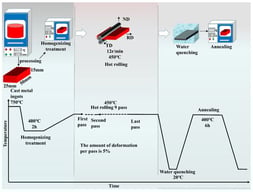
Schematic diagram of the magnesium alloy preparation process.

News & Conferences

Issues

Open for Submission

Editor's Choice

Get Alerted

Add your email address to receive forthcoming issues of this journal.

XFacebookLinkedIn
Metals - ISSN 2075-4701