Skip to Content
You are currently on the new version of our website. Access the old version .

Metabolites

Metabolites is an international, peer-reviewed, open access journal of metabolism and metabolomics, published monthly online by MDPI.

Indexed in PubMed | Quartile Ranking JCR - Q2 (Biochemistry and Molecular Biology)

All Articles (6,312)

The “Movie Theater” Study: Acute Cardiometabolic Effects of a Cinema-Style Meal

  • Jenna K. Schifferer,
  • Alexis R. Quirk and
  • Bryant H. Keirns
  • + 3 authors

Background/Objectives: Meals eaten at movie theaters may have acute, negative health effects due to high refined sugar and moderate sodium content. We aimed to characterize the cardiometabolic response to movie-theater-style meals independently (fasting) and after high-fat meal consumption. Methods: Participants (N = 10; 5M/5F; 18–45 y) completed two meal trials (randomized). At both trials, participants ate a movie-theater-style meal (popcorn, candy, and soda; 884 kcal, 150 g sugar, and 700 mg sodium). At one trial, the movie theater meal was consumed while fasting (Fasting Trial). At the other trial, a high-fat meal (820 kcal; 56 g fat) was consumed 3.5 h prior to the movie theater meal (Fed Trial). Blood was collected (0, 0.5, 1, 2, 3, and 4 h) and endothelial function (i.e., flow-mediated dilation or FMD) was assessed (0, 2, and 4 h) at both trials. Serum metabolic markers (glucose, insulin, triglycerides, and HDL-C) and biomarkers of intestinal permeability (sCD14 and LBP) were measured. Mixed-model ANOVAs (meal × time) and change scores (Δ) were used to compare responses between trials. Results: At both trials, glucose, insulin, and triglycerides increased, while HDL-C decreased (ptime’s ≤ 0.05). ΔInsulin (p = 0.02), but not Δglucose, was higher at Fasting versus Fed. Peak glucose (range = 86–178 mg/dL) and insulin (range = 28.3–307.6 mU/L) were highly variable between participants across trials. Absolute and percent FMD tended to decrease, regardless of trial (ptime’s ≥ 0.08). Conclusions: Overall, the movie theater meal impacted a number of cardiometabolic factors when consumed independently and after a high-fat meal, although there was notable inter-individual variability.

18 February 2026
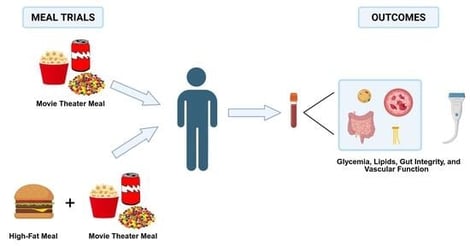
Study Design. Participants completed two meal trials in a random order: the Fasting Trial and the Fed Trial. At the Fasting Trial, serum markers and FMD were measured prior to movie theater meal consumption (BL). Additional blood samples were taken at 0.5, 1, 2, 3, and 4 h, and FMD at 2 and 4 h after the first bite. At the Fed Trial, serum markers and FMD were measured prior to consumption of a high fat meal (BL-0). After meal consumption, participants were allowed to leave for 3 h with instructions to remain sedentary and only consume water. Upon return, the Fed Trial procedures were identical to the Fasting Trial, starting with BL. Abbreviations: BL—baseline; FMD—flow-mediated dilation. Created in BioRender. Keirns, B. (2025) https://BioRender.com/z86j451 accessed on 15 February 2026.

Background: Cultivation environments impose distinct abiotic and biotic stresses that act as primary drivers reshaping the metabolic profile and microbiome assembly of medicinal plants. This study investigates the impact of simulative habitat versus arched greenhouse cultivation on the synthesis of bioactive ginsenosides and the associated root microbiome structure in Panax ginseng. Methods: A combined metabolomics and microbiomics approach was applied to compare ginsenoside accumulation and rhizosphere microbial community composition under the two cultivation modes. Results: Ginseng from simulative habitat cultivation exhibited significantly higher ginsenoside content, particularly ginsenoside Re, compared to arched greenhouse cultivation, with this advantage being more pronounced in long-term cultivation. Microbiome profiling revealed that specific taxa, including Bradyrhizobium, were strongly enriched in simulative habitats and positively correlated with enhanced ginsenoside accumulation, suggesting a microbiome-mediated mechanism for metabolic plasticity. In contrast, arched greenhouse cultivation was associated with a more complex microbial structure characterized by increased negative interactions, which may compromise metabolic quality. Conclusions: These findings, utilizing multi-omics correlations, provide a theoretical basis for optimizing Panax ginseng quality through ecological cultivation strategies that leverage stress-responsive microbe–metabolite interactions.

18 February 2026

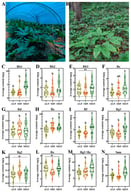
Growth environment and ginsenoside content of P. ginseng. Arched greenhouse cultivation (A) and simulative habitat cultivation (B) of P. ginseng. (C–L): The content of ginsenoside Rb1, Rb2, Rb3, Rc, Rd, Re, Rf, Rg1, Rg2 and Ro. (M): The sum of the contents of ginsenoside Rg1 and Re. (N): The sum of the 10 ginsenoside contents mentioned above. AG5: P. ginseng cultivated in an arched greenhouse for 5 years. SH5: P. ginseng cultivated in the forest for 5 years. SH15: P. ginseng cultivated in the forest for 15 years. Significance was calculated using ANOVA (n = 12). a and b represent p < 0.05.

Background: Pulmonary neuroendocrine cells (PNECs) are rare airway sensory cells implicated in amplifying allergic inflammation, yet due to their scarcity, the contribution of PNECs to the metabolic programs and responses of the airway epithelium remains poorly defined. Using a newly developed PNEC-enriched human airway epithelial model (ePNEC), we investigated the influence of PNECs on neuroendocrine and immune-modulatory metabolite production in response to the common aeroallergen of the house dust mite (HDM). Methods: Human bronchial epithelial cells (HBECs) and ePNEC cultures were differentiated at the air–liquid interface. Global untargeted metabolomics was performed to quantify metabolite abundance at baseline and following stimulation with HDMs. Differential expression, overlap significance, metabolite class enrichment, and pathway analyses were used to define PNEC-specific metabolic programs. Results: Principal component analysis (PCA) demonstrated strong baseline separation between ePNECs and HBECs, with HDMs inducing additional within-cell-type shifts. ePNECs displayed broader and more pronounced metabolite changes than HBECs. Baseline differences were largely preserved following allergen exposure, with significant overlap in both up- and down-regulated metabolites. ePNECs exhibited enriched neurotransmitter-linked metabolites—including serotonin, L-noradrenaline, dopamine, and histamine—at baseline and after HDM exposure. Amino acid–centered metabolism dominated the dataset, with enhanced histidine and tryptophan pathway activity in ePNECs. Pathway analysis revealed significant enrichment of phenylalanine, tyrosine, tryptophan, glutathione, and arginine–proline metabolism in ePNECs, whereas HBECs showed no significant pathway-level enrichment after HDM exposure. Conclusions: Human ePNECs engage a distinct, neuroactive metabolic program that is amplified upon HDM exposure. These findings provide a metabolic framework for how PNECs shape epithelial and neuroimmune responses to inhaled allergens.

17 February 2026

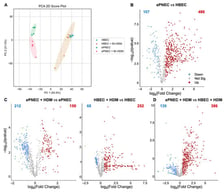
Global metabolic landscape of ePNECs and HBECs. (A) Principal component analysis (PCA) of all detected metabolites showing clear separation between Pulmonary neuroendocrine-enriched human airway epithelium (ePNECs) and Primary human bronchial epithelial cells (HBECs) along PC1 (50.4%), with House dust mites (HDM) stimulation driving additional within-cell-type variation along PC2 (21.0%). Each point represents an individual sample. (B–D) Volcano plots depicting log2FoldChange (FC) on the x-axis and –log10(qvalue) on the y-axis. Comparisons show ePNECs vs. HBECs at baseline (B), ePNEC + HDM vs.  ePNEC, and HBEC + HDM vs. HBEC (C), and ePNEC + HDM vs. HBEC + HDM (D). Numbers and colored dots indicate significantly altered metabolites (FC > 1.5 and False Discovery Rate (FDR)-adjusted q-value threshold < 0.25).

Background/Objectives: Circulating inflammatory cytokines and tissue sensitivity are both elevated following heat stress-induced intrauterine growth restriction (IUGR). Cytokines disrupt myoblast function and muscle growth, and thus we hypothesized that suppressing inflammatory tone in IUGR-born lambs by supplementing anti-inflammatory nutraceuticals would improve early postnatal growth. Methods: IUGR lambs produced by maternal heat stress were supplemented daily with 42 mg/kg oral omega-3 polyunsaturated fatty acid (ω-3 PUFA) Ca2+ salts or placebo from birth to 28 days of age. Results: By day 28, the 21% lighter bodyweights for IUGR lambs were fully resolved by ω-3 PUFA due to the complete recovery of average daily gain. Subcutaneous fat deposition and visceral organ growth were modestly diminished in IUGR-born lambs, but skeletal muscle mass was more markedly restricted. This coincided with 63% less muscle AdipoR2 but 27% greater circulating adiponectin. ω-3 PUFA reduced or eliminated deficits in subcutaneous fat, visceral organs, and five of the six individual muscles assessed, which corresponded with rescue of myoblast populations and AdipoR2 content. In turn, asymmetric growth restriction was resolved at one month of age. Conclusions: These findings show that targeting heightened inflammatory tone during the neonatal period in IUGR-born offspring can recover early growth in skeletal muscle and other soft tissues.

17 February 2026

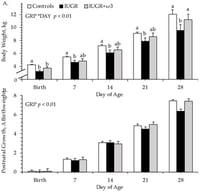
Growth of IUGR-born lambs supplemented daily with oral ω-3 PUFA Ca2+ salts. Data from controls (n = 12), IUGR (n = 11), and IUGR + ω3 (n = 12) lambs are presented for weekly bodyweights (A) and bodyweight changes from birth (B). Effects of experimental group, day, and GRP*DAY were assessed and are noted where significant (p ≤ 0.05). a,b Means with differing superscripts differ (p ≤ 0.05).

News & Conferences

Issues

Open for Submission

Editor's Choice

Get Alerted

Add your email address to receive forthcoming issues of this journal.

XFacebookLinkedIn
Metabolites - ISSN 2218-1989