




- Article

Sperm DNA Fragmentation Is Associated with Impaired Directional Motility and Kinematic Efficiency: A CASA-Based Study
- Ioana Cristina Rotar,
- Richard Buda and
- Mircea Ioan Sandor
- + 5 authors
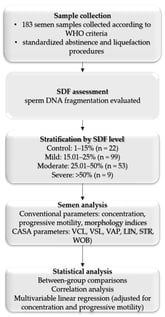
Background and Objectives: Sperm DNA fragmentation (SDF) has emerged as an important marker of male reproductive potential; however, its relationship with sperm kinematic performance remains incompletely understood. While conventional semen analysis primarily evaluates sperm concentration and motility, computer-assisted semen analysis (CASA) enables a more detailed assessment of sperm motility parameters, including velocity, path length, and directionality. Materials and Methods: This observational study included 183 semen samples, stratified by SDF levels into control (1–15%), mild (15.01–25%), moderate (25.01–50%), and severe (>50%) fragmentation groups. Sperm kinematic parameters were assessed using CASA, including curvilinear velocity (VCL), straight-line velocity (VSL), average path velocity (VAP), linearity (LIN), straightness (STR), and wobble (WOB). Group comparisons were performed using ANOVA or Kruskal–Wallis tests, correlation analyses were conducted using Spearman’s rank coefficient, and multivariable linear regression models were applied to evaluate the independent effect of SDF after adjustment for sperm concentration and progressive motility. Results: Parameters reflecting directional motility and movement efficiency differed significantly across increasing SDF categories. VSL, LIN, STR, and WOB showed a progressive decline with higher levels of DNA fragmentation, whereas VCL and VAP did not demonstrate a proportional decrease across groups. Correlation analysis revealed significant negative associations between SDF and VSL (ρ = −0.367, p < 0.001), VAP (ρ = −0.323, p < 0.001), and VCL (ρ = −0.202, p = 0.006), while correlations with LIN, STR, and WOB were negative but not statistically significant. Multivariable regression analysis confirmed SDF as an independent negative predictor of VSL and VAP after adjustment for conventional semen parameters, whereas the association with VCL was no longer significant. Conclusions: Increased sperm DNA fragmentation is associated with impaired sperm motility efficiency and directionality, rather than a uniform reduction in motility. These findings highlight the functional relevance of sperm DNA integrity in shaping sperm kinematic performance and support the complementary use of SDF assessment and CASA parameters in evaluating male fertility.
13 February 2026