
Journal Menu
► ▼ Journal Menu-
- Mathematics Home
- Aims & Scope
- Editorial Board
- Reviewer Board
- Topical Advisory Panel
- Instructions for Authors
- Special Issues
- Topics
- Sections & Collections
- Article Processing Charge
- Indexing & Archiving
- Editor’s Choice Articles
- Most Cited & Viewed
- Journal Statistics
- Journal History
- Journal Awards
- Society Collaborations
- Conferences
- Editorial Office
Journal Browser
► ▼ Journal BrowserNeed Help?
Announcements
22 January 2026
“Do Not Be Afraid of New Things”: Prof. Michele Parrinello on Scientific Curiosity and the Importance of Fundamental Research

In atomic and molecular simulation, researchers have long-needed efficient ways to predict material properties in order to focus on the most promising real laboratory tests instead of redundant work. Addressing this challenge, Prof. Michele Parrinello introduced two transformative methods that have redefined the field: the Car–Parrinello method, which serves as a “virtual lab” for studying reactions and electronic properties, and the Parrinello–Rahman method, a cornerstone for crystal phase transition studies. His work has reshaped the way that we study atomic systems, earning him the status of one of the most cited scholars in his field.
To honor his enduring legacy and continued impact, MDPI has established the Michele Parrinello Award. This award celebrates innovation and recognizes senior scientists who have made outstanding contributions to computational physical sciences, spanning the fields of physics, chemistry, and materials science.
We had the great honor of speaking with Prof. Parrinello in an exclusive interview, where he shared his perspectives on his current research focus, personal scientific experiences, support for basic research, and his advice for global researchers.
Access the full interview to hear his insights in this conversation.
6 November 2025
MDPI Launches the Michele Parrinello Award for Pioneering Contributions in Computational Physical Science
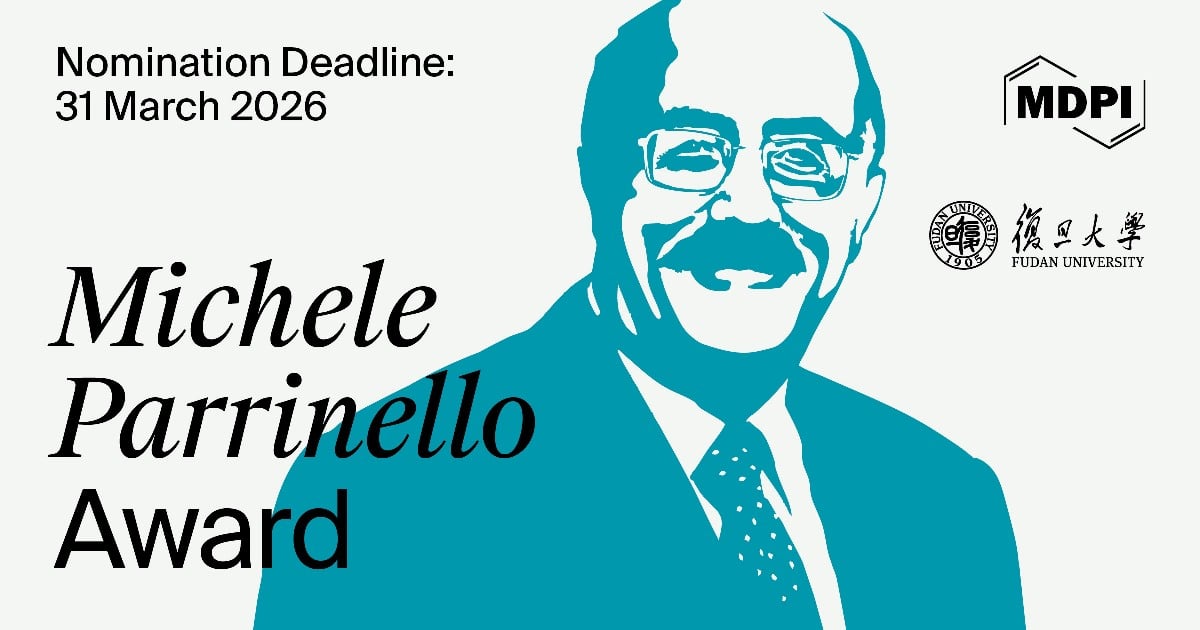
MDPI is delighted to announce the establishment of the Michele Parrinello Award. Named in honor of Professor Michele Parrinello, the award celebrates his exceptional contributions and his profound impact on the field of computational physical science research.
The award will be presented biennially to distinguished scientists who have made outstanding achievements and contributions in the field of computational physical science—spanning physics, chemistry, and materials science.
About Professor Michele Parrinello
"Do not be afraid of new things. I see it many times when we discuss a new thing that young people are scared to go against the mainstream a little bit, thinking what is going to happen to me and so on. Be confident that what you do is meaningful, and do not be afraid, do not listen too much to what other people have to say.”
——Professor Michele Parrinello
 |
Born in Messina in 1945, he received his degree from the University of Bologna and is currently affiliated with the Italian Institute of Technology. Professor Parrinello is known for his many technical innovations in the field of atomistic simulations and for a wealth of interdisciplinary applications ranging from materials science to chemistry and biology. Together with Roberto Car, he introduced ab initio molecular dynamics, also known as the Car–Parrinello method, marking the beginning of a new era both in the area of electronic structure calculations and in molecular dynamics simulations. He is also known for the Parrinello–Rahman method, which allows crystalline phase transitions to be studied by molecular dynamics. More recently, he has introduced metadynamics for the study of rare events and the calculation of free energies. |
For his work, he has been awarded many prizes and honorary degrees. He is a member of numerous academies and learned societies, including the German Berlin-Brandenburgische Akademie der Wissenschaften, the British Royal Society, and the Italian Accademia Nazionale dei Lincei, which is the major academy in his home country of Italy.
Award Committee
 |
The award committee will be chaired by Professor Xin-Gao Gong, a computational condensed matter physicist, academician of the Chinese Academy of Sciences, and professor at the Department of Physics, Fudan University. Professor Xin-Gao Gong will lead a panel of several senior experts in the field to oversee the evaluation and selection process. The Institute for Computational Physical Sciences at Fudan University (Shanghai, China), led by Professor Xin-Gao Gong, will serve as the supporting institute for the award. |
"We hope the Michele Parrinello Award will recognize scientists who have made significant contributions to the field of computational condensed matter physics and at the same time set a benchmark for the younger generation, providing clear direction for their pursuit—this is precisely the original intention behind establishing the award."
——Professor Xin-Gao Gong
The first edition of the award was officially launched on 1 November 2025. Nominations will be accepted before the end of March 2026. For further details, please visit mparrinelloaward.org.
About the MDPI Sustainability Foundation and MDPI Awards 
The Michele Parrinello Award is part of the MDPI Sustainability Foundation, which is dedicated to advancing sustainable development through scientific progress and global collaboration. The foundation also oversees the World Sustainability Award, the Emerging Sustainability Leader Award, and the Tu Youyou Award. The establishment of the Michele Parrinello Award will further enrich the existing award portfolio, providing continued and diversified financial support to outstanding professionals across various fields.
In addition to these foundation-level awards, MDPI journals also recognize outstanding contributions through a range of honors, including Best Paper Awards, Outstanding Reviewer Awards, Young Investigator Awards, Travel Awards, Best PhD Thesis Awards, Editor of Distinction Awards, and others. These initiatives aim to recognize excellence across disciplines and career stages, contributing to the long-term vitality and sustainability of scientific research.
Find more information on awards here.
11 September 2025
Meet Us at Entropy 2026: Exploring Complexity and Information in Science, 1–3 July 2026, Barcelona, Spain
We are pleased to announce that Entropy 2026: Exploring Complexity and Information in Science will be held in Barcelona, Spain, from 1 to 3 July 2026.
This conference, organized by MDPI's open access journal Entropy (ISSN: 1099-4300; IF: 2.0), offers an exciting opportunity to explore cutting-edge advances and foster collaboration in the rapidly evolving fields of fundamental and applied physics, information theory, mathematics, and complex systems. We anticipate that Entropy 2026 will bring together more than 200 participants from around the world.
Topics of Interest:
S1. Complex Systems and Network Science;
S2. Information Theory, Data Science, and Artificial Intelligence;
S3. Quantum Information and Quantum Computing;
S4. Thermodynamics and Energy Systems;
S5. Non-Equilibrium Systems and Entropy Production;
S6. Statistical Physics and Stochastic Processes;
S7. Soft and Living Matter;
S8. Applications of Entropy in Science and Engineering.
Conference Chairs:
- Prof. Dr. Miguel Rubi, University of Barcelona, Spain;
- Prof. Dr. Kevin H. Knuth, University at Albany, USA.
Important dates:
- Abstract submission deadline: 1 March 2026;
- Acceptance notification deadline: 30 March 2026;
- Early Bird Registration Deadline: 31 March 2026;
- Registration: 15 June 2026.
For any enquiries regarding the event, please contact entropy2026@mdpi.com.
We look forward to seeing you at Entropy 2026.


28 February 2026
MDPI INSIGHTS: The CEO’s Letter #32 - MDPI China and Thailand, China Science Daily, 1,000 Partnerships, R2R

Welcome to the MDPI Insights: The CEO's Letter.
In these monthly letters, I will showcase two key aspects of our work at MDPI: our commitment to empowering researchers and our determination to facilitating open scientific exchange.
Opening Thoughts

Reflections from China: Year-End-Celebrations and Open Access Publishing
In February, I had the pleasure of joining over a thousand colleagues from our Tongzhou and Haidian offices at their end-of-year annual celebration in Beijing.
Spending time with our teams in China is also a powerful reminder of the scale and complexity of MDPI as a global organization. Our colleagues in Beijing, Wuhan, and across the country play a significant role in our day-to-day operations and long-term development. I’m grateful for the hospitality, collaboration, and commitment shown by our managers and teams in China, alongside colleagues worldwide, who have helped steadily build MDPI, brick by brick, over the years.
Below are some data on Open Access (OA) publishing in China and our collaboration in this important research market.
Open Access Publishing in China
China has been the world’s leading country in research and review article publication volume since 2019, exceeding one million publications in 2025. Over the past five years, the gap between China and the second-ranked country, the United States, has continued to widen.
In 2025:
- 47% of China’s research output was published Open Access
- Of those OA publications, 76% were Gold Open Access (approximately 382,930 articles)
- The overall OA distribution remained stable compared with 2024, with Gold OA increasing by 1%
Over the past five years (2021–2025):
- China published 4,398,050 research and review articles
- Approximately 48% of this output was OA
According to Dimensions, when comparing the top 20 countries by publication volume (2021–2025):
- China ranks 1st worldwide in publication volume
- China ranks 9th in citation performance within this group (for comparison, the US ranks 2nd in publication volume and 10th in citation ranking)
- Average citations per article: 12.51
Among the top 10 universities globally by publication volume, six are Chinese institutions, alongside Harvard University (USA), the University of São Paulo (Brazil), the University of Toronto (Canada), and the University of Oxford (UK).

MDPI and China
China is an important and long-standing part of MDPI’s global publishing ecosystem:
- In 2025, MDPI was the largest fully Open Access publisher in China
- MDPI published 22% of China’s Gold Open Access output (82,133 papers)
- We received 290,999 submissions from China-affiliated authors and published 82,133 articles
- There are 8,500+ active Editorial Board Members based in China
- 64% (5,438) have an H-index above 26
- MDPI works with:
- 117 Editors-in-Chief
- 103 Section Editors-in-Chief
- 71 China-based institutions currently hold IOAP agreements with MDPI, seven of which rank among the top 10 Chinese institutions by publication volume
China's scale in research output means that the publishing platforms chosen by Chinese scholars will continue to influence the direction of scholarly publishing. At the same time, MDPI’s strength comes from its international collaboration, with colleagues, editors, reviewers, and authors working together across regions and disciplines.
Thank you to all our colleagues in China, and around the world, who support MDPI’s publishing activities across departments and help advance open access research every day.
Impactful Research

“Progress in open science is built through trust, dialogue, and relationships”
Behind the Scenes: A Conversation with China Science Daily
During my trip to Beijing, I also had the opportunity to visit China Science Daily and take part in an interview and broader exchange with their team in Beijing. Visits like this matter because progress in open science is built not only through platforms and infrastructure, but also through trust, dialogue, and relationships across research communities and regions.
China Science Daily: History Museum
As part of the visit, I was given a tour of their History Museum, which offers a thorough perspective on the evolution of China’s first science and technology newspaper, established in 1959. The exhibition highlights how the organization developed into a trusted institution connecting research with the public and policymakers. It was a helpful reminder that at the core of publishing is stewardship, credibility, and long-term public engagement with science.

An Open Exchange on Open Science
During the visit, I met with Dr. Zhao Yan, Editor-in-Chief of ScienceNet. We had an open and engaging conversation about MDPI’s role in Open Access, the evolution of open science globally, and the potential for more collaboration going forward. He especially appreciated the candid and personal nature of our exchange, noting that this kind of dialogue feels important in a landscape where trust and transparency matter.

Interview on Open Access
I also participated in an interview with Ms. Yan Jie, from the Online Media Center and Editor-in-Chief of ScienceNet, China Science Daily. Our discussion covered the growth of Open Access over the past 30 years, MDPI’s mission and values, academic integrity, collaboration with the Chinese research community, and MDPI’s own 30th anniversary milestone. It was a great opportunity to reflect on how open science has matured, and where shared responsibility across publishers, institutions, and researchers continues to matter most.
“Progress in open science is built by more than scale and infrastructure”
I’m sharing a few photos from the visit as a glimpse behind the scenes. The full interview will be published by China Science Daily in due course, and I look forward to sharing it when it is available.

More broadly, visits like this reinforce something I’ve always believed in: progress in open science is built not only through scale and infrastructure, but also through continued dialogue, mutual respect, collaboration, and a willingness to listen across regions and perspectives. That remains central to our work, especially as MDPI reflects on 30 years of publishing, built together.
Inside MDPI

Bangkok Visit: Growth, Partnership, and Local Impact
In February, I also had the opportunity to visit our Bangkok office for the second time in two years to support their local meetings and deliver a training session on how we present MDPI at a corporate level.
It’s easy to spend time with our colleagues in Thailand. From Editorial and Production to Conferences, Marketing, Design, and our Regional Journal Relations Specialist (RJRS), the team continues to grow in scale and professionalism. I’d also like to recognize our local management and admin teams, who have been steadily expanding our office and supporting more than 500 colleagues on the ground.
Academic Partnerships
During the visit, we met with the Engineering Department at King Mongkut’s Institute of Technology Ladkrabang (KMITL). Our discussion focused on the recent MDPI developments, Institutional Open Access Program (IOAP) opportunities, Author Publishing Workshops (APW), and the potential use of JAMS to support their institutional journal.

“MDPI is the third-largest OA publisher in Thailand”
We also shared insights into the growth of Open Access (OA) in Thailand and KMITL’s own publishing trends. These conversations matter because institutions are looking for sustainable ways to support their researchers. Our IOAP agreements are one simple example of how we can provide value in this area while maintaining accessibility for authors.
Thailand and MDPI: 2025 Snapshot
Our Bangkok office, officially launched in 2022, has been growing to support over 500 staff members while continuing to expand its engagement in scholar visits, workshops, and conference collaborations. As at 2025, Thailand submissions to MDPI have increased about 21% and publications by about 25%, maintaining a rejection rate close to the company average. MDPI is the third-largest OA publisher in Thailand, publishing 15% of all Gold OA output in 2025.
Representing MDPI Externally
During the visit, I delivered a training session on how we present MDPI at external events.

This session covered topics related to:
- Our aim and guiding principles
- High-level company milestones and Indexing facts and figures
- Industry partnerships and collaborations
- Market trends in OA and subscription publishing
- Country-specific publishing data and collaborations with MDPI
- Insights from our Voice of Community report
I find that while many colleagues are very familiar with the specific journal for which they have responsibility, fewer have visibility into the broader MDPI ecosystem and the company’s global positioning. These sessions help build alignment, confidence, and consistency in how we represent the company.
What stands out most is that MDPI’s growth is not abstract: it’s visible in the people, the partnerships, and the professionalism developing across our offices.
Coming Together for Science

1,000 Institutional Partners: A Milestone Built on Trust
This month, we reached an important milestone: more than 1,000 institutions worldwide are now part of MDPI’s Institutional Open Access Program (IOAP). On paper, that is a number. In practice, it represents trust.
This milestone symbolizes thousands of conversations with libraries and institutions. It stands for negotiations, renewals, consortium expansions, and, most importantly, relationships built over time. It reflects the work of colleagues across publishing, institutional partnerships, marketing, editorial, finance, and many other teams who contribute to making these agreements operational.
In 2025 alone, more than 61,300 research articles benefited from article processing charge (APC) discounts through IOAP agreements. Tens of thousands of authors were able to publish through a simplified and structured process. At the same time, institutional administrators gained clearer oversight and streamlined workflows.

Why IOAP Matters
When we launched IOAP, the objective was straightforward: to reduce barriers for researchers while supporting institutions in navigating the evolving OA landscape. Over the past decade, the research ecosystem has changed. Funder mandates, national policies, and Plan S–aligned requirements have accelerated the transition to OA.
Institutions need publishing partners who provide transparency, scalability, and operational efficiency. IOAP was designed to support that reality.
For colleagues who would like to better understand the program, this blog-post overview of MDPI’s IOAP provides additional context, including common questions around the transition to OA and how our institutional partnerships are structured.
“Institutions need publishing partners who provide transparency, scalability, and operational efficiency”
Recent Examples
Our agreements continue to evolve across regions:
- In Sweden, MDPI signed a national Open Access publishing agreement with 96 institutions, enabling affiliated researchers to publish without managing individual APC payments.
- In Spain, we extended our flat-fee agreement with Universidad Católica de Valencia, reinforcing institutional support for OA publishing.
These examples show that institutions seek structured, predictable models that support their researchers at scale.
Looking Ahead
Crossing the threshold of 1,000 partners tells us that institutions see MDPI not just as a publisher but as a reliable operational partner in advancing open science. This milestone is not a finish line. It is a reminder that the work continues.
Thank you to the entire IOAP team and to all colleagues who contributed to reaching this achievement.
P.S. You can read about this milestone across industry outlets, including STM Publishing News, ALPSP, Research Information, EurekAlert, Brightsurf, among others. You can also read about the coverage in Poland (e.g., media-room, bomega) Korea (newstap), and Romania (EduLike).
Closing Thoughts

Reflections from the Researcher to Reader Conference
During 24–25 February, I attended the 2026 Researcher to Reader Conference in London, UK. Leaders from across scholarly publishing, research infrastructure, libraries, and technology gathered to discuss AI and research integrity, peer review reform, metadata and infrastructure, community engagement, open research policy, and the evolving role of publishers in a rapidly shifting ecosystem.
The conversations were open and honest, and at times uncomfortable – exactly what we need at times. Below are a few reflections that stayed with me.
The Battle for Knowledge: What Becomes Accepted as ‘True’?
One recurring theme was not whether science evolves but whether our infrastructure is resilient enough to sustain trust at scale. Science does not promise certainty: it promises process. As publishing systems grow more complex and become more technologically mediated, the question is how intentionally we design, monitor, and strengthen that process.
Peer Review: Speed, Credentials, and Structural Loops
Researchers consistently call for faster peer review. At the same time, reviewer credentials are often tied to publication records. This creates a structural loop. Publishing history opens reviewing opportunities, reviewing strengthens credentials, and those without early access remain outside the cycle.
There is a need for us to reflect on how opportunity circulates within our systems: we should ask how we create more inclusive pathways for researchers globally to participate in peer review.
Community Engagement Workshop
One of the highlights of R2R was the workshop format, whereby small groups met repeatedly over two days and moved from ideas to tangible strategies.
I joined the Community Engagement workshop led by Lou Peck (CEO at The International Bunch) and Godwyns Onwuchekwa (Principal Consultant at Global Tapestry Consulting). We explored two deceptively simple questions: What is a community? and What does engagement truly mean?
“Engagement requires shared design and shared responsibility”
Too often, organizations equate communication with engagement. The framework discussed mapped a maturity spectrum – from enablement (broadcasting, informing and consulting) to true engagement (collaborating and co-creating).
It was a useful reminder of the fact that if we want trust and loyalty, engagement must go beyond announcements and surveys. It requires shared design and shared responsibility.
AI: Democratization or Digital Colonialism?
I especially enjoyed the thought-provoking presentation from Nikesh Gosalia (Chief Partnership Officer at Cactus Communications), which highlighted an uncomfortable reality:

- 93% of AI-generated content is in English
- Approximately 2% is in French
- Approximately 2% is in German
- More than 7,000 languages are represented in less than 5% of the content within large AI systems
The implications are profound. Is AI democratizing access to scholarly publishing (making it easier for researchers everywhere to participate in global knowledge production)? Or are we encoding colonialism at scale (entrenching linguistic and structural hierarchies, and making it harder for voices from the Global South to be heard)?
AI is already reshaping how research is created, reviewed, discovered, and shared. Its potential is enormous. But its impact depends not only on capability, but on governance, design, and intentionality. Publishers, funders, and researchers all share responsibility in shaping how these systems evolve.
Ethicality in practice (Lightening Talk)

It was also great to have our colleague Dr Miloš Čučulović (Head of Technology Innovation at MDPI) present MDPI’s Ethicality platform during a lightning talk.
“Technology alone is not the answer”
Ethicality embeds AI-driven checks directly into the submission workflow, supporting editors proactively rather than reacting after publication. As we scale, tools like this help balance trust, efficiency, and research integrity.
This goes back into the underlying theme of the conference that technology alone is not the answer. However, technology embedded thoughtfully within clear governance frameworks can strengthen confidence in the editorial process.
Final thought
The question is no longer whether technology will transform research infrastructure: it is already doing so. The real question is what role each of us will play in shaping that transformation deliberately, with structural maturity, inclusive governance, and engagement that moves from informing to co-creating.
Science needs to evolve, responsibly. And that responsibility extends not only to what we publish, but also to how the systems behind publication are designed. Some important topics to continue reflecting on both internally and within our broader community.
Chief Executive Officer
MDPI AG
27 February 2026
MDPI Webinar | International Day of Mathematics 2026, 13 March 2026

To celebrate International Day of Mathematics 2026, MDPI is hosting a special webinar series that brings researchers together to foster collaboration and highlight the essential role that mathematics plays in advancing knowledge across disciplines. From theoretical foundations to applied innovations, this campaign underscores how the exchange of ideas strengthens our collective understanding and drives meaningful real-world impact. Mathematics is not confined to equations on paper; it shapes technology, informs policy, and fuels discovery in every field it touches.
We very much look forward to welcoming you to the International Day of Mathematics Webinar 2026. Through expert-led sessions and dynamic discussions, this event offers a platform to connect with peers, gain new perspectives, and celebrate the global mathematics community. Please find the latest webinar details and program outline below and join us in marking this important occasion.
Session 1
Date: 13 March 2026
Time: 12:00 CET
Webinar ID: 850 4208 6889
Click here to register!

| Speaker | Time (CET) |
| Introduction | 12:00–12:05 |
| Prof. Dr. Apala Majumdar The Multi-Faceted Applications of Liquid Crystals—a Mathematician’s Perspective |
12:05–12:45 |
| Q&A Session | 12:45–12:55 |
| Prof. Dr. Graham Hall Projective Structure in Geometry and Physics |
12:55–13:35 |
| Q&A Session | 13:35–13:45 |
| Prof. Dr. Huiyu Zhou Image Completion with Context-Adaptive Diffision |
13:45–14:25 |
| Q&A Session | 14:25–14:35 |
| Closing | 14:35–14:45 |
Session 1 Keynote Speakers:
- Prof. Apala Majumdar, Department of Mathematics, The University of Manchester, UK;
- Prof. Graham Hall, Institute of Mathematics, University of Aberdeen, UK;
- Prof. Huiyu Zhou, School of Computing and Mathematic Sciences, University of Leicester, UK.
Session 2
Date: 13 March 2026
Time: 15:00 CET
Webinar ID: 850 4208 6889
Click here to register!
| Speaker | Time (CET) |
| Introduction | 15:00–15:10 |
| Prof. Dr. Jong-Min Kim Counterfactual Q-learning via the Linear Buckley–James Method for Longitudinal Survival Data |
15:10–15:50 |
| Q&A Session | 15:50–16:00 |
| Prof. Dr. Yingjie Liu NNLCI: A Neural Framework for Predicting Smooth and Non-smooth PDE Solutions with Minimal Training Data, Strong Generalization, and Drastically Reduced Complexity |
16:00–16:40 |
| Q&A Session | 16:40–16:50 |
| Prof. Dr. George Anastassiou Multi-composite General Neural Network Approximation Over Finite Dimensional Banach Spaces |
16:50–17:30 |
| Q&A Session | 17:30–17:40 |
| Closing | 17:40–17:50 |
Session 2 Keynote Speakers:
- Prof. Jong-Min Kim, Statistics Discipline, Division of Science and Mathematics, University of Minnesota-Morris, USA;
- Prof. Yingjie Liu, School of Mathematics, Georgia Institute of Technology, USA;
- Prof. George Anastassiou, Department of Mathematical Sciences, University of Memphis, USA.
Session 3
Date: 13 March 2026
Time: 19:00 CET
Webinar ID: 822 1986 2226
Click here to register!
| Speaker | Time (CET) |
| Introduction | 19:00–19:10 |
| Prof. Dr. Huaizhong Zhao Ergodic Theory Under Nonlinear Expectations |
19:10–19:50 |
| Q&A Session | 19:50–20:00 |
| Prof. Dr. Anatoliy Swishchuk Role of pi in Mathematics, Probability and Stochastic Processes: Overview |
20:00–20:40 |
| Q&A Session | 20:40–20:50 |
| Prof. Dr. Palle Jorgensen Reflection Positivity |
20:50–21:30 |
| Q&A Session | 21:30–21:40 |
| Prof. Dr. Youssef Raffoul Necessary and Sufficient Conditions for Stability of Integro-dynamic Equations on Time Scales via Resolvent and Lyapunov Functionals |
21:40–22:20 |
| Q&A Session | 22:20–22:30 |
| Closing | 22:30–22:40 |
Session 3 Keynote Speakers:
- Prof. Huaizhong Zhao, Department of Mathematical Sciences, Durham University, UK;
- Prof. Dr. Anatoliy Swishchuk, Department of Mathematics and Statistics, University of Calgary, Canada;
- Prof. Palle Jorgensen, Department of Mathematics, University of Iowa. USA;
- Prof. Dr. Youssef Raffoul, Department of Mathematics, University of Dayton, USA.
20 February 2026
MDPI Virtual Academic Publishing Workshop (New Harvest), 25 February 2026
This Academic Publishing Workshop will be led by MDPI Regional Journal Relations Specialist, Dr. Sally Wu, on “Author Training”. Participants will receive practical advice on essential aspects of writing academic articles. Participants will leave with a clearer understanding of the academic publishing landscape and how to successfully contribute to it.
Date: 25 February 2026
Time: 11:30 a.m.–1:30 p.m. EST
Schedule:
|
Speaker |
Program |
Time in EST |
|
Dr. Sally Wu |
Introduction |
11:30–11:40 a.m. |
|
Dr. Sally Wu |
Tips for Writing Great Research Papers
|
11:40 a.m.–12:15 p.m. |
|
Dr. Sally Wu |
How to Respond to Peer Reviewers
|
12:15–12:50 p.m. |
|
Dr. Sally Wu |
AI in Publishing: Challenges and Opportunities
|
12:50–13:30 p.m. |
Speakers:
|
|
Dr. Sally Wu received a PhD in medical science from the University of Toronto in the fall of 2025. She joined MDPI in February 2025 as an Assistant Editor for Cells. She was recently promoted to Regional Journal Relations Specialist position in August. In this role, she works with many journals, liaising with authors, board members, and EiCs. She has attended several conferences across North America, hosted scholar visits, and taken part in other outreach events. |

18 February 2026
MDPI’s Open Access Program Reaches 1,000 Institutions Worldwide

MDPI has surpassed the milestone of 1,000 partners within the Institutional Open Access Program (IOAP). The agreements span 59 countries, covering North and South America, Europe, Asia, Africa, and Oceania.
Last year alone, more than 150 new libraries and academic institutions joined MDPI’s IOAP. With the expansion of an existing consortium deal in Sweden we welcomed a further 75 partners to the program in January 2026, enabling us to surpass the 1,000-partners milestone.
The IOAP supports affiliated researchers by streamlining submission processes, reducing administrative burdens, and offering discounted Article Processing Charges (APCs). Through IOAP membership, more than 61,300 research articles received APC discounts in 2025, driving greater visibility and accessibility for partner institutions and global research communities alike.
"This milestone marks a significant step towards expanding MDPI’s global impact," said Stefan Tochev, MDPI's CEO. "Reaching 1,000 IOAP partnerships is a true testament to the growing trust and collaboration we’ve built with universities, libraries, and research organizations worldwide. We are proud to lead the way in Open Access publishing, ensuring researchers have the support they need to reach global audiences." "The success of our program is reflected in the growing global demand for Open Science and quality publishing services," said Becky Castellon, MDPI institutional partnerships manager. "Equally, institutions are increasingly seeking Open Access publishing options that support funder and national mandates. Joining the IOAP makes compliance simple."
6 February 2026
Interview with Dr. Federico Nudo—Winner of the Mathematics Travel Award

The journal Mathematics (ISSN: 2227-7390) is proud to present the winner of the Mathematics 2026 Travel Award—Dr. Federico Nudo!
Dr. Federico Nudo is a postdoctoral researcher specializing in the intersection of approximation theory, numerical analysis, and finite element methods. He earned his PhD through a joint program between the University of Calabria and Université de Pau et des Pays de l’Adour. Following his doctorate, he conducted postdoctoral research at the University of Padova and currently holds a prestigious European Union-funded research contract. His research focuses on developing novel numerical schemes to handle challenging problems involving singularities or oscillatory structures.
The following is a short interview with Dr. Federico Nudo:
1. Could you give a brief introduction of yourself to the readers? Could you introduce your current research direction and provide an update on your progress?
My name is Federico Nudo. I completed my PhD in a cotutelle program between the University of Calabria in Italy and the University de Pau et des Pays de L'adour in France, under the supervision of Professor Francesco Dell'Accio and Professor Allal Guessab. During my PhD, my research focused on polynomial approximation theory, with particular attention to interpolation problems in several dimensions, orthogonal polynomials, and finite element methods.
Before starting my PhD, I was awarded a three-month research grant in Lugano, Switzerland, where I worked on the development of my master’s thesis. After completing my PhD, I held postdoctoral positions in Padova and at the Institute of High Mathematics in Italy. In Padova, my research activities were mainly devoted to interpolation and related approximation techniques.
I am currently a postdoctoral researcher in Calabria, where I continue working on polynomial approximation, orthogonal polynomials, local and global approximation problems, and finite element and least-squares-type methods.
2. Based on your experience, which research topics do you think are of particular interest to the research community in the coming years?
Rather than singling out one specific topic as more important than others, I believe that a particularly promising direction for the research community in the coming years lies in the interaction between well-established mathematical theories and emerging problems arising from modern applications. In particular, the development of numerical and approximation methods that are both theoretically sound and computationally efficient will continue to be of great interest, especially in high-dimensional and locally adaptive settings.
3. Could you introduce the core content of your conference presentation at NUMTA 2026 conference and what you hope to contribute or gain from the discussion?
The work I intend to present at the NUMTA 2026 conference, titled “Truncated Gegenbauer–Hermite Weighted Approach for the Enrichment of the Crouzeix–Raviart Finite Element”, recently published in BIT Numerical Mathematics in collaboration with F. Dell’Accio, A. Guessab and G. V. Milovanović, is a clear example of this approach. In this paper, we propose two families of weighted polynomial enrichments for the classical Crouzeix–Raviart finite element, designed to enhance its approximation power when reconstructing bivariate functions from integral data. The enrichment functions are built using exponential Gegenbauer–Hermite weighted polynomials, depending on two real parameters, σ > 0 and λ > −1/2, which allow the basis to adapt to specific features of the function being approximated. Numerical experiments demonstrate a significant gain in accuracy compared to standard finite element methods, particularly in handling functions with rapid variation or low smoothness.
This work is also deeply connected to the theory of orthogonal polynomials—a subject in which Prof. Gradimir V. Milovanović, one of the co-authors, is a world-renowned expert. His guidance and insights have been fundamental in the development of the weighted framework that underpins this contribution. The fusion of classical polynomial theory with modern numerical techniques is at the heart of this research and reflects the kind of interdisciplinary dialogue.
NUMTA 2026 provides an ideal platform for presenting this work, as its themes encompass not only advanced numerical methods but also their philosophical and theoretical foundations. The conference’s openness to a broad range of computational paradigms and its emphasis on modeling in nature make it particularly relevant to the mathematical framework developed in our paper. Participating in NUMTA would allow me to exchange ideas with a wide community of researchers, gain valuable feedback, and initiate new collaborations that build upon the synergy between approximation theory and numerical computation.
4. Can you please share with us your sentiments about winning the award? Where do you obtain information about participation in journal awards?
Winning the award is extremely important to me, both professionally and personally. It is an international prize evaluated by a strong and independent committee, which makes it particularly meaningful for my CV. The Mathematics Travel Award is especially valuable because it enables me to attend conferences that I could not otherwise afford due to limited financial support.
I learned about the awards directly through the journal’s website and communication. The application process was very intuitive and accessible, which I truly appreciated. I also value that the committee evaluates the applications seriously and fairly, independent of whether candidates have published them in the journal before.
5. What is your opinion on the open access model of publishing?
I strongly support the open access publishing model. In today’s world, science should be accessible to everyone. Keeping research behind paywalls no longer makes sense, especially when information can often be found through unofficial channels. Open access ensures equal opportunities for researchers and readers worldwide and reflects the idea that science belongs to the entire community.
6. What inspired you to pursue mathematics, and were there pivotal moments or mentors who guided your path? As the winner of this award, is there something you want to express or someone you wish to thank most?
I was inspired to pursue mathematics during high school, mainly thanks to an excellent and passionate teacher in my final years who motivated me deeply. Another pivotal experience was participating in university-level mathematics courses for high school students organized by the University of Calabria, where I encountered inspiring lectures on probability and complex analysis.
As the winner of this award, I would like to sincerely thank the entire committee, the Editorial Board and everyone involved in organizing and promoting the award. I am also grateful for the clear communication and email notifications, which make these opportunities accessible to young researchers like myself.
4 February 2026
Acknowledgment to the Reviewers of Mathematics in 2025

The editorial office of Mathematics would like to extend its sincere gratitude to all reviewers who contributed to the improvement of the journal quality by providing their expert opinion and evaluation of the submitted research.
We appreciate that thorough peer review demands considerable time and intellectual investment from our reviewers. In 2025, Mathematics received 22848 review reports from contributors across 126 countries and territories, demonstrating the breadth of international expertise and scholarly engagement that has strengthened our publication standards.
The reviewers who agreed to have their names published this year are listed below in alphabetical order by first name. The editorial team acknowledges with gratitude all reviewers, named and anonymous alike, for their vital role in maintaining the scholarly standards of Mathematics.
| Aajaz Ahmad Teali | Herman Yuliansyah | Peter Anuoluwapo Gbadega |
| Aamir Rashid | Herwin Huillcen | Peter Mola Makolo |
| Abbas J. Sultan | Hesam Varaee | Péter Veres |
| Abdelati El Allaoui | Hezhi Lu | Petra Bevandić |
| Abdelbasset Felhi | Hilaire Nzokem | Petro Pukach |
| Abdelghani Lakhdari | Hilal Hudan Nuha | Petru Aurelian Simionescu |
| Abdelghani Ouahab | Hiram Calvo | Phakdi Charoensawan |
| Abdelhakim Dorbane | Hiroki Hashiguchi | Philippe Van Bogaert |
| Abdelhalim Saadi | Hoi Leong Lee | Pier Nicola Sergi |
| Abdelkader Aguir | Ho-Joon Lee | Pierpaolo Angelini |
| Abdelkader Belhenniche | Homa Saeidfirozeh | Piotr Marek Marusak |
| Abdelkrim Moussaoui | Hongjun Li | Piotr Mieczysław Ciepliński |
| Abdellatif Jarjar | Hongjun Xing | Piotr Nowak |
| Abdelnaser Omran | Hongli Yang | Pitipat Nittayakamolphun |
| Abdelouahab Moussaoui | Hongmei Chen | Pokpong Songmuang |
| Abdelouahed Alla Hamou | Hongwei Zhang | Pooria Kianoush |
| Abdelwahhab Khatir | Horacio Rostro-Gonzalez | Porfirio Toledo |
| Abderrahim Waga | Hossein Azgomi | Potula Sree Brahmanandam |
| Abdu Alameri | Hossein Ghaffarnejad | Pouriya H. Niknam |
| Abdulghani Muhyi | Hossein Lotfi | Pouya Faroughi |
| Abdullah Alsoboh | Hossein Maleki Toulabi | Pouyan Fakharian |
| Abdullah Mohammad Ghazi Al Khatib | Hossein Rostami Najafabadi | Prabakaran Raghavendran |
| Abdulrahman Mawlood Abdulghani | Hossein Yarahmadi | Prabhu Sethuramalingam |
| Abhijit Datta Banik | Houssem Achouri | Pragnyaban Mishra |
| Abhilash Pati | Hranislav Stanković | Pramodkumar P. Gupta |
| Abhishek Sharma | Hsin-Wei Hsu | Prasenjit Mandal |
| Abhishek Tyagi | Huainian Zhu | Prashant R. Nair |
| Abootaleb Shirvani | Huan Zhang | Pratibha Verma |
| Achmad Rizal | Huangling Gu | Praveen Kumar Sekharamanitry |
| Adam Heyduk | Huanjie Tao | Predrag Ivaniš |
| Adan Ramirez-Lopez | Huashui Zhan | Preeti Rani |
| Addisu Jember Zeleke | Huda Ali Aldweby | Pritam Dey |
| Adeb Ali Mohammed Salh | Hugo Cruz-Suárez | Priyadarsan Parida |
| Adedibu Sunny Akingboye | Hugo Jimenez Hernandez | Przemysław Kowalik |
| Adejimi Adeniji | Hugo Luiz Mariano | Purna Prakash Kasaraneni |
| Adel Shirazy | Hugo Martiniano | Putthiporn Thanathamathee |
| Adetayo Olugbenga Onososen | Huilong Fan | Qaisar Ali |
| Adeyemi Adegoke Adeleke | Hüseyin Tayyer Canseven | Qasim Khan |
| Adham Salih | Hyeri Hong | Qi Xiong |
| Adil Jhangeer | Hyoung-In Lee | Qiang Yang |
| Adimoolam Malaiyalathan | I. Nyoman Apraz Ramatryana | Qiang Yu |
| Adirak Kanchanaharuthai | Iaroslav M. Pasternak | Qiang Zhang |
| Adis Puška | Ibtissam Bakkouri | Qingjun Zhao |
| Aditya Mahatidanar Hidayat | Igor Anureev | Qing-Wen Wang |
| Adnan Ahmad Mahmud | Igor Gluhih | Qingxiang Meng |
| Adnan Mohsin Abdulazeez | Igor Gritsiuk | Qiong Li |
| Adrian Popa | Igor Kondrashuk | Qiru Wang |
| Adrián Rodríguez Ramos | Igor Litvinchev | Qi-Xian Huang |
| Adrian Stancu | Igor Todorović | Qizhang Luo |
| Adrian Vilcu | Ihor I. Demkiv | Quang Hung Do |
| Adriana Naydenova Borodzhieva | Ijaz Khan | R. Dhineshbabu |
| Adriano N. Raposo | Ikhlef Jebbor | R. Elakkiya |
| Afis Saliu | Ilia Safonov | R. Janagaraj |
| Agata Gniadkowska-Szymańska | Ilyos Khujayorov | R. Kamalakannan |
| Agatha Clarice Da Silva-Ovando | Imad Kissami | R. Maheswar |
| Agbotiname Lucky Imoize | Imam Mustafa Kamal | R. Seetharaman |
| Aghil Shavalipour | Iman Malmir | R. Siva Subramanian |
| Agnieszka Blokus-Dziula | Imre Ferenc Barna | Rabia Riad |
| Agnieszka Malgorzata Zbrzezny | Imtiaz Ahmad | Rabin Chakrabortty |
| Ahmad Adel Abu-Shareha | Ioannis Antoniou | Rabindra Kumar Jena |
| Ahmad Alshorman | Ioannis Athanasios Bartsiokas | Rachana Jaiswal |
| Ahmad Faiz Minai | Ioannis S. Stamatiou | Rada Mutavdzic Djukic |
| Ahmad Ghiaskar | Ion Cornel Mituletu | Radwan Mohammed Al-Omary |
| Ahmad Hajatzadeh Pordanjani | Ion Mihai | Rafael Avanço |
| Ahmad Rezaee Jordehi | Ionut Nica | Rafael E. Vásquez |
| Ahmad Saeed Mohammad | Irik Mukhametzyanov | Rafael Guillermo García-Cáceres |
| Ahmad Yamin Rasa | Irina Daniela Cismasu | Rafael Haag |
| Ahmadjan Muhammadhaji | Irina Kochetkova | Rafał Rak |
| Ahmadreza Montazerolghaem | Irina Meghea | Rafik Lasri |
| Ahmed Aberqi | Irving Paputungan | Ragavesh Dhandapani |
| Ahmed Adnan Zaid | Irwan Ary Dharmawan | Raghav Prasad Parouha |
| Ahmed Al Mansur | Isaí Barboza-Ramos | Raghavendar Kondooru |
| Ahmed Bensaoud | Isak Karabegović | Raghed Ibrahim Esmaeel |
| Ahmed Cardona | Islambek Saymanov | Ragul Ravi |
| Ahmed Elsayed | Ismail A. Mageed | Raheam Al-Saphory |
| Ahmed Ghezal | Ismail Nikoufar | Rahim Ali Abbaspour |
| Ahmed K. Jameil | Isnaini Rosyida | Rahmatullah Ibrahim Nuruddeen |
| Ahmed Mohammed Sami Al-Janabi | Issa Atoum | Rajaa Saidi |
| Ahmed Mohsen | Issam Hanafi | Rajan Chattamvelli |
| Ahmet Durap | István Üveges | Rajesh Kumar |
| Ahmet Emin | Isyaku Muhammad | Rajkishor Kumar |
| Ahmet Saymbetov | Iván Juan Carlos Pérez Olguín | Raju Patel |
| Aikaterini Aretaki | Ivan Matveev | Rajveer Shastri |
| Aimi Salihah Abdul Nasir | Ivan Rozhnov | Ralf Hofmann |
| Ajay Sharma | Ivan Toplica Ciric | Raman Kumar |
| Akbar Ergash Ugli Rashidov | Ivanna Dronyuk | Ramesh Chandra Das |
| Akbar Rezaei | Ivo Siekmann | Ramesh Kumar Vats |
| Akeel Almagtome | Ivo Sousa-Ferreira | Ramon Ramirez-Villalobos |
| Akhlaq Husain | J. Arun Pandian | Raneem Qaddoura |
| Akhmad Habibi | J. Sebastian Terence | Ranganathan Rani Hemamalini |
| Akshay Kumar | Jabbar Abbas | Ranjit Ranbhor |
| Alaa A. Abdallah | Jaeseung Baek | Raquel Ochoa Ornelas |
| Alaa Eleyan | Jaka Sriyana | Rashed Kaiser |
| Alaaeddine Lahbas | Jakub Keller | Rastislav Róka |
| Albena Doicheva | Jalal Javadi Moghaddam | Rasul Kochkarov |
| Albert Bobin | James F. Whidborne | Ratnakar Das |
| Alberto Gudiño-Ochoa | Jamileh Seyed-Yazdi | Raúl Alberto Reyes Villagrana |
| Aldo Tamburrino | Jamolbek Mattiev | Raul Gismeros Moreno |
| Alejandra Guadalupe Silva Trujillo | Jan Cieśliński | Raul Matsushita |
| Alejandro Fuentes-Penna | Jani Dugonik | Raúl Temoltzi-Ávila |
| Aleksandar Dimitrijevic | János Botzheim | Ravindra Madhukar Moharil |
| Aleksandar Milić | János D. Pintér | Raymond Ghandour |
| Aleksandar Stanimirovic | Janusz Miśkiewicz | Rayna Georgieva |
| Aleksandr O. Smirnov | Jaroslav Marek | Reggie Pantig |
| Aleksandr Rakhmangulov | Jatinder Manhas | Reinoud Jan Slagter |
| Aleksandr Romanov | Javad Alavi | Rekha Guchhait |
| Aleksandra Bartosiewicz | Javad Vahidi | Renato R. Maaliw III |
| Aleksey Filippov | Javed K. Sayyad | Renjith V. Ravi |
| Aleksey Kabanov | Javier Rodriguez-Herrejon | Renming Yang |
| Alessandra Querino Da Silva | Jay Jahangiri | Reza Parvaz |
| Alessandra Retico | Jayendra Kumar | Reza Shahin |
| Alex Piccioni | Jean Claude Ndayishimiye | Riaz-Ul-Haque Mian |
| Alex Povitsky | Jegadeeshwaran Rakkiyannan | Ricardo Cajo |
| Alex Vano-Vinuales | Jegan Rajendran | Ricardo Fabricio Escobar Jiménez |
| Alexander Chupin | Jelena Stojanov | Ricardo Pires |
| Alexander Evgen'evich Teretenkov | Jennie Golding | Riccardo Scodellaro |
| Alexander Feoktistov | Jens Kai Perret | Rina Ristiana |
| Alexander Kazakov | Jerzy Rosłon | Riyadh Bouddou |
| Alexander Kryukov | Jessica S. Ortiz | Riza Andrian Ibrahim |
| Alexander Lyapin | Jesus E. Garcia | Robert Ipanaqué-Chero |
| Alexander Robitzsch | Jesús Everardo Olguín-Tiznado | Róbert Skapinyecz |
| Alexander Shapovalov | Jesús García Díaz | Robert Sousa |
| Alexander V. Glushkov | Jesús M. Barraza-Contreras | Roberto Gueli |
| Alexandr Romanenkov | Jesus Medrano-Hermosillo | Roberto I. Fuentes |
| Alexandr Yurevich Petukhov | Jhonny Rodrigues | Rodolfo Bojorque |
| Alexandra Georgiana Gerea | Ji Eun Kim | Rogério Serôdio |
| Alexandra Solodchuk | Jia Mao | Roman Dmytryshyn |
| Alexandre Landry | Jiabin Zuo | Roman Ivanov |
| Alexandru-Gabriel Tudorache | Jiahao Diao | Roman Rodriguez-Aguilar |
| Alexei A. Deriglazov | Jiajia Shi | Roman Voliansky |
| Alexey Fomin | Jia-Lang Xu | Romeo Marin Marian |
| Alexey G. Voloboy | Jian Gu | Romil Rawat |
| Alexey I. Shinkevich | Jian Liu | Ronald Manríquez |
| Alexey Karpov | Jian Wang | Ronald Sukwadi |
| Alexey Mashtakov | Jian Yang | Ronaldo Thibes |
| Ali Abghari | Jianbo Feng | Ronan Joseph Le Bras |
| Ali Al-Allawee | Jianchao Bai | Rony Teguh |
| Ali Asghari | Jian-Guo Liu | Rosana Rego |
| Ali Ebrahimijahan | Jianhua Wu | Rosanna Campagna |
| Ali Fareed Jameel | Jianjun Jiao | Rotimi-Williams Bello |
| Ali Foroutannia | Jianping Sun | Ruben Ruiz-Gonzalez |
| Ali Hasan Ali | Jianqiang Xie | Ruben Ruiz-Torrubiano |
| Ali Majeed Mahmood | Jiapeng Liu | Rufaizal Che Mamat |
| Ali Nourollah | Jiawei Xiong | Rui Araújo |
| Ali Shojaei-Fard | Jiawen Li | Rui Cao |
| Ali Sorourkhah | Jiayin Lu | Rui Deng |
| Aliaksey A. Kapanski | Jie Feng | Rui Dong |
| Alicja Jokiel-Rokita | Jie Jin | Rui Zhang |
| Alireza Goli | Jie Zheng | Rui Zhong |
| Alireza Rezvanian | Jiexin Tang | Ruiyuan Huang |
| Alison Marr | Jihad Younis | Runyuan Guo |
| Aliya Bayakhmetova | Jiju Gillariose | Ruobin Wang |
| Alla Levina | Jinduo Liu | Rupesh Kumar Tipu |
| Allan Ranieri Pereira Moreira | Jing Hu | Ruslan Kravets |
| Alma Y. Alanis | Jing Li | Ruslan Shevchuk |
| Amadou Diop | Jing Liu | Ruslan Smeliansky |
| Aman Garg | Jing Xu | Ryuji Ishizaki |
| Amar Nath Chatterjee | Jingcao Cai | S. Kanaga Suba Raja |
| Ambreen Shafqat | Jinglei Liu | S. Kumar Balakrishnan |
| Amer Morshed | Jinhu Xu | S. N. V. Bramareswara Rao |
| Amin Jajarmi | Jinjie Liu | S. Phani Praveen |
| Amir Mehdiabadi | Jinlian Ren | S. Rajeshkannan |
| Amir Najibi | Jinlong Li | S. Vinoth |
| Amir R. Masoodi | Jinnan Zhang | Saad Khadar |
| Amira B. Sallow | Jiongran Wen | Saad Talib Hasson |
| Amit Avhad | Jize Zhang | Saber Arabi Nowdeh |
| Amit Kumar | João Lagarto | Sabri My Abdelouahed |
| Amrik Singh Phuman Singh | João Manuel Gonçalves Cabral | Sabri T. M. Thabet |
| Amrita Kundu | João Paulo Martins | Sachin Kumar |
| Ana Gabriela Haro | Jochen Merker | Sachindra Kumar Rout |
| Anam Nawaz Khan | Jochen Staudacher | Saddaf Rubab |
| Anamaria Ilie | Joel Weijia Lai | Sadeq Taha Abdulazeez |
| Anand Kumar Yadav | Johan Augusto Bocanegra Cifuentes | Saeed Hashemi Sababe |
| Ananda Shankar Datta | John Reyes | Saeed Mojtabazadeh-Hasanlouei |
| Anandhavalli Muniasamy | Jonathan Hernandez-Capistran | Saeid Jafari |
| Anass Kharbouche | Jonathan Michael Blackledge | Saeid Jafarzadeh Ghoushchi |
| Andang Sunarto | Jordi Ripoll | Safanah Mudheher Raafat |
| Andi Trimulyono | Jorge A. Ruiz-Vanoye | Sagvan Musa |
| Andranik S. Akopov | Jorge Alberto Márquez | Sahar Ebadinezhad |
| André Andrade Longaray | Jorge Alfredo Esquivel-Avila | Sahbi Chaibi |
| Andrea Lincoln Piroddi | Jorge Caravantes | Saher Albatran |
| Andrea Rožnjik | Jorge De Andrés-Sánchez | Sahil Nokhwal |
| Andreas C. Georgiou | Jorge Flores-Troncoso | Said Bouchkaren |
| Andreas Kalogeropoulos | Jorge Pereira Fatelo | Said El Kafhali |
| Andreas Wichert | Jose Alberto Hernandez-Aguilar | Said Gaci |
| Andrei Karatkevich | José Alberto Rodrigues | Sajad Iqbal |
| Andrei Kartoziia | Jose Alfredo Brambila | Sakthivel Gnansekaran |
| Andrei V. Panteleev | Jose Alfredo Ruiz Vargas | Salam Al-E'mari |
| Andreia Dionisio | Jose Anand | Salawudeen Ahmed Tijani |
| Andrew Mutsvangwa | José Angel Vásquez Coronel | Salem Saidi |
| Andrey Afanasiev | José Antonio Hernández-Torres | Salman Saeidlou |
| Andrey Ivantsov | José Antonio Reyes-Suárez | Salomon Marthinus Millard |
| Andrey K. Gorshenin | José Gabriel Ríos Moreno | Saloua Senhaji |
| Andrey Kazak | Jose L. Alvarez-Flores | Salvatore Mignemi |
| Andrey Morgulis | Jose Luis Chavez-Hurtado | Salvatore Russotto |
| Andrey V. Lychev | José Luis Echenausía Monroy | Samad Kheybari |
| Andrii V. Kondratiev | Jose Luis Ordoñez-Avila | Samajh Singh Thakur |
| Andriy Zagorodnyuk | José Manuel Campos-Salazar | Samarendra Nath Sur |
| Andrzej Popenda | José Manuel Escorcia Tafur | Samer Aabdulateef Waheeb |
| Anel A. Kireyeva | José R. García-Martínez | Samer Al Ghour |
| Angel Akio Tateishi | José Ramón Trillo | Samingun Handoyo |
| Angel C. Herrero | José Renato Mendes De Sousa | Samir Abood |
| Angel Israel Soto Marrufo | Jose Vicente Riera | Samiran Chakraborty |
| Angel Saul Cruz-Ramirez | José-Joel Gonzalez-Barbosa | Sampath Dakshina Murthy Achanta |
| Angelo Marcelo Tusset | Joseph Malinzi | Sang Truong Ha |
| Angshuman Khan | Jothimani Ravichandran | Sangita Yadav |
| Anh-Tuan Tran | Józef Wiora | Sania Asif |
| Anibal Coronel | Juan Alberto Ramirez-Quintana | Sanjib Biswas |
| Anil Kumar Jonnalagadda | Juan De Dios Sanchez-Lopez | Sanjoy Basu |
| Aniruddha Bhattacharjya | Juan Diego Sánchez-Torres | Sankar Prasad Mondal |
| Aniruddha Rajendra Rao | Juan José Fernández-Durán | Sankar Sarkar |
| Anjali Awasthi | Juan L. Mata-Machuca | Sanoj Kumar |
| Anna Jodejko-Pietruczuk | Juan M. Xicoténcatl-Pérez | Santan Kumar |
| Anna Lempert | Juan R. Gomez | Santiago Daniel Puma-Araujo |
| Anna Rita Sambucini | Juan-Manuel Ramirez-Cortes | Santosh Kumar |
| Anni Zhao | Jue Wang | Santosh Kumar Sahu |
| Annibal Parracho Sant’Anna | Julee Shahni | Santosh Reddy Addula |
| Anton Eremin | Julien Moussa H. Barakat | Saori Chiba |
| Anton Romanov | Julio Cesar Ramos-Fernández | Sapan Tiwari |
| Antonieta Martínez-Velasco | Jun Ni | Sara Mahmoudi Rashid |
| Antonio Concha | Jun Yang, Beihang University, China | Sara Santos |
| Antonio Di Crescenzo | Jun Yang, Xianyang Normal University, China | Saravanan Gunasekar |
| Antonio Gaspar-Cunha | Junfeng Lu | Saravanan Krishnan |
| Antonio Marco-Ferreira | Junjie Jiang | Sarfaraz Hashemkhani Zolfani |
| António Melo | Junjie Li | Saroj Kumar Panigrahy |
| Antonios Kalampakas | Junkai Wang | Sathish Kumar Marappan |
| Antonyswamy Robert Singh | Junming Chen | Sathish Kumar Selvaperumal |
| Anurag Dutta | Junsheng Zhao | Satla Zouaoui |
| Anwar Shahid | Junying Li | Satoshi Uchida |
| Aparna Satsangi | Jyothsna Kanithi | Sattianadan Dasarathan |
| Apichit Maneengam | K. Arathi Bhat | Satwinder Singh |
| Arangarajan Vinayagam | K. Hemant Kumar Reddy | Satyadhar Joshi |
| Arash Mousaei Alyar | K. K. Viswanathan | Satyendra Narayan |
| Arash Shams Taleghani | K. Karthick | Sa'ud Al-Sa'di |
| Arban Uka | K. V. Santhosh | Saúl Díaz-Infante |
| Ardak Nurpeisova | Ka Zhang | Saúl Zapotecas-Martínez |
| Ardianto Satriawan | Kadhavoor R. Karthikeyan | Saurabh Bilgaiyan |
| Aree Ali | Kadhim K. Resan | Sayantan Guha |
| Areeyuth Sama-Ae | Ka-Hou Chan | Sead H. Masovic |
| Aref Mehditabar | Kai Qu | Sebastian Camilo Vanegas Ayala |
| Arfive Gandhi | Kai Zhang | Sedelnikov Andry |
| Ari Muzakir | Kaihong Zhao | Seham Mahyoub Al-Mekhlafi |
| Aristeidis Karras | Kaimeng Ding | Selasi Kwaku Ocloo |
| Armand Șerban Stere | Kaipu Wang | Selver H. Pepić |
| Armando Gallegos | Kalaiarasi Kalaichelvan | Senguttuvan Alagiriswamy |
| Armel Asongu Nkembi | Kaliaperumal Rukmani Devabalaji | Seppo Karrila |
| Armin Mahmoodi | Kalika Prasad | Sergei Shevyrev |
| Arsalan Rahmani | Kamel Mouloudj | Sergey A. Dolenko |
| Arshad Ali | Kamil Świętochowski | Sergey Bolokhov |
| Artem A. Lopatin | Kandasamy Pirapaharan | Sergey Gataullin |
| Artem Ochirov | Kannimuthu Subramanian | Sergey Gladkov |
| Artem Okulov | Kanokwan Sitthithakerngkiet | Sergey Grigor'evich Pyatkov |
| Arto Annila | Kareem N. Salloomi | Sergey Pereselkov |
| Artur Chudzik | Karol Santoro | Sergey Shvydun |
| Arturo Yee-Rendon | Kassem Danach | Sergey Valer'yevich Lazarenko |
| Arulmurugan Ramu | Katsumi Sakakibara | Sergey Yablochnikov |
| Arulvalavan Tamilarasan | Kaushik Dehingia | Sergio Macario |
| Arun K. Somani | Kaushik Paul | Serhii Baraban |
| Arun Kumar | Kaustav Aditya | Serhii O. Mashchenko |
| Aruna Kirubanandam | Kayode Oshinubi | Seshendra Palakurthy |
| Arwin Datumaya Wahyudi Sumari | Ke Wang | Seyed Abbas Rafat |
| Ashish Rayal | Keith Andrew | Seyed Abdollah Mansouri Mehryan |
| Ashkan Safari | Keivan Kaboutari | Seyed Mohammad Hossein Mousakazemi |
| Ashok Kumar Panigrahi | Kemal Eren | Seyed Pendar Toufighi |
| Ashutosh Singh | Keyue Yan | Seyed Sahand Mohammadi Ziabari |
| Ashwini Bhat | Khaled Mehrez | Seyyed Abed Hosseini |
| Asit Saha | Khamis A. Al-Karaawi | Shabbir Ahmad |
| Assia Guezane Lakoud | Khaoula Aidi | Shabir Ahmad |
| Atabek Atabekov | Khreshna Syuhada | Shahab Wahhab Kareem |
| Atul Kumar | Khrystyna Lipianina-Honcharenko | Shahid Ahmad Wani |
| Atul Kumar Singh | Khuong Vo | Shahid Karim |
| Aubain Nzokem | Kiarash Biabani Hamedani | Shahriar Shah Heydari |
| Audace Amen V. Dossou Olory | Kimia Kimi Shirini | Shahriar Shirvani Moghaddam |
| Avadhesh Kumar | Kiran Meena | Shakhobiddin Karimov |
| Avrilia Konguetsof | Kiran Sood | Shakil Ahmad |
| Ayad Al-Dujaili | Kirill Danilovskiy | Shalini Aggarwal |
| Ayad R. Khudair | Klodian Dhoska | Shalini Puri |
| Aybeyan Selim | Komeyl Baghizadeh | Shamim Hasnat Ripon |
| Ayman Mahmoud Bazzi | Konstantin Kozlov | Shaofeng Yao |
| Aymen I. Zreikat | Konstantin Rybakov | Shaoru Zhang |
| Ayyarao Tummala | Konstantinos Zervoudakis | Sharmistha Roy |
| Azadeh Famili | Kotchaporn Karoon | Shatha Hasan |
| Azadeh Kiani-Sarkaleh | Krassimir T. Atanassov | Shawn McCarthy |
| Azam Imomov | Krassimira Vlachkova | Sheng Hong |
| Aziida Nanyonga | Kristina Sutiene | Shenghui Guo |
| Azra Malik | Kritsanapong Somsuk | Shervan Fekri-Ershad |
| Babak Shiri | Krzysztof Gdawiec | Shichang Xiao |
| Babu R. Dawadi | Kumar Harendra | Shidong Zhang |
| Baghavathi Priya Sankarlingam | Kumar Perumal | Shigang Wang |
| Bahram Jalili | Kumar Shubham | Shihao Zhang |
| Baihao Qiao | Kunwar Singh Vaisla | Shilpi Sharma |
| Baiyan Wu | Kuppusamy Pothanaicker | Shiquan Wang |
| Bakang Percy Tlhaloganyang | Kyriaki Tsilika | Shireen Jawad |
| Balaji Mahadevan | L. A. C. P. Antonio Campinho Pereira Da Mota | Shiva Shankar Reddy |
| Balakrishnan Janani | Lai Soon Lee | Shivam Shukla |
| Balamurugan Soundararaj | Laib Abdelbaset | Shoutao Li |
| Baljeet Singh | Lakhlifa Sadek | Shuangsi Xue |
| Balti Ala | Lakshmi Narayan Mishra | Shuangxi Liu, National University of Defense Technology, China |
| Bambang Leo Handoko | Lalith Pankaj Raj Nadimuthu | Shuangxi Liu, Shandong Agricultural University, China |
| Bangyong Sun | Larysa Zomchak | Shubhajyoti Das |
| Baravan A. Asaad | Latifa Dekhici | Shu-Fei Wu |
| Baridhi Malakar | Laurent Donzé | Shujie Cheng |
| Bartłomiej Kiczek | Laurentiu Marius Baicu | Shun Zhong |
| Basem Aref Frasin | Layla H.Abood | Shuvodeep De |
| Basheera M. Mahmmod | Layth Mohammed Abdali | Shuwei Zhu |
| Beata Bieszk-Stolorz | Lazaros Moysis | Shuxia Li |
| Beatriz Laiate | Leandre Kamdjeu Kengne | Shuyang Yu |
| Bekim Fetaji | Lechang Yang | Shyam Panjwani |
| Belal Khaldi | Lefeng Cheng | Shyamsunder Kumawat |
| Bello Yakubu | Lehel Dénes-Fazakas | Siamak Pedrammehr |
| Belmiro Pereira Duarte | Lei Hu | Sichen Tao |
| Benedictus Rahardjo | Lei Wang | Sid Ahmed El Mehdi Ardjoun |
| Beny Neta | Leilei Wei | Siddharth Dabhade |
| Benyamin Mohebi | Leimin Wang | Sidheswar Behera |
| Bernard Piette | Leixin Ouyang | Siham Bakkouri |
| Bernard Stanisław Twaróg | Leonid Vladimirovich Sorokin | Silvester Dian Handy Permana |
| Bharat S. Chaudhari | Lev Kuzmin | Silvia Baeva |
| Bhimraj Basumatary | Li Du | Silvia Elena Iacob |
| Bhupendra Chauhan | Liang Chen | Silvia Zarkova |
| Bhuvaneswari Marimuthu | Liang Huang | Silvino Alejandro Balderrama Prieto |
| Bibhu Prasad Ganthia | Lianwei Wu | Silviya Kostova |
| Bijankumar Bagchi | Liaqat Ali | Simona Mihaela Bibic |
| Bikash Ranjan Behera | Libor Pekař | Sisca Octarina |
| Bilal El-Ariss | Lidong Zhang | Sitesh Kumar Singh |
| Bilkisu Jimada-Ojuolape | Liguo Yuan | Sivasubramanian Srikandan |
| Bin Huang | Liliana Ibeth Barbosa-Santillan | Sivkumar Mishra |
| Bin Li | Liming Yang | Siyu Chen |
| Bin Pi | Lin Zhang | Sławomir Szrama |
| Bin Yan | Lina Gozali | Slobodan Morača |
| Bin Zhu | Ling Peng | Slobodan Tričković |
| Bingchang Zhou | Ling Zheng | Slobodanka Mitrovic |
| Bingquan Chen | Linyun Xiong | Sofia Strukova |
| Binlin Zhang | Linzi Yin | Sokratis Vavilis |
| Bishwajit Roy | Lipu Zhang | Somayeh Motamed |
| Biswa Mohan Sahoo | Liudmila Zhilyakova | Somenath Chakraborty |
| Biswaranjan Acharya | Livio Ruggiero | Sonal Jain |
| Bo Chen | Liying Cao | Songsong Dai |
| Bo Wang | Ljubiša D. R. Kočinac | Songsong Sun |
| Bo Yin | Llorenc Macia | Sonia Kherbachi |
| Boban Bondzulic | Loganathan Mk | Sonja D. Radenković |
| Boban Sazdic-Jotic | Long He | Sorin Zoican |
| Bobby Kurniawan | Long Jian | Soufiene Bettaibi |
| Bogart Yail Marquez | Longjun Dong | Souhail Mssassi |
| Bogdan Milicevic | Loredana Crenganis | Soundararajan Ganesan |
| Bogusz Wisnicki | Loredana Florentina Iambor | Sowmmiya Uthayakumar |
| Bohdan Kopchak | Lorenzo Escot | Sridevi Subbiah |
| Bojan Baskot | Lorenzo Sillari | Sridhar Ramsamy |
| Bonfim Amaro Junior | Lu Yang | Srihari Palli |
| Botean Adrian Ioan | Lu You | Srinivasa P. Pai |
| Bowen Wang | Luay Jum'a | Srinivasa Rao Gampa |
| Boyan Dimitrov | Luca Martini | Stanimir Ivanov Kabaivanov |
| Brahim Benhammouda | Luca Nanni | Ştefan Cristian Gherghina |
| Branimir Kalaš | Luccas Attílio | Stefano Bonnini |
| Branislav M. Randjelovic | Luchuan Ceng | Stefano Innamorati |
| Brijesh Patel | Lucia Morosan-Danila | Stefano Montaldo |
| Bui Thanh Hung | Luciano Lara | Steffen Lange |
| Byron Wladimir Oviedo Bayas | Ludovica Maria Oliveri | Štefica Mrvelj |
| C. Aris Chatzidimitriou-Dreismann | Luigi Pilo | Stelios Zimeras |
| Caijian Hua | Luis Alfonso Menéndez-García | Stevan P. Dimitrijević |
| Can Wang | Luis Angel Iturralde Carrera | Subrat Kumar Jena |
| Canyi Chen | Luis Diambra | Subrata Kundu |
| Carlos E. Budde | Luís Margalho | Suchuan Xing |
| Carlos Frajuca | Luis Miguel Pires | Sudhakarapandian Ranjitharamasamy |
| Cătălin Nae | Luis Morales-Velazquez | Suha Shihab |
| Cédric Stéphane Tekouabou Koumetio | Luis Vazquez | Suhail Odeh |
| Celso Cruz | Luiz Felipe Pugliese | Sujan Ray |
| Cesar Hernando Valencia | Luiza Loredana Năstase | Sujata Goswami |
| Cesar Maldonado | Lukasz Kurylowicz | Sujit Das |
| Cezary Szwed | Lusine Ghulghazaryan | Sukono Sukono |
| Chaker Abdelaziz Kerrache | Luttfi A. Al-Haddad | Sule Omeiza Bashiru |
| Chandima Dilrukshi Tilakaratne | Lyudmila Bel'skaya | Sumarni Hamid Aly |
| Chandra Prakash Jaiswal | M. Ajithkumar | Suncheng Xiang |
| Chandrakanta Mahanty | M. C. Shanmukha | Sundar Santhoshkumar |
| Changbin Tian | M. Kaviyarasu | Sunil Kumar |
| Changchun Liu | M. Mujiya Ulkhaq | Sunil L. Bangare |
| Chang-Duo Liang | M. Murali | Suo Gao |
| Changguang Zhang | M. Niranjanamurthy | Supakit Rooppakhun |
| Changpeng Ji | M. R. Qader | Suparerk Janjarasjitt |
| Changqing Yu | M. Riaz Khan | Surajit Chattopadhyay |
| Changyou Wang | M. S. Priyadarshini | Surapon Riyana |
| Chao Chen | M. Thenarasu | Suresh Madushan Sampath Kadinappuli Hewage |
| Chao Lian | M. V. Suganyadevi | Suwin Sleesongsom |
| Chao Mou | Maciej Bielecki | Suzan Obaiys |
| Chao Sun | Maciej Romaniuk | Svetlana N. Sorokova |
| Chao Zhang | Madhav Btp | Swapnil Verma |
| Chao Zheng | Magdalena Jaciow | Swati Tyagi |
| Chaoan Lai | Magdi El-Bannany | Tadeusz Kufel |
| Chaouki Mohammed Abounaima | Mahaveer Sree Jayan Madasamy | Tae-Young Choe |
| Che Haziqah Che Hussin | Mahboubeh Molavi-Arabshahi | Tahir Mahmood |
| Chee Chin Lim | Mahdi Mahmoudi | Takaya Uchida |
| Cheng Fang | Mahdi Roozbeh | Takele Ferede Ferede Agajie |
| Cheng Ning Loong | Mahdi Salehi | Takeshi Emura |
| Chengliang Liu | Mahesh Kumar Jayaswal | Tamara Diaz Chang |
| Chengwei Yu | Mahesh Singh | Tamara Zivkovic |
| Chengyu Wu | Maheshi B. Dissanayake | Tamás Szabados |
| Cheong Kim | Mahmoud Alrsai | Tanmoy Mahapatra |
| Chia-Hung Wang | Mahmoud Farfoura | Tao Liu |
| Chia-Yang Lin | Mahmoud Samiei Moghaddam | Tao Shu |
| Chien-Chih Wang | Mahsa Zokaee | Tao Xu |
| Chigozie Andy Ngwaba | Mahtab Uddin | Taqwa Alhadidi |
| Chih-Te Yang | Majeed Ahmad Yousif | Taras Goy |
| Chinmoy Roy Rahul | Majid Forghani-Elahabad | Tarek Berghout |
| Chioneso Show Marange | Majlinda Fetaji | Tareq Al-shami |
| Chitaranjan Mahapatra | Maksym Afonin | Tarun Kumar Soni |
| Chivon Choeung | Maksym Seniv | Tatiana Olinic |
| Christian Budde | Malaya Kumar Nath | Tatiana P. Moschovou |
| Christian Pérez Bernal | Malesela Clifford Kekana | Tatjana V. Sibalija |
| Christodoulos Sophocleous | Malik Muhmmad Anas | Tatyana V. Kukharova |
| Chuang Liu | Malmathanraj Ramanathan | Teerapong Panboonyuen |
| Chuang Yang | Manas Ranjan Biswal | Teerawat Simmachan |
| Chuchu Chen | Manirathinam Thangaraj | Temitope Olubanjo Kehinde |
| Chudamani Poudyal | Manish Kumar Gupta | Teodor Bulboaca |
| Chunbin Qin | Manisha Shivaram Joshi | Thanatkij Srichok |
| Chunjiong Zhang | Manjeet Singh | Thang Nguyen |
| Chun-Wu Yin | Mannon Musinovich Ochilov | Thangadurai Natarajan |
| Claris Shoko | Manuel Alberto M. Ferreira | Thatayaone Moakofi |
| Claudia N. Sanchez | Manuel Calixto | The Hung Tran |
| Claudio Delrieux | Manuel De La Sen | Theocharis Kosmas |
| Claudio Giorgi | Manuel Emilio Milla Pino | Theoharis Babanatsas |
| Claudio Guarcello | Manuel Israel Flota-Bañuelos | Therar Kadri |
| Clifford Neves Pinto | Manuel Saba | Thien M. Tran |
| Constantin Ilie | Manwai Yuen | Thien Tich Truong |
| Constantinos Halkiopoulos | Maosud Soroush Bathaei | Thir Dangal |
| Cosmin Grigoras | Marcelo Albuquerque De Oliveira | Thomas Most |
| Cristian Valeriu Stanciu | Marcelo Kaminski Lenzi | Tiago Silveira Gontijo |
| D. Kalamani | Marcelo Werneck Barbosa | Tianbo Ji |
| D. Piriadarshani | Márcio André Traesel | Tianci Huang |
| D. S. Vijayan | Marcio Poletti Laurini | Tianqi Chen |
| Da He | Marco A. Morales | Tianquan Liang |
| Daehwan Kim | Marco Antonio Marquez-Vera | Tianyao Ji |
| Dahlia Al-Janabi | Marco Lo Cascio | Tibor Fauszt |
| Dan Song | Marco V. José | Tien Anh Tran |
| Dan Vilenchik | Marcos Jesús Villaseñor-Aguilar | Timothy Taro Takahashi |
| Danfeng Guo | Marek Góźdź | Timur Imankulov |
| Đặng Võ Phúc | Maria Korovina | Tmnu Akhund |
| Danica Rosinova | Maria Lapina | Tobias Hartung |
| Daniel Augusto De Moura Pereira | Maria Lima | Todor Tagarev |
| Daniel Cristobal Andrade Girón | Maria Monserrat Morin | Todorka Glushkova |
| Daniel Papla | Maria Vasileva | Tomas Ruzgas |
| Daniela Lopez-Betancur | Mária Ždímalová | Tomasz Krzywicki |
| Danijela Rabar | Marian Poniewiera | Tomasz Piłka |
| Dário Ferreira | Mariana Durcheva | Tomasz Siudek |
| Dariush Heidari | Mariarosaria Natale | Tommaso Grossi |
| Dariusz Siudak | Marichelvam Mariappan Kadarkarainadar | Tong Gao |
| Darja Rupnik Poklukar | Marija Milijić | Tony Wong |
| Darko Radovancevic | Marina Apanovich | Toussaint Djidjoho Oke |
| David Alfaro | Marinela Ință | Tran Thang |
| David Alvarez-Martinez | Marius Valerian Paulet | Tri Harsono |
| David Fernando Muñoz | Mariusz Bialecki | Tsvetelin S. Zaevski |
| David Kieda | Mariusz Ciesielski | Tuoyuan Cheng |
| David Naseh | Mariya Armyanova Armyanova | Tuyet Anh T. Le |
| David Oaknin | Marjan Mernik | Uganya Gopalan |
| Davide Batic | Mark Kelbert | Ulises Uriostegui-Legorreta |
| Davron Aslonqulovich Juraev | Marko Mišić | Uma Maheswari Chinta |
| Da-Wei Yang | Marko Orošnjak | Umadevi Venkatappa |
| Da-Zhi Sun | Marko Penčić | Umamaheswari Kandasamy |
| De Rosal Ignatius Moses Setiadi | Markus Grebe | Umer Daraz |
| Debajyoti Choudhuri | Marshal Raj | Umer Draz |
| Deepak Kumar Dalai | Marta Pittavino | Umida Baltaeva |
| Deepalakshmi Perumalsamy | Martynas Patašius | Upain Kumar Mandal |
| Deepshikha Bhati | Marwan Abdul Hameed Ashour | Usman Shahzad |
| Dejan Viduka | Marwan Al-Momani | Usman Younas |
| Dengguo Xu | Marwan Al-Raeei | V. G. Narendra |
| Denis E. C. Vargas | Marwan Mansour | Vadim Kramar |
| Deyslen Mariano-Hernández | Marwan Qaid Mohammed | Vadim Monakhov |
| Deyu Li | Massimo Ferri | Vadim Moshkin |
| Deyu Tong | Mathias Foo | Vadym Radchenko |
| Deyu Wu | Matthew Olanrewaju Oluwayemi | Vagheesan Senthilkumar |
| Dhaval B. Shah | Mauricio De la Cruz-Ávila | Vahid Darvish |
| Dheya Ghazi Mustafa | Mauro Giudici | Vahid Goodarzimehr |
| Dhiaa Halboot Muhsen | Mauro Venturini | Vahid Hajihashemi |
| Dhirendra Prasad Yadav | Maxim Polyakov | Vahideh Bafandegan Emroozi |
| Dhivya Ravi | Maxim Sakharov | Vaibhav Kumar |
| Di Yuan | Maxsuel M. F. De Lima | Vakhid Gani |
| Di Zhou | Maxwell Akwasi Boateng | Valentyn Sobchuk |
| Diah Chaerani | Maziyar Bahri | Valerio Frascolla |
| Dian Palupi Restuputri | Md. Alimul Haque | Valeriy Andreev |
| Diana Savin | Md. Asaduzzaman | Valery Karachik |
| Diana V. Manukovskaya | Md. Hasanuzzaman | Van-Van Huynh |
| Didar Yedilkhan | Md. Rashedul Islam | Vasile Pais |
| Diego Alexis Ramos Huarachi | Md. Rejaur Rahman | Vasile-Aurel Caus |
| Diego Carrión | Md. Sadikur Rahman | Vasileios Giannopoulos |
| Diego Gabriel Rossit | Meennapa Rukhiran | Vasileios Papageorgiou |
| Dillip Das | Mehak Khurana | Vasili B. V. Nagarjuna |
| Dimitar Ginchev | Mehdhar S. A. M. Al-Gaashani | Vasily Lubashevskiy |
| Dimitar Mihailov Tokmakov | Mehdi Ebadi-Jamkhaneh | Vedran Dakic |
| Dimitri Mugnai | Mehdi Rezaei | Velibor Ilic |
| Dinesh Kumar | Mehran Ghaderi | Venkataramani Kumar |
| Dingding Yang | Mehran Namjoo | Versavia Maria Ancusa |
| Dinh Thuan Le | Meiqi Wang | Vesela Mihova |
| Dipesh Dalal | Mengce Zheng | Vesna Antoska Knights |
| Dipraj Debnath | Meraou Mohammed Amine | Vesselin G. Gueorguiev |
| Djati Wibowo Djamari | Mezroui Soufiane | Victor Andre Ariza Flores |
| Dler H. Kadir | Mian Zhu | Victor Augusto Durães De Faria |
| Dmitrii Aleksandrovich Kovalev | Michael A. Zazanis | Victor Novikov |
| Dmitrii Tverdyi | Michael Carl | Vijay Kumar Kukreja |
| Dmitry Erokhin | Michael Leighton | Vijayaraja Loganathan |
| Dmitry Lukyanenko | Michael Ronald Malin | Vikas Sharma |
| Dmytro Chumachenko | Michał Wiśniewski | Vikrant Sharma |
| Doan Van Dinh | Michela Borghesi | Viktor Khavalko |
| Domenico De Carlo | Michele Ambrosanio | Viktor O. Gutarevich |
| Donald Michael McFarland | Michele Piconi | Viktor Reshniak |
| Donato Hernández Fusilier Hernández Fusilier | Mieczysław Cichoń | Viktoria Savatorova |
| Donatus Iweh | Miguel Ángel Garcia Morales | Vilmar Steffen |
| Done Stojanov | Miguel Angel Uribe-Opazo | Vinayak Malik |
| Dong Pan | Miguel Felgueiras | Vincent Ademola Adeyemi |
| Dong Zhang | Mihai Zaharia | Vincent Omollo Nyangaresi |
| Dongqi An | Mijanur Rahaman Seikh | Vinodkumar Arumugam |
| Dongxu Chen | Mike Yuliana | Vinoth Babu Kumaravelu |
| Dora Almeida | Mikhail Anatolievich Artemov | Viola Savy Dsouza |
| Dorota Jegorow | Milan Matejdes | Violeta Leoreanu-Fotea |
| Dossan Baigereyev | Milan Zlatanovic | Vipul A. Shah |
| Dragan Marinkovic | Miled El Hajji | Virath Singh |
| Dragana Oros | Milorad K. Banjanin | Vishal Pradhan |
| Duc Hung Pham | Miloš Sedak | Vishnu G. Nair |
| Dumitru Alexandru Mara | Milovan Kovač | Vitaliy Korendiy |
| Dumitru Toader | Min Xia | Vitaly Miroshnikov |
| Dušan Jordan Simjanović | Ming Cheng | Vitrice Ruben Folifack Signing |
| Eben Maré | Ming Wu | Vlad Gheorghita |
| Edgar Alejandro León | Mingcheng Zuo | Vladica Stojanović |
| Edmanuel Cruz | Mingliang Hu | Vladimir Berezovsky |
| Eduard Manziuk | Mingyang Li | Vladimir Shepelev |
| Eduardo Bayona | Minh Hoang Trinh | Vladimir Shper |
| Edward Bednarz | Min-Jie Luo | Vladimir Tudić |
| Edwin Samson Eyube | Miralda Cuka | Vladimir Ulansky |
| Efrén Vázquez-Silva | Mirjana Milijevic | Vladimir V. Arlazarov |
| Efthimios Dragotis | Mirjana Pantović | Vladislav Karyukin |
| Efthimios Providas | Miroslava Antić | Vladislav Kuchanskyy |
| Ehmet Kasim | Mo’men Ayasrah | Volodimir Simulik |
| Ehsan Akbari Sekehravani | Moceheb Lazam Shuwandy | Volodymyr Fesenko |
| Ehsan Rahimi | Mohamd Saleem Lone | Volodymyr Pastukhov |
| Ekaterina Kadochnikova | Mohamed Amine Tahiri | Volodymyr Rusyn |
| Ekaterina Madamlieva | Mohamed Ben-Romdhane | Volodymyr Sokolov |
| Ekaterina Tolstaya | Mohamed Boualem | Vuk N. Stojiljkovic |
| Ekhlas Hamza | Mohamed Ch-Chaoui | Vukasin Pajic |
| Ekta Gujral | Mohamed Elnaggar | Vyacheslav Burlayenko |
| El Moutaouakil Karim | Mohamed Hamdi | Wanatchapong Kongkaew |
| Eleftherios Kofidis | Mohamed Hanini | Wang Yang |
| Elena Almaraz Luengo | Mohamed Mouafik | Wanida Limmun |
| Elena L. Makarova | Mohamed Moussaui | Wanming Lin |
| Elena Tovbis | Mohammad Abul Kashem | Waqar Riaz |
| Elham Kordi Ghasrodashti | Mohammad Afhamisis | Washington Ramírez Montalvan |
| Elham Shadkam | Mohammad Alauthman | Wasiq Ali |
| Elvin James Moore | Mohammad Ali Saniee Monfared | Watheq J. Al-Mudhafar |
| Elvis Aponte | Mohammad Al-Khaleel | Wei Feng |
| Emad Ahmad Az-Zo'bi | Mohammad Ayman-Mursaleen | Wei Hown Tee |
| Emanuel Indrei | Mohammad Balgeshir | Wei Ou |
| Emanuele Macca | Mohammad Farid | Wei Shi |
| Emina Hadzalic | Mohammad Fatalilou | Wei Song, North China University of Technology, China |
| Emmanouil Sofianos | Mohammad Ichsan | Wei Song, Northeastern University, China |
| Endri Endri | Mohammad Izat Emir Zulkifly | Wei Zuo |
| Enrique Chipicoski Gabrick | Mohammad Javad Maleki | Weichen Zhan |
| Enrique Garcia-Trinidad | Mohammad Khairuddin Othman | Weicong Chen |
| Eralda Gjika | Mohammad M. Hamed | Weicun Zhang |
| Ergude Bao | Mohammad Meghdadian | Weidi Wang |
| Erika Barojas-Payán | Mohammad Rashid | Weidong Fang |
| Erika Fecková Škrabuľáková | Mohammad Reza Maghami | Weidong Yang |
| Eriyeti Murena | Mohammad Safi Ullah | Weishu Wu |
| Erlandson F. Saraiva Ferreira Saraiva | Mohammad Shahbazi Asl | Weisi Chen |
| Ernesto Cadena Muñoz | Mohammad Shokouhifar | Weixu Liu |
| Ernesto Ponsot | Mohammad Taghi Darvishi | Weizheng Gao |
| Ernesto Urenda Cázares | Mohammadhossein Derakhshan | Weizhong Tian |
| Ernestos Nikolas Sarris | Mohammed A. M. Abdullah | Wen Jiang |
| Ernst Stadlober | Mohammed Alaa Ala'anzy | Wenbin Chen |
| Erricos Ventouras | Mohammed Ali Qaraad | Wenchen Han |
| Ertuğrul Doğruluk | Mohammed Alnahhal | Wenhao Kang |
| Esraa Khatab | Mohammed Jajere Adamu | Wenke Zang |
| Essalih Mohamed | Mohammed Sahib Mechee | Wenshun Sheng |
| Estaner Claro Romão | Mohammed Shakhatreh | Widi Aribowo |
| Esvan-Jesús Pérez-Pérez | Mohanraj Thangamuthu | Willard Munyoka |
| Eugene Pinsky | Mohd Hafizuddin Bin Kamilin | William Joel Marin-Rodriguez |
| Eugene Vladimirovich Popov | Mohd Nadeem | Willian S. Panni |
| Eunchan Kim | Mohsen Brahmi | Winita Sulandari |
| Evangelos Bitsikas | Mohsen Esmaeilbeigi | Wojciech Sumelka |
| Evangelos Ioannidis | Mohsen Saffari Pour | Wojciech Szumiński |
| Everardo Barcenas | Mojtaba Mohammadi Najafabadi | Worapong Tangsrirat |
| Everardo Efren Granda-Gutierrez | Mojtaba Sedighi | Xavi Barber |
| Evgenii I. Kaptsov | Moncef Benkherrat | Xi Du |
| Evgeny Domakhin | Monica Andrea Arango | Xiangji Cai |
| Ezekiel Olaoluwa Omole | Monica Dutcas | Xiangliang Xu |
| F. W. S. Lima | Monjed Samuh | Xiangyang Lu |
| Fabian Andres Lara-Molina | Montassar Aidi Sharif | Xiangyu Zhao |
| Fabian Moodley | Morteza Mohammadi Zanjireh | Xianming Gu |
| Fabiano Ferrari | Moses Ashawa | Xiao Chen |
| Fabio Caldarola | Moslem Dehghani | Xiao Jian Tan |
| Fabio Sattin | Mostefa Kara | Xiao Jing |
| Fabricio Augusto Barone Rangel | Mo'tassem Al-Arydah | Xiaochen Fan |
| Fagner José Coutinho De Melo | Mouhssine Koussour | Xiaochen Zeng |
| Fahad Al Basir | Moulay Rachid Douiri | Xiaofei Li |
| Fahd Ahmed Alqasemi | Mouncef Filali-Bouami | Xiaofeng Wang |
| Fahd Masood | Mourani Sinha | Xiaokai Liu |
| Faisal Ahmed | Mourtadha Sarhan Sachit | Xiaolei Chu |
| Faisal Ghazi Al-Sharqi | Muayad Habashneh | Xiaoling Liang |
| Faizan Danish | Muchamad Taufiq Anwar | Xiaoning Shen |
| Fan Zhang | Mudasir Younis | Xiaopeng Zhao |
| Fang Wang | Muhamad Deni Johansyah | Xiaoquan Xu |
| Fangyuan Li | Muhammad Abdul Basit | Xiaowei Yang |
| Farah Jemili | Muhammad Ali Ijaz Malik | Xiaoxi Hu |
| Faraidun Kadir Hamasalh | Muhammad Ayaz Akbar | Xiaoxi Shen |
| Farhad Hadadi | Muhammad Farooq Siddique | Xiaoyue Cao |
| Faried Effendy | Muhammad Kashif | Xin Chen |
| Farman Ali | Muhammad Marwan | Xin Dong |
| Farouk Smith | Muhammad Nadeem | Xin Pei |
| Fars Esmat Samann | Muhammad Nawaz Khan | Xinshan Zhu |
| Farzad Ghafoorian | Muhammad Nouman Qureshi | Xinyu Yao |
| Fasikaw Kibrete | Muhammad Riaz | Xiong Wang |
| Fateme Movahedi | Muhammad Salman Habib | Xiuhong Hao |
| Faycal Touazi | Muhammad Sarfraz | Xu Xiao |
| Federica Pes | Muhammad Shahin Miah | Xu Xin |
| Fedor Vasilyev | Muhammad Suhail Shaikh | Xu Yan |
| Fei Ye | Muhammad Zainul Abidin | Xuelian Zheng |
| Fei Yu | Muhammed Elayadeth Meethal | Xulong Zhang |
| Feibin Zhang | Muhanned Al-Murib | Xun Jin |
| Feier Chen | Mujiangshan Wang | Xuyue Yin |
| Felipe Alves Rubio | Munevver Elif Asar | Yacine Halim |
| Felipe Pinheiro Pinheiro | Munirah Rossdy | Yadi Cao |
| Felipe T. Muñoz | Muralitharan Jothimani | Yadulla Hasanli |
| Feng Li | Murat Demiral | Yahia Awad |
| Fengmin Yao | Murilo Eduardo Casteroba Bento | Yameng Wang |
| Fengyan Yi | Murlidhar Patel | Yang Liu |
| Fengyun Xie | Murugesan Murugesan | Yang Xu |
| Feras Yousef | Muslikhin Muslikhin | Yang Yang |
| Fernando Arturo Peña-Ramirez Peña-Ramírez | Mustafa Avci | Yange Sun |
| Fernando Baltazar-Larios | Mustafa Wassef | Yanhong Peng |
| Fernando Henrique Antunes De Araujo | Mustapha Ahlaqqach | Yanhui Sun |
| Fernando Miguel Soares Mamede dos Santos | Mustapha Benoudi | Yanjie Song |
| Fernando Tohme | Mustapha Bouallala | Yanlai Song |
| Fikret Alic | Musthafa Ibrahim | Yanqi Wu |
| Firas Adel Fawzi | Mykhaylo Evstigneev | Yao Wang, Shanghai Maritime University, China |
| Flor Yanhira Rentería Baltiérrez | Myroslav Komar | Yao Wang, University of Science and Technology of China, China |
| Fnu Neha | Myroslava Vovk | Yaodong Zhou |
| Fouad Ibrahim Abdou Amir | N. Aravinth | Yaohui Li |
| Francesca Mauro | Nadeem Rao | Yapeng Xu |
| Francesco Esposito | Nadesh Rk | Yaqeen Sabah Mezaal |
| Francisco Alonso | Nadia Al-Saidi | Yaseen T. Mustafa |
| Francisco Bulnes | Nadia H. Al-Noor | Yasir Arfat |
| Francisco Eugenio Mendonça Da Silveira | Naduvilthara U. Visakh | Yasmine Ghazlane |
| Francisco J. Valverde-Albacete | Naida Ademović | Yassine Adjabi |
| Francisco Javier Delgado-Cepeda | Nalin Kant Mohanty | Yau Ni Wan |
| Francisco Miranda | Namal Rathnayake | Yaxiong Chen |
| Francisco Novoa-Muñoz | Nanqiao Wang | Ya-Zhou Shi |
| Francisco Peña | Naoki Fukuta | Ye Ji |
| Frederico Machado Almeida | Narayan Prasad Patidar | Ye Yaseen |
| Frimpong Justice Alex | Narong Wichapa | Yellapragada Venkata Pavan Kumar |
| Fuchen Zhang | Natalia Alexandrovna Serdyukova | Yi Fang |
| Fuhu Liu | Nataliia Lysa | Yi Shen |
| G. P. Ramesh | Natalya Denissova | Yidu Hong |
| Gábor Nagy | Natalya Sedova | Yin Liu |
| Gabriel Calzada-Lara | Natasha Singh | Yinghao Shan |
| Gabriel Lobo | Nattapol Aunsri | Yinghong Xu |
| Gabriel Marín Díaz | Navaneet Chaturvedi | Yinghui Dong |
| Gabriele Papadia | Neelesh Shankar Upadhye | Yingisani Chabalala |
| Galya Georgieva-Tsaneva | Neeraj Dhiman | Yingkai Song |
| Gang Peng | Nemanja Zdravković | Yinlong Liu |
| Gang Wu | Nenad Stojanovic | Yirga Yayeh Munaye |
| Gaole Zhang | Neng Ye | Yirui Wang |
| Gaozheng Zhao | Néstor García-Chan | Yitao Li |
| Gaukhar Shaikhova | Neyfe Sablón-Cossío | Yiting Lin |
| Genshui Wu | Nguyen Van Tam | Yoanh Espinosa-Almeyda |
| Gentry Atkinson | Nhat-Luong Nhieu | Yogendra Kumar Rajoria |
| George Abuselidze | Niansheng Tang | Yogesh J. Bagul |
| George Cosmin Stănică | Nicholas Mecholsky | Yogita Dubey |
| George Karabatsos | Nicola Menga | Yolanda S. Stander |
| George Teseleanu | Nicolae Brinzei | Yong Wang |
| George Xiroudakis | Nidal Al Said | Yong Ye |
| Georgia Irina Oros | Nidal Anakira | Yonggui Yan |
| Georgios Angelidis | Nikita Lovyagin | Yongjie Zhuang |
| Gerardo Díaz | Nikita Osintsev | Yongshun Xu |
| Gerardo Herrera Corral | Nikola Kadoić | Yoshio Josue Rubio Higuera |
| Gerardo L. Febres | Nikola Komatina | Younes Talaei |
| Gergana Spasova | Nikolai Sergeevich Akintsov | Youness El Yazidi |
| Gergana Taneva-Angelova | Nikolaos Theodorakatos | Youness Zahouan |
| Ghaida A. Al-Suhail | Nikolay Kyurkchiev | Yousef Gholami |
| Ghalia Nassreddine | Nikunj Mashru | Yousif Yaqoub Yousif |
| Ghassan Samara | Nima Gharaei-Moghaddam | Youssef Harrath |
| Ghazi Abed Meften | Nita Shah | Yu Suo |
| Gheorghe Oros | Nitesh Kumar | Yu Tang |
| Ghulam Bary | Nitidetch Koohathongsumrit | Yuanbin Mo |
| Giacomo Bergami | Nitin Goyal | Yuanhong Chang |
| Gianluca Fabiani | Nitin Kumar Mishra | Yuanlong Xiao |
| Gianmarco La Rosa | Nitsa Herzog | Yuchen Wang |
| Gioia Failla | Nizar Faisal Alkayem | Yucheng Chen |
| Giorgio Sonnino | Nohe R. Cazarez-Castro | Yue Wang |
| Giovanni Battista Gaggero | Nonita Sharma | Yufeng Tian |
| Giovanni Farina | Nor Ain Azeany Mohd Nasir | Yuhang Lin |
| Giovanni Guzmán-Lugo | Nrusingha Tripathy | Yulian Cao |
| Giuseppe Lovisi | Nuno Costa | Yulong Fu |
| Glaucia Maria Bressan | Nuno M. C. Oliveira | Yumnam Rohen |
| Gopal Narayan Srivastava | Nur Adilah Liyana Aladdin | Yunfeng Wu |
| Gopi Prasad | Nurgissa Myrzakulov | Yunpeng Liu |
| Goran Marinkovic | Nurisya M. Mohd Shah | Yupin Wang |
| Goutam Saha | Nurkhat K. Zhakiyev | Yuping Song |
| Graça Tomaz | Nyoman Karna | Yuri Alexandre Meyer |
| Gracieli Dienstmann | Obadah Said Solaiman | Yuri Gordienko |
| Gradimir V. Milovanovic | Octavian Agratini | Yurii Kynash |
| Gregory A. Chechkin | Oded Margalit | Yuriy Shablya |
| Grzegorz Ćwikła | Oksana Gavrina | Yushan Bai |
| Guanchao Tong | Oksana Mulesa | Yusif Gasimov |
| Guanghao Jiang | Okto Dinaryanto | Yuslena Sari |
| Guangrui Xie | Oleg Illiashenko | Yusuf Olatunji Tijani |
| Guennady Ougolnitsky | Oleg V. Kravchenko | Yuta Nakamura |
| Guifeng Zhao | Oleksandr Barmak | Yuting Yang |
| Guilherme Henrique Fiorot | Oleksandr Kuchanskyi | Yuttana Kongjeen |
| Guillermo De Ita | Oleksandr Tsymbal | Yvon Wong |
| Guillermo R. Zemba | Oleksii Tiutkin | Zahra Sadat Aghayan |
| Guillermo Valencia-Palomo | Oleksii Vambol | Zaid Albataineh |
| Guimin Zhu | Oleksii Vodka | Zameer Abbas |
| Guiyuan Ma | Olena Stankevych | Zbigniew Lesniak |
| Gundlapally Shiva Kumar Reddy | Olga Belova | Zbigniew Łosiewicz |
| Guoping Zeng | Olga Kochueva | Željko Stević Stević |
| Guorong Wu | Olga Pogorelova | Zeljko Stojanov |
| Gustavo Antonio Saenz-Ravello | Olha Kovalchuk | Zengqiang Tan |
| Gustavo Arroyo-Figueroa | Olha Trach | Zeric Tabekoueng Njitacke |
| Gustavo Santos De Sousa Vicente | Oliver Knodel | Zeroual Abdelhafid |
| Guy Mélard | Olivér Ősz | Zhai Cong |
| Hadeel Nasrat Abdullah | Olumuyiwa Otegbeye | Zhan-Ao Xue |
| Hafedh M. Alnoghashi | Omar Bazighifan | Zhangyang Kang |
| Hagos Hailu Gidey | Omar M. Bwaliez | Zhao Li |
| Hai Van Pham | Omid Nikan | Zhaohu Fan |
| Haibing Wen | Orlando Joaqui-Barandica | Zhaoping Du |
| Haiming Liu | Oscar Adrian Aguirre Castro | Zhaowei Zhang |
| Haitham Abu Ghazaleh | Oussama Aoun | Zhaoyun Zhang |
| Haithem Boumediri | Oyebayo Ridwan Olaniran | Zhe Liu, Qingdao University of Technology, China |
| Haixia Mei | Özgür Ömer Ersin | Zhe Liu, Xinyu University, China |
| Haiyan Shi | Ozod Yusupov | Zhehao Zhang |
| Halim Zeghdoudi | P. Chellamani | Zhelyazko Terziyski |
| Halyna Padalko | P. Kumar | Zhen Chao |
| Hamadjam Abboubakar | P. Manigandan | Zhen Tian |
| Hamdy Mahmoud | P. V. Sabeen Govind | Zhen Wang |
| Hamed Nozari | Pablo Palacios Játiva | Zhen Zheng |
| Hameed Ur Rehman | Pachaivannan Partheeban | Zhenbin Fan |
| Hamid Ali AlAsadi | Pameli Saha | Zhenbo Liu |
| Hamid Sharafi | Pampa Sadhukhan | Zhengyang Chen |
| Hammed Anuoluwapo Abass | Panpan Liu | Zhenlong Jiang |
| Hamza Abubakar | Paola Stefanelli | Zhenqing Su |
| Hamza El-Houari | Paolo Giudici | Zhensong Li |
| Hamza Faraji | Paolo Pagliuca | Zhibin Wu |
| Hamza Kheddar | Paramate Horkaew | Zhigang Ren |
| Hamza Rouah | Paranthaman Mohanraj | Zhihua Deng |
| Hangfang Zhao | Pardhu Thottempudi | Zhihua Zhang |
| Hanzhou Wu | Pari Amiri | Zhijiang Chen |
| Hao Sun | Partha Sarathi Bishnu | Zhiming Li |
| Hao Wang | Parthiban Kathirvel | Zhiqiu Xia |
| Haochen Sun | Pathmanaban Sriramakrishnan | Zhitang Li |
| Hapnes Toba | Patrick Solé | Zhiwei Hou |
| Haresh Kumar Sharma | Paul A. Valle | Zhiyuan Ma |
| Haris Prasanchun | Paul Didier Kamdem Kuate | Zhonghua Li |
| Harsh Tripathi | Paula C. R. Vicente | Zhonghui Zhang |
| Harun Or Roshid | Paulo Marcelo Tasinaffo | Zhongmiao Sun |
| Hasan S. Panigoro | Paulo Pereira | Zhongqiang Luo |
| Hasrat Shah | Pavle Pitka | Zhou Yu |
| Hassan Harb | Pavlo Radiuk | Zhuqing Xu |
| Hassan Kamil Jassim | Paweł Penar | Zia Muhammad |
| Hassan Ranjbar | Pawel Tadeusz Kazibudzki | Zihan Yang |
| Haval Tariq Sadeeq | Paweł Tomiło | Ziwei Shu |
| Hayder R. Hashim | Pedro Fernando Fernández Espinosa | Zixiao Liu |
| He Wen | Pei Xiang | Ziyan Li |
| Héctor Durán-Muñoz | Peiya Li | Ziyu Chen |
| Héctor Eduardo Gilardi Velázquez | Peiying Zhang | Zobeir Raisi |
| Hehui Zhang | Peng Jiang | Zoran Pavlović |
| Hemanta Agricultural Saikia | Peng Li | Zoriana Novosad |
| Hendy Fitrian Suhandri | Peng Yang | Zouqing Tan |
| Hengfei Ding | Pengbin Feng | Zsuzsa Balajti |
| Henrique Santos Lima | Penio Lebamovski | Zuocheng Li |
| Herbert Kimura | Pervez Akhtar | Zuzana Brodnianská |
2 February 2026
MDPI INSIGHTS: The CEO's Letter #31 - MDPI 30 Years, 500 Journals, UK Summit, Z-Forum Conference, APE
Welcome to the MDPI Insights: The CEO's Letter.
In these monthly letters, I will showcase two key aspects of our work at MDPI: our commitment to empowering researchers and our determination to facilitating open scientific exchange.
Opening Thoughts

MDPI at 30: Three Decades of Open Science, Built Together
As we begin 2026, we approach a meaningful milestone in MDPI’s history: 30 years of advancing Open Science.
What began in 1996 as a small, researcher-driven initiative has grown into a global open-access publisher, supporting hundreds of journals, millions of researchers, and a shared belief that scientific knowledge should be openly available to all. Over these three decades, Open Access has moved from the margins to the mainstream, and MDPI has been proud to help shape that transformation.
To mark this anniversary year, we are pleased to share our MDPI 30th Anniversary logo.
The Anniversary logo is intentionally simple, confident, and enduring, designed to work across cultures, disciplines, and digital environments. It reflects both continuity and progress, honouring MDPI’s established identity while representing the company we are today. The green accent symbolizes our connection to the research communities we serve and the collaborative nature of Open Science itself.
Alongside the visual identity, we are also introducing our 30th Anniversary tagline:
30 Years of Open Science, Built Together.

This phrase captures what has always defined MDPI. Open Science is not the work of a single organization: it is a collective effort shaped by researchers, editors, reviewers, institutions, and the many teams who support the publishing process every day. MDPI’s role has been to provide the infrastructure and commitment that allow this collaboration to thrive.
Throughout 2026, we will mark this anniversary through regional events, global conversations, and editorial initiatives that reflect on MDPI’s evolution, its impact across disciplines, and the communities that make this work possible.
“Open Science is a collective effort”
Whether you have been part of MDPI’s journey for decades or are engaging with us for the first time this year, this milestone belongs to all of us. The past 30 years have shown what is possible when openness, trust, and collaboration are placed at the centre of scholarly communication.
As we look ahead, our focus remains clear: continuing to strengthen quality, integrity, and partnership – so that Open Science can keep moving forward, together.
Impactful Research

A Shared Milestone: MDPI’s Journal Portfolio Reaches 500 Titles
MDPI has reached an important milestone: our journal portfolio grew to more than 500 academic journals last year, spanning the fields of chemistry, engineering, biology, medicine, environmental sciences, the social sciences, and beyond.
The number itself is significant, but what matters more is what supports it: hundreds of scholarly communities that have chosen to collaborate, grow, and publish with MDPI.
From our beginnings nearly 30 years ago with a single Open Access journal (Molecules), MDPI has been guided by a simple aim: advancing Open Science. Reaching 500 journals is not an endpoint. It reflects the diversity of disciplines, ideas, and research cultures that now form part of our shared ecosystem.
Growth with Purpose
Every journal exists because a specific community believes there is a need for focus, visibility, and dialogue in a particular field. As our portfolio has expanded, so has our responsibility to ensure that scale is matched with strong editorial standards, robust research integrity practices, and meaningful academic leadership.
This milestone comes as we enter MDPI’s 30th anniversary year, a fitting moment to reflect on what scale in scholarly publishing truly requires: not only reach, but also dedicated long-term stewardship.
New Journals, New Communities
In December 2025 alone, MDPI welcomed eight newly launched journals and three journal transfers (details below), all of which published their inaugural issues by year-end.

Each of these journals is shaped by its Editors-in-Chief, Associate Editors, and Editorial Board Members, who define its scope, standards, and direction. We are grateful for the time, expertise, and commitment they bring to building these new communities.
Welcoming Transferred and Acquired Journals
We were pleased to publish the first MDPI issues of three recently transferred or acquired journals:
- Cardiovascular Medicine – advancing research on the prevention, diagnosis, and treatment of cardiovascular disease
- Germs – addressing infectious diseases through clinical, public health, and translational perspectives
- Romanian Journal of Preventive Medicine (RJPM) – supporting population health, early detection, and preventive care in collaboration with the Romanian Society of Preventive Medicine
Each of these journals brings an established identity and legacy. Our role is to support their continued development with the same editorial rigor, transparency, and Open Access principles that guide our broader portfolio.
A Collective Achievement
Reaching more than 500 journals is not the achievement of any single team or individual. It is the result of collaboration across the entire scholarly ecosystem. As such, I would like to thank our authors, reviewers, academic editors, and Editorial Board Members, as well as our colleagues across MDPI, who support these communities every day.
As we look ahead, we will continue to expand the breadth and depth of our publishing activities while remaining attentive to the evolving expectations of Open Science, research integrity, and responsible growth.
This milestone is a reminder that Open Access publishing is not only about making research available. It is about building platforms where knowledge can be shared, challenged, improved, and trusted, at scale, and with care.
Inside Research

MDPI UK Summit 2026 in Manchester (21–22 January)
On 21–22 January, we had the pleasure of hosting the MDPI UK Summit 2026 in Manchester. Over two days, we welcomed more than 20 Editors-in-Chief (EiC), Section Editors-in-Chief (SEiC), and Associate Editors for an open, in-depth conversations about how MDPI supports Open Science, editorial independence, and research standards across our journals.
What stood out most was not just the quality of the discussions, but the openness, curiosity, and mutual respect that shaped every session.
|
|
|
|
|
|
|
|


What We Covered
The programme was designed to give insight into how MDPI works behind the scenes and how different teams collaborate to support our journals and editors. Topics included:
- MDPI overview and the evolving Open Access market
- MDPI–UK collaboration and local engagement
- Editorial and peer-review processes
- Research integrity and publication ethics
- Institutional partnerships
- Indexing, journal development, and academic community engagement
Sessions were led by MDPI colleagues across editorial, research integrity, indexing, partnerships, and UK operations, showing how cross-functional our work truly is.
What We Heard
The feedback from editors was both encouraging and grounding:
- 92% rated the Summit Excellent (8% Good)
- 100% said their understanding of MDPI’s values, editorial processes, and local collaborations had significantly improved
- 69% attended primarily to stay informed about academic publishing and research integrity
- 85% felt fully heard and engaged
A few comments that stayed with me:
- “Today’s event truly gave me the opportunity to see the heart of MDPI UK.”
- “The summit was very informative – I really enjoyed seeing the behind-the-scenes operations.”
- “Keep being open to discussions and making editors feel part of the MDPI family.”
These reflections remind us that transparency, listening, and dialogue are not nice-to-haves: they are foundational to trust.
|
|
|
|


Looking Ahead
The UK Summit is one of more than 10 MDPI Summits we are organizing this year across North America, Europe, and APAC. Each one is an investment in relationships, shared understanding, and improvement.
Thank you to the MDPI UK team and supporting colleagues across departments who made this event possible. This was a positive step in strengthening our editorial engagement and kicking off a year of MDPI Summits.
Coming Together for Science

Recapping the Z-Forum 2026 Conference on Sustainability and Innovation (15–16 January 2026)
In January, MDPI supported and participated in the Z-Forum on Sustainability and Innovation, held across Zurich (ETH Zurich) and the city of Baden. With 96 participants and more than 30 speakers and panellists, the forum brought together leaders from government, academia, industry, and innovation ecosystems to explore how sustainability, Open Science, and innovation intersect in practice.
Why this mattered for MDPI
As a Swiss-based publisher with global reach, our investment in Z-Forum reflects a strategic intent: to anchor MDPI more deeply within Swiss research networks while contributing to national and international conversations on sustainability and innovation.
This was not only about visibility; it was also about relationship-building and long-term engagement with institutions shaping research policy and practice in Switzerland.
|
|
|
|
|
|
|
|
|
|


High-level participation and credibility
The forum was supported and sponsored by several key Swiss institutions, including:
- The Swiss National Science Foundation (SNSF) – Switzerland’s central research funding body
- ETH Zurich
- The University of Zurich
- The University of Basel
- Swiss Innovation Park Central
The sponsorship of SNSF lent the forum strong institutional credibility and signalled the relevance of the themes discussed, especially around sustainability, innovation frameworks, and responsible research practices.
|
|
|


Beyond the Room: Extending the Conversation
While attendance was intentionally focused to encourage dialogue, the forum’s reach extended well beyond the venue. Multiple LinkedIn posts before and during the event (e.g., Link 1, Link 2, Link 3, and more) built on the discussions and helped position MDPI as an active and credible contributor within Switzerland’s research and innovation landscape.
A Broader Strategic Signal
Z-Forum is part of a wider effort to:
- Build on MDPI’s Swiss institutional relationships
- Reinforce our leadership in Open Science and sustainability
- Engage proactively with funders, universities, and innovation bodies
- Ensure MDPI remains a visible and constructive partner in the ecosystems where research policy and practice are shaped
Thank you to our Conference team and everyone involved in supporting this event, both behind the scenes and on the ground. These moments of engagement may be small in scale, but they are foundational in impact.

Closing Thoughts

Reflections from the Academic Publishing in Europe Conference
During 13-14 January, I attended the Academic Publishing in Europe (APE) Conference in Berlin, a long-standing forum for discussing scholarly publishing and the deeper principles that support it.

MDPI was proud to be a Gold Sponsor of the 20th Anniversary of the APE conference, reflecting our continued commitment to supporting the scholarly community to engage in critical industry discussions.
This year’s program covered a range of topics, from AI and research integrity to policy, infrastructure, and trust, but one theme stood out clearly for me: academic freedom, and what it means to protect the conditions under which knowledge can be produced, evaluated, and shared responsibly.
Before turning to that, I would like to highlight the opening keynote by Carolin Sutton (CEO, STM), which helped set the tone for the conference.
An Independent Publishing Industry: The Case for Checks and Balances
In her opening remarks, Carolin focused on the importance of continually evolving systems of checks and balances, both operationally and at the marketplace level, to prevent any single actor from dominating knowledge production. Her framing emphasized shared responsibility across publishers, institutions, and research communities, rather than placing the burden on any one group.
As part of this, she revisited the work of sociologist Robert K. Merton, and his CUDOS norms of scientific ethos, first articulated in his 1942 work, The Normative Structure of Science.

Merton outlined four ideals that support healthy scientific systems:
- Communalism – knowledge as a public good
- Universalism – evaluation based on merit, not status or identity
- Disinterestedness – orientation toward truth over personal or financial gain
- Organized Skepticism – systematic, critical scrutiny of claims
While these are ideals, and not guarantees that are perfectly lived up to, they remain powerful reference points today for research systems and organizations as they aim to grow and scale.
It was interesting to see how closely these norms align with foundational principles of Open Access. For example, making research openly available supports communalism. Transparent peer review and editorial processes reinforce universalism and organized skepticism. Strong ethics frameworks and governance help counter conflicts of interest and support disinterestedness.
“Merton’s ideals remain powerful reference points today”
Safeguarding Research: Academic Freedom
Several of the conference sessions touched on the pressures faced by researchers, editors, and institutions: geopolitical tensions, online harassment, misinformation, reputational risk, shrinking resources, and politicized narratives around science.

“Integrity is not static. It must be actively maintained as systems grow.”
A particularly timely presentation came from Ilyas Saliba, who talked about academic freedom. His remarks resonated strongly and underlined the fact that safety in academia is not only physical or digital, but also intellectual.
Academic freedom means safeguarding the ability to ask difficult questions, challenge consensus, publish negative or unexpected results, and participate in scholarly debate without fear of undue personal, political, or commercial consequences. These discussions were a reminder that publishers play an important role in supporting the integrity, accessibility, and credibility of scholarly knowledge, particularly as researchers and institutions face mounting external pressures.
Looking Ahead
The discussions at APE reminded me that integrity is not static. It must be actively maintained as systems grow, expectations evolve, and pressures increase. This applies equally to research integrity, academic freedom, and the broader trust placed in scholarly communication.
I left APE encouraged by the openness of the dialogue and the willingness across publishers, institutions, and communities to engage with difficult questions rather than avoid them. Forums like this play a pivotal role in helping our industry pause, reflect, and recalibrate.
As MDPI continues to grow and as we enter our 30th anniversary, these conversations remind me of the core purpose of science: advancing knowledge for the benefit of society.
Chief Executive Officer
MDPI AG