Skip Content
You are currently on the new version of our website. Access the old version .
  • Tracked for
    Impact Factor
  • 2.0
    CiteScore
  • 28 days
    Time to First Decision

Magnetism

Magnetism is an international, peer-reviewed, open access journal on science and technology for all original researches on magnetism and related fields, published quarterly online by MDPI.
The UK Magnetics Society (UKMagSoc) is affiliated with Magnetism and their members receive discounts on the article processing charges.

All Articles (126)

Electromagnetic and Modeling of Induction Furnaces Using Finite Element Methods

  • Ghada Mahmoud Ibrahim,
  • Asmaa Sobhy Sabik and
  • Adel Saad Nada

This paper presents a comparative modeling and analysis of an induction furnace for melting aluminum (Al) and copper (Cu), focusing on their electromagnetic behavior and heating performance. The study employs ANSYS Maxwell software version 16.0 with the finite element method (FEM) to simulate eddy current generation, Joule heating, and current density distribution in the metallic workpieces. The effects of coil geometry, input current, and operating frequency (50–100 kHz) on heating efficiency and skin depth are investigated. Estimated heating times based on ohmic losses are provided, revealing significant differences between aluminum and copper due to their distinct electrical and thermal properties. The results demonstrate that higher frequencies concentrate heating near the surface, reducing skin depth, while copper exhibits more uniform heating than aluminum. These findings offer practical insights for optimizing induction furnace design and operation for different non-ferrous metals.

10 February 2026
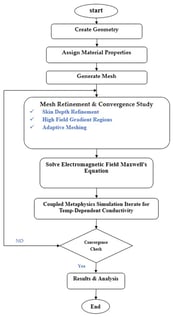
Modeling and simulation procedure of the induction furnace using ANSYS Maxwell.

We investigate a ferrimagnetic/ferroelectric bilayer in which a mixed-spin Heisenberg ferrimagnet is coupled to a three-state ferroelectric layer allowing for a nonpolar state. Using Monte Carlo simulations, we analyze how magnetic and electric single-ion anisotropies, together with interfacial magnetoelectric coupling, control phase transitions and hysteresis properties. We show that electric anisotropy, by tuning the population of nonpolar ferroelectric sites, strongly shifts the ferrimagnetic critical temperature, while magnetic anisotropy reciprocally affects the ferroelectric transition. Increasing the magnetoelectric coupling enhances both ordering temperatures and may induce a common transition. At fixed temperature, magnetic and electric hysteresis loops evolve from square to slim and nearly reversible shapes as anisotropies are varied. These results highlight the relevance of three-state ferroelectricity for describing polarization suppression and tunable magnetoelectric response in hybrid bilayers.

31 January 2026

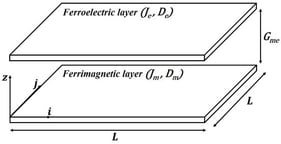
Schematic representation of the ferrimagnetic/ferroelectric bilayer. The system consists of a mixed-spin ferrimagnetic layer and a spin-1 ferroelectric layer, each forming an 
  
    L
    ×
    L
  
 square lattice, coupled through an interfacial magnetoelectric interaction.

We investigate the role of single-ion anisotropy in stabilizing higher-order skyrmion crystal phases in centrosymmetric magnets under D3d symmetry. Using a classical spin model that incorporates both a local single-ion anisotropy arising from the two-dimensional crystal symmetry and a D3d-type magnetic anisotropy originating from the D3d point-group symmetry, we perform simulated annealing calculations to explore the ground-state spin configurations. We find that a skyrmion crystal with a skyrmion number of two is stabilized over a wide range of parameters of single-ion anisotropy and D3d-type anisotropy. We also show that the skyrmion core position shifts from an interstitial site to an on-site location as the magnitude of the easy-axis single-ion anisotropy increases. Furthermore, we demonstrate that the magnetic field drives a variety of topological phase transitions depending on the sign and magnitude of the single-ion and D3d-type anisotropies. These results provide a possible microscopic understanding of how complex topological spin textures can be stabilized in centrosymmetric D3d magnets, suggesting that multiple phases with topological spin textures could emerge even in the absence of the Dzyaloshinskii–Moriya interaction.

27 January 2026

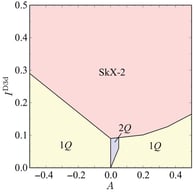
Magnetic phase diagram of the spin model in Equation (1) at low temperatures. The horizontal and vertical axes stand for single-ion anisotropy, A, and D3d-type magnetic anisotropy, ID3d, respectively. 1Q, 2Q, and SkX-2 represent the single-Q state, the double-Q state, and SkX with the skyrmion number of two, respectively.

A magnetic vortex, characterized by curling in-plane magnetization, is generally unstable in two-dimensional (2D) ferromagnetic thin films. Here, we demonstrated that this vortex could be stable in three-dimensional (3D) pyramid-shaped Fe thin films and elucidated mechanistic origin of the stable vortex. Magnetization measurements reveal characteristic MH hysteresis loops with a pronounced bending and a gradual slope near zero magnetization, contrasting strongly with the abrupt switching seen in 2D films. By decomposing the magnetization processes on each facet in pyramid, we identify the sequence of vortex formation, stabilization, and annihilation. The key factor is the 3D geometry: non-coplanar facet junctions at the ridge lines act as structural singularities that naturally pin domain walls (DWs). These ridge lines restrict DW motion, confine local magnetic structures, and mediate inter-facet interactions, creating geometrical constraints enhancing vortex stability. Vortex formation is driven by magnetostatic energy minimization, as in 2D films. However, ridge-induced weakening of inter-facet exchange becomes the dominant factor in the 3D pyramidal structure. Overall, the interplay of shape anisotropy, magnetostatic, exchange, and Zeeman energies under 3D constraints provides a clear framework for vortex stability, offering the first mechanistic insight into stable vortices in 3D ferromagnetic films and supporting future 3D magnetic devices.

9 January 2026

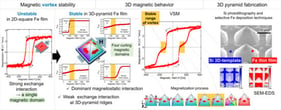
Conceptual illustration of magnetizations (red arrows) in a 3D-pyramid thin film under an applied magnetic field (
  
    H
  
). In this structure, magnetic domain walls (DWs) are pinned along non-coplanar ridges, which suppresses DW motion and stabilizes the vortex state. The colors on the facet planes indicate magnetization orientations. The symbols ⊗ and ⊙ represent magnetization directions pointing inward and outward the cross sections of the facet planes, respectively.

News & Conferences

Issues

Open for Submission

Editor's Choice

Get Alerted

Add your email address to receive forthcoming issues of this journal.

XFacebookLinkedIn
Magnetism - ISSN 2673-8724