Skip to Content
You are currently on the new version of our website. Access the old version .

Macromol

Macromol is an international, peer-reviewed, open access journal on all aspects of macromolecular research published quarterly online by MDPI.

Quartile Ranking JCR - Q2 (Polymer Science)

All Articles (227)

Ionic liquids (ILs) and deep eutectic solvents (DESs) have emerged as effective solvents for poorly soluble materials such as natural polysaccharides, including chitin. This review describes recently developed efficient chitin derivatization methods that harness the solubilizing power of ILs and DESs. It covers chitin acylation approaches, including acylation and mixed ester formation, as well as chitin etherification protocols. For example, the ILs 1-allyl-3-methylimidazolium bromide (AMIMBr) and 1-allyl-2,3-dimethylimidazolium bromide serve as effective media for chitin acylation and etherification, respectively, yielding single esters and benzyl derivatives with high degrees of substitution (DS). The use of DESs comprising AMIM chloride (AMIMCl) as a hydrogen bond acceptor and several hydrogen bond donors for chitin acylation are presented. In an optimized system, acylation using acyl chlorides proceeded smoothly without additives, such as a base/catalyst, in a DES comprising AMIMCl and 1,1,3,3-tetramethylguanidine, affording high-DS ester derivatives. The method was extended to the synthesis of mixed chitin esters bearing both long and bulky acyl substituents at appropriate substitution ratios, which exhibit thermoplasticity.

11 February 2026
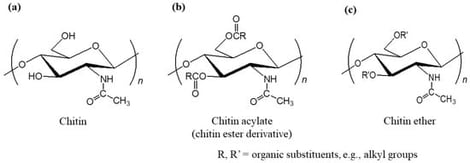
Chemical structures of (a) chitin, (b) chitin acylate (chitin ester derivative), and (c) chitin ether.

This study presents the first characterization of the globulin fraction from a newly registered chickpea cultivar, which represents the first desi-type cultivar (GB Cappuccino) released in Brazil. Although desi chickpeas are widely consumed in other countries, they have not been part of the Brazilian dietary pattern, and this introduction may represent an opportunity for changing this scenario. Characterizing its proteins is essential, given that legumes are recognized as important protein sources. In this study, globulins were confirmed as the predominant protein fraction, with the legumin-like fraction accounting for more than 80% of the total globulins. Its electrophoretic and amino acid profiles were highly distinctive and strongly influenced by this major fraction. In addition to the expected solubilization in saline solution, under in vitro pepsin–pancreatin digestion conditions designed to assess maximum hydrolysis potential, the globulin fraction was partially hydrolyzed, indicating a degree of protein digestibility while simultaneously releasing peptides that exhibited antioxidant activity and angiotensin-converting enzyme (ACE) inhibitory potential. Overall, these results highlight the nutritional relevance of this new cultivar and, based on the preliminary bioactivity screening performed, suggest that its globulin-rich protein composition may represent a promising source of bioactive peptides.

9 February 2026

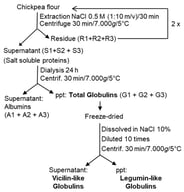
General scheme of globulin isolation.

Innovations in Tannin-Based Phenolic Foams: A Review of the Research

  • António G. Abreu,
  • Joana J. Costa and
  • Felismina T. C. Moreira
  • + 3 authors

Research on tannin-based foams has shown promising results. However, all developments in this field have not been addressed from different perspectives, in a systematic way, and with an emphasis on sustainability. This work discusses different formulations, emphasizing their bio-based components and how modifications influence key properties. It examines life cycle assessment (LCA) studies through a sustainability lens and identifies major commercial phenolic products to highlight the practical use of tannin foams for thermal insulation. The type of tannins, as well as their sources, influences the key properties of these foams. The replacement of formaldehyde, a crosslinking agent known for its health risks, is possible, particularly through more sustainable alternatives that allow for foams with better properties than those obtained with formaldehyde. Substitution of diethyl ether with less hazardous alternatives results in foams with improved thermal and mechanical performance. The elimination of the blowing agent—the green alternative—also leads to foams with good performance. The presence of additives (surfactants, plasticizers, and fillers), some of which are sustainable, improves the mechanical properties of the foams. The performance in fire-related applications, already promising, is also enhanced by the presence of additives. An increase in understanding, combined with the sustainable nature of the various alternatives, makes tannin-based foams promising candidates for next-generation insulation and structural materials in construction.

6 February 2026

Pathway to climate-neutral buildings: energy efficiency and Renovation Wave.

Catabolite Repression and Substrate Induction as Strategies for Protease Production in Edible Mushrooms

  • Giovanna Lima-Silva,
  • Walter J. Martínez-Burgos and
  • Larissa R. Chevreuil
  • + 5 authors

Edible mushrooms are an underexplored source of industrial proteases, whose synthesis is highly dependent on the cultivation substrate. This study investigated the effect of nine culture media on the proteolytic profiles of Auricularia sp., Lentinus sp., Macrocybe sp., and Grifola frondosa. Fungi were cultivated on diverse media (e.g., Czapek, Malt, Soy Flour). We analyzed total protein, specific activities (total, cysteine, serine proteases) using a biochemical assay, and protein secondary structure via FTIR, with metabolic patterns identified by PCA. A dissociation was found between total protein yield (highest in MFI/Casein media) and specific activity (highest in maltose media), suggesting catabolite repression. Distinct metabolic strategies emerged: Grifola frondosa specialized in serine protease production in the minimal Czapek medium (catabolic derepression), while Macrocybe sp. maximized cysteine protease production on soy flour (substrate induction). FTIR confirmed this, revealing a β-sheet-dominant (75.5%) structure for Grifola extract versus a random-coil-dominant (60.8%) structure for Macrocybe. This study provides a framework for mechanism-based bioprocess design, enabling the tailored production of serine proteases from G. frondosa (Czapek medium) or cysteine proteases from Macrocybe sp. (soy medium) for customized biotechnological applications.

5 February 2026

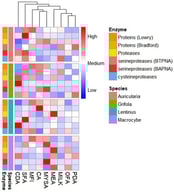
Hierarchical clustering and heatmap of fungal enzymatic activities. The activity values for each assay were normalized using a row-wise Z-score to allow for comparison. Hierarchical clustering was applied to group both the enzymatic assays (rows) and the fungus-medium combinations (columns) based on their activity profiles. The color scale represents the relative activity, from low (blue) to high (red). Row annotations on the left categorize the assays by enzyme class.

News & Conferences

Issues

Open for Submission

Editor's Choice

Get Alerted

Add your email address to receive forthcoming issues of this journal.

XFacebookLinkedIn
Macromol - ISSN 2673-6209