Skip Content
You are currently on the new version of our website. Access the old version .
  • 27 days
    Time to First Decision

Lymphatics

Lymphatics is an international, peer-reviewed, open access journal on lymphatics and related disorders published quarterly online by MDPI.

All Articles (95)

Therapy resistance remains a major cause of relapse and poor outcomes in acute lymphoblastic leukemia (ALL). Recent multi-omics studies in ALL have revealed that resistance arises from a combination of leukemia-specific genetic lesions, treatment-driven clonal evolution, and adaptive non-genetic programs. Genomic analyses have identified recurrent alterations associated with resistance to chemotherapy, tyrosine kinase inhibitors, and immunotherapies, while single-cell profiling has uncovered heterogeneous cell states that persist during treatment and contribute to minimal residual disease. Emerging epigenetic, proteomic, and metabolic data further indicate that reversible regulatory and signaling changes play a central role in leukemic persistence. Integrative analyses are beginning to define convergent resistance pathways and clinically relevant biomarkers, although longitudinal sampling and clinical translation remain limited. This review summarizes the current multi-omics landscape of therapy resistance in ALL and discusses opportunities to improve risk stratification and therapeutic strategies.

29 January 2026
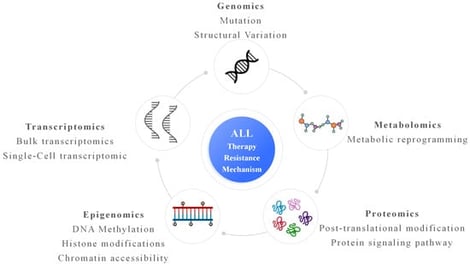
Multi-omics underlying therapy resistance in ALL. Genomic alterations, including gene mutations and structural variations, provide the genetic basis for resistance. Transcriptomic analyses, at both bulk and single-cell resolution, reveal heterogeneous gene expression programs and rare drug-tolerant cell states. Epigenomic changes, such as DNA methylation, histone modifications, and altered chromatin accessibility, enable transcriptional plasticity and adaptive responses to therapeutic pressure. Proteomic profiling captures post-translational modifications and rewired signaling pathways that directly mediate survival and drug insensitivity. Metabolomic reprogramming reflects adaptive changes in cellular metabolism that support energy homeostasis and stress tolerance during treatment. Integration of these multi-omics layers converges on a comprehensive understanding of ALL therapy resistance, highlighting interconnected molecular mechanisms and potential therapeutic vulnerabilities.

EBV-Driven NK/T-Cell Lymphoproliferative Disorders: Clinical Diversity and Molecular Insights

  • Aleksander Luniewski,
  • Sahil Chaudhary and
  • Ifeyinwa E. Obiorah
  • + 1 author

The World Health Organization (WHO) and International Consensus Classification (ICC) systems have classified EBV-positive NK/T-cell neoplasms in adults and EBV-positive T/NK-cell lymphoid lymphoproliferative disorders (LPD) in children. Recent molecular profiling techniques have revealed the pathogenesis of these disorders, showing interactions among EBV-encoded proteins, host immune responses, and genetic alterations. Extranodal NK/T-cell lymphoma (ENKTL) shows molecular diversity, with various subtypes (TSIM, MB, and HEA) identified through a multiomics approach. Aggressive NK-cell leukemia (ANKL) has mutations in JAK/STAT, epigenetic regulators, and TP53 pathways. EBV-positive nodal T- and NK-cell lymphoma (ENTNKL) is a new entity, distinguished by primary nodal presentation and a unique molecular profile. Severe mosquito bite allergy (SMBA), hydroa vacciniforme lymphoproliferative disorder (HVLPD), and systemic chronic active EBV disease (CAEBV) are rare childhood EBV-driven LPDs defined by clinico-pathologic criteria, with largely unexplored genomic landscapes. Studies of CAEBV samples have found ENKTL-like driver mutations, including DDX3X and KMT2D, in EBV-infected NK/T cells, while KMT2D and chromatin modifier mutations were common in HVLPD. Comprehensive molecular sequencing of SMBA and Systemic EBV-positive T-cell lymphoma of childhood remains lacking. These findings suggest all EBV⁺ NK/T-cell LPDs exist on a biological continuum of viral oncogenesis. The integration of clinical, pathological, and molecular information aims to create a more accurate classification system, enabling better risk evaluation and tailored treatment strategies for patients with these complex disorders.

26 January 2026

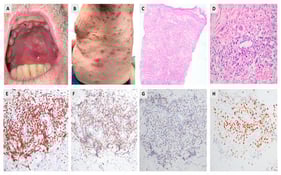
Clinical and pathologic presentation of the extranodal NK/T-cell lymphoma. Clinical photographs showing mucosal lesions in the oral cavity (A) and generalized papular and nodular cutaneous lesions (B). Skin punch biopsy from the back, revealing a patchy dermal infiltrate with a perivascular distribution ((C), H&E stain, 10×). The atypical lymphocytic infiltrate exhibits an angiocentric pattern and consists of neoplastic lymphoid cells of medium to large size, interspersed with histiocytes and small lymphoid cells. ((D), H&E stain, 40×). Immunohistochemistry (IHC) of skin biopsy confirm positive expression of (E) CD3, (F) CD56, (G) perforin (IHC, 40× each), and (H) EBV RNA (RNAscope, 40×).

Recognizing Lymphoma Risk in EBV- and HIV-Positive Patients: The Otorhinolaryngologist’s Perspective

  • Stefano Ramirez-Gil,
  • Jose de Jesus Ley-Tomas and
  • Cecilia Belen Espinosa-Arce

Epstein–Barr virus (EBV) is a key oncogenic pathogen implicated in the development of lymphomas, particularly among HIV-positive and immunocompromised individuals. While the association between EBV and lymphoma is well established, the mechanisms underlying progression from infection to malignancy—especially in the head and neck region—remain incompletely understood. This review offers a comprehensive analysis of the pathophysiological pathways by which EBV and HIV contribute to lymphomagenesis, with an emphasis on latency patterns, immune evasion, and epigenetic “hit and run” oncogenesis. Notably, it integrates novel findings on the diagnostic implications of EBV latency proteins, explores HIV-mediated B-cell dysregulation, and evaluates the emerging landscape of targeted therapies, including monoclonal antibodies and lytic cycle inducers. By focusing specifically on head and neck lymphomas, this review underscores a clinically underrepresented domain and offers insights that may guide future diagnostics, surveillance, and treatment strategies in vulnerable patient populations. This review also highlights the pressing need for improved animal models and continued research into EBV-specific therapeutic targets.

23 January 2026

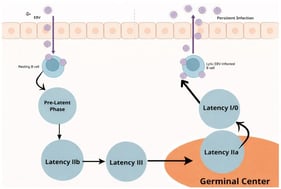
Diagram illustrating the progression of EBV latency states in B cells. Created with Canva.

The hepatic lymphatic system, long underappreciated, plays a critical role in liver physiology by maintaining interstitial fluid balance, removing metabolic waste, and facilitating immune surveillance. Emerging evidence indicates that lymphatic dysfunction contributes to the pathogenesis and progression of multiple liver diseases, including non-alcoholic fatty liver disease/non-alcoholic steatohepatitis (NAFLD/NASH), hepatitis, fibrosis, cirrhosis, and hepatocellular carcinoma. This review summarizes current knowledge on hepatic lymphatic anatomy, physiology, and molecular regulation, highlights pathological alterations, and discusses potential therapeutic implications. A better understanding of the hepatic lymphatic system may enable the development of novel lymphatic-targeted strategies to improve liver health and treat liver disease.

23 January 2026

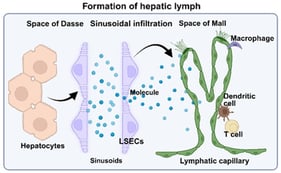
Overview of Hepatic Lymph Formation. The space of Disse is a perisinusoidal compartment between hepatocytes and fenestrated liver sinusoidal endothelial cells that facilitates plasma filtration, metabolic exchange, and lipoprotein transport. Sinusoidal endothelial fenestrae regulate fluid and macromolecule exchange between the sinusoidal lumen and the space of Disse. Interstitial fluid is subsequently collected by initial lymphatic capillaries in the space of Mall and drained into periportal lymphatic vessels, which also interact with immune cells (i.e., macrophage, dendritic cell, and T cell) and contribute to hepatic immune regulation. Created in BioRender. Do, L. (2025) https://BioRender.com/9wkyxw3 (accessed on 22 December 2025).

News & Conferences

Issues

Open for Submission

Editor's Choice

Get Alerted

Add your email address to receive forthcoming issues of this journal.

XFacebookLinkedIn
Lymphatics - ISSN 2813-3307