Skip Content
You are currently on the new version of our website. Access the old version .

Logistics

Logistics is an international, scientific, peer-reviewed, open access journal of logistics and supply chain management published monthly online by MDPI. 

Quartile Ranking JCR - Q2 (Operations Research and Management Science | Management)

All Articles (726)

Beyond the Buffer: A Hierarchical Blueprint for Resilient Supply Chain

  • Narassima Madhavarao Seshadri,
  • Anbuudayasankar Singanallur Palaniswamy and
  • Sumesh Arangot
  • + 2 authors

Background: Supply Chain Flexibility (SCF) has transitioned from being viewed merely as a competitive edge to now being essential for survival during the current “high-impact, low-frequency” disruption era. Most research treats Supply Chain Flexibility enablement as a list of unrelated elements. Methods: To address this gap, this study develops an Interpretive Structural Modelling (ISM) to illustrate how Supply Chain Flexibility elements impact “Data-Driven Organisational Culture” so they can provide core technology and operational capabilities to Supply Chain Flexibility. Results: The hierarchical structure developed indicates that the “Nature of Customers” is the main building block of Supply Chain Flexibility, whereas “Strategic Redundancies” are viewed as the result of an advanced Supply Chain Flexibility system rather than as an initial factor in Supply Chain Flexibility. This study develops an integrated framework to align the macro-level Supply Chain Flexibility elements with the five operational areas such as market, delivery, logistics, organisational and volume flexibility. Conclusions: The finding provides practical guidance for practitioners to prioritise foundational cultural and strategic investments before adopting software tools or other surface-level solutions, thereby supporting the systematic development of robust and sustainable Supply Chain Flexibility.

10 February 2026
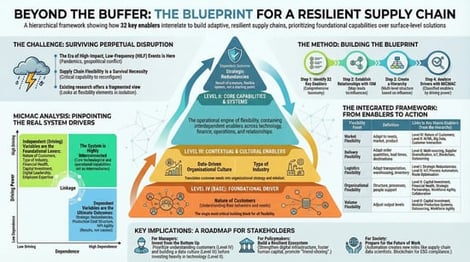
Hierarchical ISM digraph of Supply Chain Flexibility enablers.

Background: The transition toward Industry 4.0 and Supply Chain 5.0 requires performance measurement frameworks that integrate efficiency, digitalization, and sustainability indicators. Although the SCOR® 4.0 model provides standardized metrics, it lacks predictive capabilities under complex and nonlinear conditions. This study addresses this gap by extending the SCOR® framework and integrating it into an AI-based predictive model. Methods: A Multilayer Perceptron (MLP) neural network was developed to forecast Supply Chain Performance (SCP) using an expanded set of SCOR® 4.0 indicators. Additional Level 1 and Level 2 metrics, capturing digitalization and sustainability (including carbon footprint and waste reduction), were incorporated. The MLP model was optimized and trained using the Levenberg–Marquardt algorithm on a synthetically generated dataset derived from deterministic Extended SCOR® 4.0 formulations, in order to capture complex nonlinear relationships under controlled, simulation-based conditions. Results: Simulation-based validation demonstrates high predictive accuracy, achieving low RMSE, MAE, and MAPE values and strong correlation coefficients. Conclusions: The findings demonstrate the methodological feasibility and internal consistency of integrating extended SCOR® metrics with an optimized MLP architecture for forecasting multidimensional SCP under simulated conditions in digital and sustainability-oriented supply chains; external validity to real operational environments remains to be established in future empirical studies.

9 February 2026

Key Performance Indicators for Sustainable Supply Chain Management in SMEs: A Bibliometric Review

  • Wipada Sompong,
  • Siwarit Pongsakornrungsilp and
  • Shishank Shishank
  • + 3 authors

Background: This study presents a bibliometric analysis of key performance indicators (KPIs) for sustainable supply chain management (SSCM) in small- and medium-sized enterprises (SMEs). Despite growing academic attention, particularly after 2020, important gaps remain in how sustainability performance is measured and assessed in SME contexts. Methods: Using the Scopus database, we identified 169 relevant studies published between 2004 and 2025. The dataset was obtained through sustainability- and SME-related keyword filtering, followed by manual screening based on predefined eligibility criteria. Results: The findings reveal a research landscape dominated by economic and technological KPI dimensions, with Italy, India, and Indonesia emerging as leading contributors. However, the results also indicate limited research attention to social sustainability, organizational capabilities, and governance within SME supply chains. Overall, eight underexplored KPI domains are identified as opportunities for future research and practical development. Conclusions: This analysis clarifies the intellectual landscape of SSCM KPI research and provides evidence-based insights for researchers and practitioners regarding which KPI dimensions are emphasized and which remain underdeveloped for practical application in SME supply chains, without developing or validating a new KPI framework.

9 February 2026

Background: The rapid diffusion of large language models (LLMs) such as Claude, ChatGPT, Gemini, LLaMA, and Mistral is reshaping logistics and supply chain management by embedding generative intelligence into planning, coordination, and governance processes. While prior studies emphasize algorithmic capability, far less is known about how differences in diffusion pathways shape productivity outcomes, managerial cognition, and institutional control. Methods: This study develops and applies an integrative analytical framework—the AI Diffusion Triad—comprising Productivity, Perspective, and Power. Using comparative qualitative analysis of five leading LLM ecosystems, the study examines how technical architecture, access models, and governance structures influence adoption patterns and operational integration in logistics contexts. Results: The analysis shows that diffusion outcomes depend not only on model performance but on socio-technical alignment between AI systems, human workflows, and institutional governance. Proprietary platforms accelerate productivity through centralized integration but create dependency risks, whereas open-weight ecosystems support localized innovation and broader participation. Differences in interpretability and access significantly shape managerial trust, learning, and decision autonomy across supply chain tiers. Conclusions: Sustainable and inclusive AI adoption in logistics requires balancing operational efficiency with interpretability and equitable governance. The study offers design and policy principles for aligning technological deployment with workforce adaptation and ecosystem resilience and proposes a research agenda focused on diffusion governance rather than algorithmic advancement alone.

5 February 2026

News & Conferences

Issues

Open for Submission

Editor's Choice

Reprints of Collections

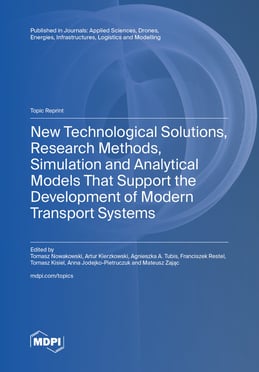
New Technological Solutions, Research Methods, Simulation and Analytical Models That Support the Development of Modern Transport Systems
Reprint

New Technological Solutions, Research Methods, Simulation and Analytical Models That Support the Development of Modern Transport Systems

Editors: Tomasz Nowakowski, Artur Kierzkowski, Agnieszka A. Tubis, Franciszek Restel, Tomasz Kisiel, Anna Jodejko-Pietruczuk, Mateusz Zaja̧c

Get Alerted

Add your email address to receive forthcoming issues of this journal.

XFacebookLinkedIn
Logistics - ISSN 2305-6290