Skip to Content

Life

Life is an international, peer-reviewed, open access journal related to fundamental themes in life sciences from basic to applied research, published monthly online by MDPI.
The Spanish Association for Cancer Research (ASEICA) is affiliated with Life and its members receive a discount on the article processing charges.
Indexed in PubMed | Quartile Ranking JCR - Q1 (Biology)

All Articles (10,769)

Bowdichia virgilioides Kunth is a tree largely present in South America, notably in the Cerrado savannah. The species is known for the quality of its dense and resistant wood, used in construction and furnishing. B. virgilioides is also a medicinal plant used, from leaves to roots, for the treatment of various human pathologies (pharyngitis, bronchitis, healing wounds, diabetes, and arthritis). The present review provides an analysis of the scientific literature pertaining to B. virgilioides, with a focus on pharmacological activities. Aqueous and organic extracts have been used to treat inflammatory pathologies and to combat infectious diseases caused by microorganisms and parasites. All phytochemicals at the origin of the bioactivities of extracts have been identified, including 37 terpenoids, 8 alkaloids, 21 flavonoids and 13 other products. All natural products are discussed, with a focus on a dozen compounds with well-documented pharmacological properties and/or a known mechanism of action. Key products include ormosanine (alkaloid), vouacapane (diterpenoid), lupeol (terpenoid), isoquercetin (flavonoid), isocordoin (chalcone), and little-known specific products (bowdichine and bowdenol). The botanical and phytochemical analysis shed light on this valuable Fabaceae species with the objective to promote its preservation and cultivation, as well as further pharmacological investigations aimed at rationalizing its long-established ethnobotanical use.

20 February 2026
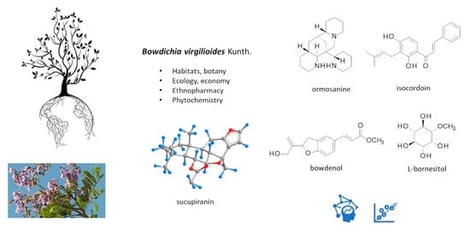
(a) Distribution of Bowdichia virgilioides in South America (https://powo.science.kew.org/taxon/urn:lsid:ipni.org:names:482144-1, accessed on 30 November 2025) and (b) illustrations of the tree, flowers and leaves (https://www.gbif.org/occurrence/gallery?taxon_key=2975476, accessed on 30 November 2025).

Selective Androgen Receptor Modulators in Women: What Do We Know, and What Is Still Missing

  • Veselin Vasilev,
  • Katerina Georgieva and
  • Nikolay Boyadjiev
  • + 3 authors

Androgens and androgen receptor (AR) signaling influence many aspects of female physiology, including reproduction, musculoskeletal health, metabolism, and neurological regulation, yet are less studied than in males. Selective androgen receptor modulators (SARMs) were developed to provide tissue-selective anabolic effects with reduced androgenic side effects, but their effects in women are not well defined. This narrative review summarizes preclinical and clinical evidence on SARM use in female rodents and women, focusing on AR biology, tissue selectivity, therapeutic potential, and safety. A literature search of PubMed, Scopus, and Google Scholar identified relevant experimental and clinical studies addressing sex-specific AR signaling and SARM effects in females. Preclinical data indicate that SARMs can enhance sexual motivation and improve muscle and bone outcomes in ovariectomized models, with compound-dependent effects on reproductive tissues. Clinical studies in postmenopausal women demonstrate increases in lean body mass with generally limited androgenic effects, although functional benefits are inconsistent and alterations in lipid profiles and liver enzymes have been reported. Evidence also supports antitumor activity of AR-targeted SARMs in selected breast cancer subtypes. Overall, while SARMs show therapeutic potential in women, long-term safety and efficacy remain insufficiently characterized, warranting further sex-specific clinical investigation.

20 February 2026

Background: To develop and validate an automated visual acuity (VA) testing system integrating artificial intelligence (AI)–driven speech and image recognition technologies, enabling self-administered, clinic-based VA assessment; Methods: The system incorporated a fine-tuned Whisper speech-recognition model with Silero voice activity detection and pose estimation through facial landmark and ArUco marker detection. A state-driven interface guided users through sequential testing with and without a pinhole. Speech recognition was enhanced using a local Singaporean English dataset. Laboratory validation assessed speech and pose recognition performance, while clinical validation compared automated and manual VA testing at a tertiary eye clinic; Results: The fine-tuned model reduced word error rates from 17.83% to 9.81% for letters and 2.76% to 1.97% for numbers. Pose detection accurately identified valid occluder states. Among 72 participants (144 eyes), automated unaided VA showed good agreement with manual VA (ICC = 0.77, 95% CI 0.62–0.85), while pinhole VA demonstrated moderate agreement (ICC = 0.63, 95% CI 0.25–0.83). Automated testing took longer (132.1 ± 47.5 s vs. 97.1 ± 47.8 s; p < 0.001), but user experience remained positive (mean Likert scale score 4.3 ± 0.8); Conclusions: The AI-based automated VA system delivered accurate, reliable, and user-friendly performance, supporting its feasibility for clinical implementation.

20 February 2026

Floccularia luteovirens is an edible and medicinal fungus with great development value on the Qinghai–Tibet Plateau, but its artificial domestication and cultivation are limited by the lack of systematic research on cultivation substrate formulas and key parameters. This study adopted the technical route of “preliminary screening—single-factor optimization—response surface collaborative optimization” to conduct research on the screening and optimization of its domestication cultivation substrate. Firstly, through the preliminary screening of 26 groups of formulas, a basic cultivation substrate formula with compatible complex nutrition and physical structure was determined. Secondly, single-factor experiments clarified that mixed sawdust was the optimal main substrate, corn flour was the optimal auxiliary substrate, the suitable substrate-to-water ratio was 1:1.6, and the suitable compactness was a substrate surface height of 12–12.5 cm (corresponding to a bulk density of 1.10–1.15 g/cm3 and a porosity of 60.6–63.3%). Finally, based on the response surface Box–Behnken model, with the main substrate, substrate-to-water ratio, and compactness as independent variables, and the total mycelial growth in 30 days as the response value, response surface optimization was performed to obtain the optimal formula: main substrate 76.002%, substrate-to-water ratio 1:1.721, and compactness 12.845 cm. Under these conditions, the mycelial growth reached 28.75 mm, which was highly consistent with the model’s predicted value (28.012 mm), and the constructed quadratic regression model showed excellent fitness (R2 = 0.9920, p = 0.0008). This study clarified the core influencing factors and adaptation mechanism of the cultivation substrate for Floccularia luteovirens, filled the research gap in the domestication cultivation substrate of this fungus, and provided basic technical parameters for its large-scale artificial cultivation.

19 February 2026

News & Conferences

Issues

Open for Submission

Editor's Choice

Reprints of Collections

Advancements in Heart Failure Research
Reprint

Advancements in Heart Failure Research

Editors: Tzu-Hurng Cheng, Ju-Chi Liu
Veterinary Pathology and Veterinary Anatomy
Reprint

Veterinary Pathology and Veterinary Anatomy

2nd Edition
Editors: Carmen Solcan, Gheorghe Solcan

Get Alerted

Add your email address to receive forthcoming issues of this journal.

XFacebookLinkedIn
Life - ISSN 2075-1729