Skip Content
You are currently on the new version of our website. Access the old version .

Languages

Languages is an international, multidisciplinary, peer-reviewed, open access journal on interdisciplinary studies of languages published monthly online by MDPI. 
The European Society for Transcultural and Interdisciplinary Dialogue (ESTIDIA) is affiliated with Languages and its members receive discounts on the article processing charges.
Quartile Ranking JCR - Q2 (Linguistics)

All Articles (1,794)

  • Communication
  • Open Access

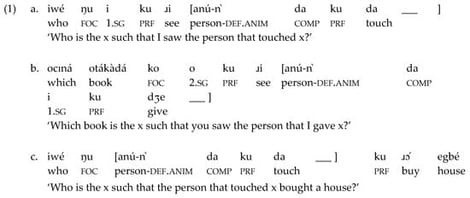
I argue that definite relative clauses, despite their stable strong island status cross-linguistically, lack island status in Adara. The structure is neither selective nor weak, but rather completely permeable, allowing the free extraction of both arguments and adjuncts. In support of the claim that A-bar movement may escape relative clause domains in Adara, I adduce evidence from crossover effects, reconstruction effects, and quantifier float. In addition, I show that relative clause-internal material may probe upwards and outwards, triggering long-distance agreement of relativized verbs with clause-external subjects in a way that is not possible with true island structures in the language.

31 January 2026
Article thumbnail image

This study examines how international students learning Romanian interpret and apply the Cooperative Principle in everyday and academic interaction. The research is grounded in the observation that pragmatic competence often develops unevenly in second-language learning, particularly in multilingual environments where learners rely on norms carried over from their first language. To investigate these dynamics, a small spoken and written corpus was compiled from classroom activities, recorded peer interactions, and informal conversations with students enrolled in Romanian language courses. The data were annotated for instances of maxim observance, weakening, and flouting, as well as for implicatures that required contextual inference. The analysis shows recurring patterns of pragmatic transfer, especially in the interpretation of relevance and quantity, and highlights areas where learners systematically misinterpret or underproduce implicatures. Several examples also reveal successful adaptation to Romanian communicative expectations, suggesting that exposure to diverse interactional settings supports the refinement of pragmatic cues. The findings contribute to a clearer understanding of how the Cooperative Principle operates in cross-cultural learning contexts and point to practical implications for teaching Romanian as a foreign language.

6 February 2026

This paper develops a mechanism of PF-deletion within a probe–goal system that incorporates C-to-T feature inheritance. I propose that the phase head C enters the derivation not only with an edge feature (EF) and agree (φ-)features but also with a delete-feature, which licenses the deletion of an element at PF (PF-deletion). When C-to-T feature inheritance applies, the target of PF-deletion is determined through φ-probing from T; when it does not, it is determined through EF-probing from C. By linking PF-deletion to phase-internal probing, this approach dispenses with pro, traditionally assumed to exist in the lexicon of null subject languages such as Italian, as a theoretical primitive. Crucially, it offers a unified account of the distribution of null arguments in both Italian (a pro-drop language) and German (a topic-drop language), two language types that have traditionally resisted unified analysis under the principles-and-parameters approach. In addition to the synchronic study of the distribution of null arguments, I further argue that diachronic evidence from old languages such as Old French and Old English lends additional support to the proposal, and conclude that whether C-to-T inheritance applies or not is a crucial factor in explaining crosslinguistic variation in null argument phenomena.

31 January 2026

Reflexivity and Reciprocity in Two Arabic Varieties: Evidence for REF-REC Category

  • Abdulazeez Jaradat,
  • Dina Mahmoud Hammouri and
  • Ahmad S. Haider
  • + 1 author

Languages vary in expressing reflexivity and reciprocity. In some languages, reflexive and reciprocal constructions are formally identical, while in some other languages, they are distinct. The third group comprises languages that have non-reflexive and reflexive–reciprocal (REF-REC) constructions. This paper investigates marking reflexivity and reciprocity in Standard Arabic and Jordanian Arabic. It demonstrates that these two varieties possess a non-reflexive reciprocal category and a REF-REC category, placing them within the third group. However, these varieties are peculiar in terms of having three possible interpretations of a sentence embedding this category: only reflexive, only reciprocal, and simultaneously both. This peculiar case has been interpreted as a case of sentential vagueness: each of the two markers in the target varieties has a univocal meaning, and the range of possible sentential interpretations arises from contextual clues. From a cross-linguistic perspective, this paper also identifies a novel source of reflexive marking: the nominal ħaal in Jordanian Arabic. This nominal, which primitively means ‘(personal) state’, is the conceptual strategy for reflexivity in this variety.

30 January 2026

News & Conferences

Issues

Open for Submission

Editor's Choice

Reprints of Collections

Phonetics and Phonology of Ibero-Romance Languages
Reprint

Phonetics and Phonology of Ibero-Romance Languages

Editors: Rebeka Campos-Astorkiza
Perception and Processing of Address Terms
Reprint

Perception and Processing of Address Terms

Editors: Helen de Hoop, Gert-Jan Schoenmakers

Get Alerted

Add your email address to receive forthcoming issues of this journal.

XFacebookLinkedIn
Languages - ISSN 2226-471X