Skip to Content

Journal of Theoretical and Applied Electronic Commerce Research

Journal of Theoretical and Applied Electronic Commerce Research (JTAER) is an international, peer-reviewed, open access journal of electronic commerce, published monthly online by MDPI (from Volume 16, Issue 3 - 2021).

Quartile Ranking JCR - Q2 (Business)

All Articles (1,354)

This study aims to analyze the effect of individuals’ digital capital on life satisfaction in the digital global marketing environment and to structurally verify the mediating effects of digital self-efficacy and the level of E-commerce utilization in this process. For this purpose, data from the 2023 Digital Divide Survey conducted by Statistics Korea was utilized, and Structural Equation Modeling (SEM) analyses were conducted. The results indicate that the sub-factors of digital capital—digital competence, digital support resources, and social capital—all have significant positive effects on digital self-efficacy. Furthermore, digital self-efficacy exerts a significant positive influence on both the level of E-commerce utilization and life satisfaction. In addition, the level of E-commerce utilization was found to have a modest but statistically significant direct effect on life satisfaction. Mediation analysis based on SEM revealed that digital self-efficacy functions as a key mediating mechanism linking digital capital to life satisfaction. While indirect effects through digital self-efficacy were consistently supported, the sequential mediation pathway involving both digital self-efficacy and E-commerce utilization level appeared relatively weak, suggesting that psychological confidence plays a more central role than behavioral usage alone. Overall, these findings suggest that digital capital extends beyond mere access to technology or frequency of use and forms a structural pathway influencing quality of life primarily through psychological empowerment and, to a lesser extent, digital behavioral engagement. This study contributes to digital divide research by presenting an integrated analytical framework connecting digital capital, digital self-efficacy, E-commerce utilization level, and life satisfaction, and provides empirical evidence supporting the importance of policies and educational interventions that enhance individuals’ digital self-efficacy alongside practical e-commerce-based digital education.

26 February 2026

Technology Acceptance Model (TAM). Source: Reconstructed by the author based on Davis, Bagozzi, and Warshaw [13] (p. 985).

Antecedents and Consequences of Customized Product Value

  • Emre Yıldırım,
  • Sima Nart and
  • Osman M. Karatepe

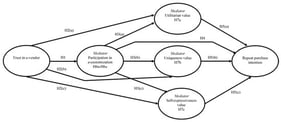
Online customization has become a prominent strategic approach for delivering personalized value. However, prior research has largely examined isolated relationships such as trust and purchase intention, customization and value, or value and loyalty. This study situates the issue within the broader context of digital co-creation and aims to provide an integrated explanation of how trust in an e-vendor and participation in e-customization shape multiple dimensions of customized product value and subsequent repeat purchase intention. Using survey data from 312 customers with prior online customization experience, the proposed relationships were tested through structural equation modeling. The results suggest that trust in an e-vendor increases participation in customization, which in turn enhances utilitarian value, uniqueness value, and self-expressiveness value. These value components positively influence repeat purchase intention, and several mediation effects have emerged. Specifically, participation partly mediates the effect of trust on all three value dimensions, while uniqueness value and self-expressiveness value partly mediate the effect of participation on repeat purchase intention. Overall, the findings provide empirical evidence for a trust–participation–value pathway and highlight the importance of both functional and symbolic value outcomes in sustaining customer engagement in online customization environments.

25 February 2026

Research Model.

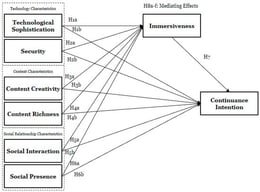
This study examines customers’ continuance intention in metaverse services by integrating technological, content, and social-relational dimensions and assessing the role of immersiveness. Six focal antecedents are considered, namely, technological sophistication, security, content creativity, content richness, social interaction, and social presence. Survey data from 231 metaverse users in China show that technological sophistication, content creativity, social interaction, and social presence are positively associated with immersiveness, whereas security and content richness are not. In addition, continuance intention is positively associated with technological sophistication, security, content richness, social interaction, and immersiveness. Despite the absence of clear indirect effects via immersiveness, the results suggest that continuance intention reflects not only immersive experience but also post-adoption evaluations of assurance and usefulness. As metaverse services move toward broader adoption and commercialization, these findings distinguish experience-building drivers from retention-relevant factors and offer implications for service development, content strategy, and community experience design.

25 February 2026

Research model.
  • Systematic Review
  • Open Access

Artificial intelligence (AI) has become a transformative force in fashion e-commerce, reshaping how consumers interact with brands across design, marketing, and retail. However, a systematic synthesis of recent empirical research on consumer interactions with AI in fashion remains underexplored. This study utilizes both systematic and bibliometric approaches to review 50 empirical articles published between 2022 and 2025, retrieved from Scopus and Web of Science, to reveal dominant topics and intellectual structures. Guided by the Theme–Theory–Method (TTM) framework, the review employs systematic content analysis complemented by bibliometric mapping to identify key themes, trends, theories, and methods in existing AI-related consumer studies in fashion. AI-powered chatbots and general AI services are most frequently examined, with the Technology Acceptance Model and Stimulus-Organism-Response framework as leading theoretical lenses. Quantitative research designs prevail, though qualitative and mixed-method approaches are emerging. Based on the findings and identified gaps, a TTM-guided future research agenda is proposed to inform theoretically grounded and practically relevant investigations in the fashion domain, meanwhile contributing to the broader advancement of e-commerce scholarship and practice. This study offers the first integrated synthesis of AI-related empirical consumer research in the contemporary fashion context and the Generative AI era.

24 February 2026

PRISMA 2020 [18] flow diagram of study identification, screening, eligibility, and inclusion. Notes. **, Records were excluded using database-embedded automation filters prior to manual screening.

News & Conferences

Issues

Open for Submission

Editor's Choice

Get Alerted

Add your email address to receive forthcoming issues of this journal.

XFacebookLinkedIn
J. Theor. Appl. Electron. Commer. Res. - ISSN 0718-1876