Skip Content
You are currently on the new version of our website. Access the old version .

Journal of Theoretical and Applied Electronic Commerce Research

Journal of Theoretical and Applied Electronic Commerce Research (JTAER) is an international, peer-reviewed, open access journal of electronic commerce, published monthly online by MDPI (from Volume 16, Issue 3 - 2021).

Quartile Ranking JCR - Q2 (Business)

All Articles (1,338)

Consumers are increasingly utilizing their smartphones to pay for goods and services, taking advantage of a variety of mobile payment options. Among these, Peer-to-Peer (P2P) mobile payment systems have gained global momentum, becoming one of consumers’ preferred choices. This study aims to examine the factors influencing consumers’ continuance intention to use CliQ, a P2P mobile payment system in Jordan. Following a thorough literature review, we extend the Theory of Planned Behavior (TPB) by integrating perceived structural assurance, perceived usefulness, and satisfaction. The Partial Least Squares Structural Equation Modeling (PLS-SEM) results indicate that perceived structural assurance significantly affects both consumer attitude and perceived security. The findings also suggest that attitude is the most influential factor in the proposed research model, while perceived usefulness and perceived behavioral control emerged as key drivers of user satisfaction and continuance intention. Furthermore, satisfaction was found to be a strong predictor of consumers’ continuance intention. These findings enrich the literature and provide valued implications for mobile-payment service providers and application developers.

9 February 2026
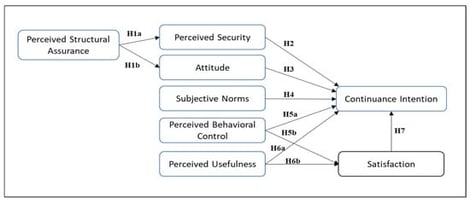
Research model.

This research investigates the impact of augmented and virtual reality (AR/VR) and AI-enabled chatbots, both individually and collectively, on consumer engagement of e-commerce platforms. Moreover, this research examines the mediating effects of perceived utility, ease of use, and enjoyment and the moderating effects of product type and technology readiness, respectively. By applying the theories of Technology Acceptance Model (TAM) and Stimulus–Organism–Response (S-O-R), this research proposed this theoretical framework and adopted a mixed-method research method. This research collected its empirical findings from 486 respondents who had utilized chatbots and AR/VR technology on three of China’s most popular e-commerce platforms, including Taobao, JD.com, and Pinduoduo. Structural equation modeling was utilized for hypothesis testing, and semi-structured interviews on 30 participants were used for validation of empirical findings. Results reveal that both AI chatbot features (β = 0.35, p < 0.001) and AR/VR technologies (β = 0.42, p < 0.001) significantly enhance consumer engagement, with AR/VR demonstrating stronger effects. Perceived enjoyment emerged as the strongest mediator (AI: β = 0.14; AR/VR: β = 0.18), surpassing traditional utilitarian factors. Technology readiness significantly moderated these relationships, with high-readiness consumers showing substantially stronger responses (AI: β = 0.45; AR/VR: β = 0.52). Experience goods amplified technology effects compared to search goods. Multi-group analysis revealed platform-specific variations, while robustness checks identified diminishing returns for AI chatbots but not AR/VR technologies. This research contributes to digital marketing and information systems literature by providing empirical evidence of differential technology impacts on engagement, highlighting the dominance of hedonic over utilitarian pathways in consumer technology adoption. The findings offer practical guidance for e-commerce platforms in optimizing technology investments and designing engagement strategies.

7 February 2026

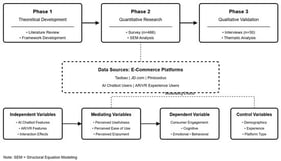
Research Design Framework. The figure illustrates the three-phase research design with variable relationships and data sources. Solid arrows indicate direct relationships between phases; dashed boxes represent data collection points across three e-commerce platforms (Taobao, JD.com, Pinduoduo).

The rapid expansion of e-commerce has significantly influenced consumer purchasing behavior, making user reviews a critical source of product-related information. However, the large volume of low-quality and superficial reviews limits the ability to obtain reliable insights. This study aims to classify Turkish e-commerce reviews as either useful or useless, thereby highlighting high-quality content to support more informed consumer decisions. A dataset of 15,170 Turkish product reviews collected from major e-commerce platforms was analyzed using traditional machine learning approaches, including Support Vector Machines and Logistic Regression, and transformer-based models such as BERT and RoBERTa. In addition, a novel Multi-Transformer Fusion Framework (MTFF) was proposed by integrating BERT and RoBERTa representations through concatenation, weighted-sum, and attention-based fusion strategies. Experimental results demonstrated that the concatenation-based fusion model achieved the highest performance with an F1-score of 91.75%, outperforming all individual models. Among standalone models, Turkish BERT achieved the best performance (F1: 89.37%), while the BERT + Logistic Regression hybrid approach yielded an F1-score of 88.47%. The findings indicate that multi-transformer architectures substantially enhance classification performance, particularly for agglutinative languages such as Turkish. To improve the interpretability of the proposed framework, SHAP (SHapley Additive exPlanations) was employed to analyze feature contributions and provide transparent explanations for model predictions, revealing that the model primarily relies on experience-oriented and semantically meaningful linguistic cues. The proposed approach can support e-commerce platforms by automatically prioritizing high-quality and informative reviews, thereby improving user experience and decision-making processes.

5 February 2026

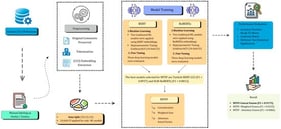
General flowchart of the proposed method.

This study examines why privacy concerns do not consistently deter online information disclosure by focusing on internal evaluative dynamics underlying privacy decisions. Drawing on theories of attitudinal ambivalence and cognitive–affective inconsistency, it investigates how internal tensions shape the translation of privacy concerns into disclosure behavior. Using two-phase data comprising a survey, the research distinguishes between threat-based and coping-based evaluative conflicts by operationalizing ambivalence and cognitive–affective inconsistency across privacy risks, perceived benefits, self-efficacy, and response efficacy. Results from Phase 1, based on 540 Amazon Mechanical Turk participants, indicate that while privacy concerns generally reduce disclosure intentions, this effect is significantly weakened when individuals experience higher levels of cognitive–affective inconsistency and ambivalence. Although ambivalence significantly reduces the magnitude of inconsistency, it has a limited influence on the moderating role of inconsistency. Phase 2 findings further show that under conditions of high ambivalence, cognitive–affective inconsistency related to self-efficacy exerts a significant effect in situation-specific disclosure contexts. By elucidating the dynamic interplay of the internal tensions, this study clarifies when and why privacy concerns fail to predict disclosure behavior and highlights the importance of incorporating internal evaluative dynamics into models of digital privacy decision-making.

4 February 2026

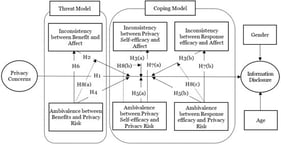
Conceptual Model.

News & Conferences

Issues

Open for Submission

Editor's Choice

Get Alerted

Add your email address to receive forthcoming issues of this journal.

XFacebookLinkedIn
J. Theor. Appl. Electron. Commer. Res. - ISSN 0718-1876