

Journal Menu
► ▼ Journal Menu-
- JPM Home
- Aims & Scope
- Editorial Board
- Reviewer Board
- Topical Advisory Panel
- Instructions for Authors
- Special Issues
- Topics
- Sections & Collections
- Article Processing Charge
- Indexing & Archiving
- Editor’s Choice Articles
- Most Cited & Viewed
- Journal Statistics
- Journal History
- Journal Awards
- Society Collaborations
- Conferences
- Editorial Office
Journal Browser
► ▼ Journal BrowserNeed Help?
Announcements
9 December 2025
Meet Us at the 146th Annual Meeting of the Pharmaceutical Society of Japan (Osaka), 26–29 March 2026, Osaka, Japan

Conference: The 146th Annual Meeting of the Pharmaceutical Society of Japan (Osaka)
Date: 26–29 March 2026
Location: Osaka, Japan
MDPI will be attending the 146th Annual Meeting of the Pharmaceutical Society of Japan (Osaka) as an exhibitor, which will be held from 26 to 29 March 2026, and we welcome researchers from diverse backgrounds to visit and share their latest ideas with us.
Pharmaceutical sciences are comprehensive sciences that require expertise from a wide range of academic fields, including physics, chemistry, biology, medical sciences, and clinical sciences. In order to overcome the various challenges surrounding pharmaceutical sciences today, cross-disciplinary collaboration beyond traditional boundaries has become increasingly important and will be emphasized and discussed during the 146th Annual Meeting of the Pharmaceutical Society of Japan (Osaka).
The conference is organized by the Pharmaceutical Society of Japan and chaired by Prof. Takashi Ohshima from the Graduate School of Pharmaceutical Sciences, Kyushu University. The theme is Promoting the Ecosystem in Pharmaceutical Sciences: Future Innovation through Cross-disciplinary Collaboration. This conference will bring together around 5,000 scientists and students to share research advances covering a wide range of scientific topics. The sessions include, but are not limited to, the following: (1) Pharmaceutical Chemistry; (2) Pharmaceutical Physics; (3) Pharmaceutical Biology; (4) Pharmaceutical Health Science and Environmental Toxicology; (5) Pharmaceutical Health Care and Sciences; and (6) Others.
The following MDPI journals will be represented at the conference:
- Pharmaceuticals;
- Diseases;
- Pharmacy;
- Applied Biosciences;
- Antibodies;
- Biomedicines;
- Future Pharmacology;
- JPBI;
- JPM;
- Marine Drugs;
- Medicines;
- Pharmaceutics;
- Pharmacoepidemiology.
6 November 2025
MDPI Launches the Michele Parrinello Award for Pioneering Contributions in Computational Physical Science

MDPI is delighted to announce the establishment of the Michele Parrinello Award. Named in honor of Professor Michele Parrinello, the award celebrates his exceptional contributions and his profound impact on the field of computational physical science research.
The award will be presented biennially to distinguished scientists who have made outstanding achievements and contributions in the field of computational physical science—spanning physics, chemistry, and materials science.
About Professor Michele Parrinello
"Do not be afraid of new things. I see it many times when we discuss a new thing that young people are scared to go against the mainstream a little bit, thinking what is going to happen to me and so on. Be confident that what you do is meaningful, and do not be afraid, do not listen too much to what other people have to say.”
——Professor Michele Parrinello
 |
Born in Messina in 1945, he received his degree from the University of Bologna and is currently affiliated with the Italian Institute of Technology. Professor Parrinello is known for his many technical innovations in the field of atomistic simulations and for a wealth of interdisciplinary applications ranging from materials science to chemistry and biology. Together with Roberto Car, he introduced ab initio molecular dynamics, also known as the Car–Parrinello method, marking the beginning of a new era both in the area of electronic structure calculations and in molecular dynamics simulations. He is also known for the Parrinello–Rahman method, which allows crystalline phase transitions to be studied by molecular dynamics. More recently, he has introduced metadynamics for the study of rare events and the calculation of free energies. |
For his work, he has been awarded many prizes and honorary degrees. He is a member of numerous academies and learned societies, including the German Berlin-Brandenburgische Akademie der Wissenschaften, the British Royal Society, and the Italian Accademia Nazionale dei Lincei, which is the major academy in his home country of Italy.
Award Committee
 |
The award committee will be chaired by Professor Xin-Gao Gong, a computational condensed matter physicist, academician of the Chinese Academy of Sciences, and professor at the Department of Physics, Fudan University. Professor Xin-Gao Gong will lead a panel of several senior experts in the field to oversee the evaluation and selection process. The Institute for Computational Physical Sciences at Fudan University (Shanghai, China), led by Professor Xin-Gao Gong, will serve as the supporting institute for the award. |
"We hope the Michele Parrinello Award will recognize scientists who have made significant contributions to the field of computational condensed matter physics and at the same time set a benchmark for the younger generation, providing clear direction for their pursuit—this is precisely the original intention behind establishing the award."
——Professor Xin-Gao Gong
The first edition of the award was officially launched on 1 November 2025. Nominations will be accepted before the end of March 2026. For further details, please visit mparrinelloaward.org.
About the MDPI Sustainability Foundation and MDPI Awards 
The Michele Parrinello Award is part of the MDPI Sustainability Foundation, which is dedicated to advancing sustainable development through scientific progress and global collaboration. The foundation also oversees the World Sustainability Award, the Emerging Sustainability Leader Award, and the Tu Youyou Award. The establishment of the Michele Parrinello Award will further enrich the existing award portfolio, providing continued and diversified financial support to outstanding professionals across various fields.
In addition to these foundation-level awards, MDPI journals also recognize outstanding contributions through a range of honors, including Best Paper Awards, Outstanding Reviewer Awards, Young Investigator Awards, Travel Awards, Best PhD Thesis Awards, Editor of Distinction Awards, and others. These initiatives aim to recognize excellence across disciplines and career stages, contributing to the long-term vitality and sustainability of scientific research.
Find more information on awards here.
2 March 2026
Meet Us at the Human Genome Meeting 2026, 21–24 April 2026, Athens, Greece
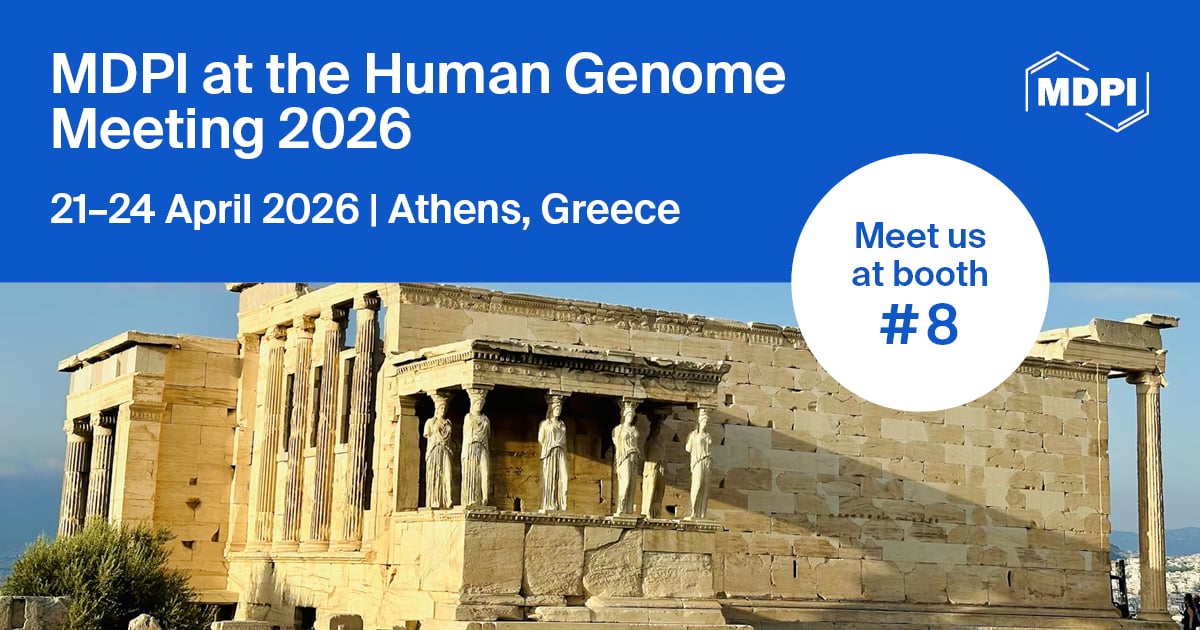
Conference: Human Genome Meeting 2026.
Organization: Human Genome Organization (HUGO).
Date: 21–24 April 2026.
Place: Athens, Greece.
Booth: #8.
MDPI journals will be attending the Human Genome Meeting 2026 as an exhibitor. The Human Genome Meeting 2026 will be held on April 22nd to 24th, 2026, in Athens, Greece, with a pre-day trainee symposium on April 21st. The theme of the HGM2026, “Bringing our Genomes to Medicine”, reflects the focus on various aspects of genome-stratified medicine and therapeutic interventions, including but not limited to pharmacogenomics, polypharmacy, population genomics, large-scale sequencing projects, clinical implementation of personalized medicine interventions, genome informatics, public health genomics, ethics in genomics, health economics, and others. Drawing on a truly broad-reaching and international line-up of experts, HGM 2026 promises to be a dynamic forum for scientific exchange and a unique opportunity to unite global expertise all focused on the subject of “Personalized Medicine and Therapeutics— Improving health”.
The following MDPI journals will be represented:
If you plan on attending this conference, feel free to stop by our booth #8. Our delegates look forward to meeting you in person to answer any questions you may have.
For more information about the conference, please visit the following link: https://www.hugo-hgm2026.org/
28 February 2026
Journal of Personalized Medicine | Editor’s Choice Articles in Q4 of 2025

We are delighted to share some of the Editor’s Choice Articles that were published in the Journal of Personalized Medicine (JPM, ISSN: 2075-4426) in Q4 of 2025. The full list can be viewed via the following link: https://www.mdpi.com/journal/jpm/editors_choice.
1. “Predicting the Onset of Diabetes with Machine Learning Methods”
by Chun-Yang Chou, Ding-Yang Hsu and Chun-Hung Chou
J. Pers. Med. 2023, 13(3), 406; https://doi.org/10.3390/jpm13030406
Available online: https://www.mdpi.com/2075-4426/13/3/406
Cited by 113 | Viewed by 12030+
2. “Advancing Patient Care: How Artificial Intelligence Is Transforming Healthcare”
by Diana Gina Poalelungi, Carmina Liana Musat, Ana Fulga, Marius Neagu, Anca Iulia Neagu, Alin Ionut Piraianu and Iuliu Fulga
J. Pers. Med. 2023, 13(8), 1214; https://doi.org/10.3390/jpm13081214
Available online: https://www.mdpi.com/2075-4426/13/8/1214
Cited by 114 | Viewed by 22095+
3. “The Role of BDNF as a Biomarker in Cognitive and Sensory Neurodegeneration”
by Anna Pisani, Fabiola Paciello, Valeria Del Vecchio, Rita Malesci, Eugenio De Corso, Elena Cantone and Anna Rita Fetoni
J. Pers. Med. 2023, 13(4), 652; https://doi.org/10.3390/jpm13040652
Available online: https://www.mdpi.com/2075-4426/13/4/652
Cited by 72 | Viewed by 11520+
4. “Biomarkers as Prognostic Predictors and Therapeutic Guide in Critically Ill Patients: Clinical Evidence”
by Rosa Méndez Hernández and Fernando Ramasco Rueda
J. Pers. Med. 2023, 13(2), 333; https://doi.org/10.3390/jpm13020333
Available online: https://www.mdpi.com/2075-4426/13/2/333
Cited by 58 | Viewed by 10090+
5. “Challenging ChatGPT 3.5 in Senology—An Assessment of Concordance with Breast Cancer Tumor Board Decision Making”
by Sebastian Griewing, Niklas Gremke, Uwe Wagner, Michael Lingenfelder, Sebastian Kuhn and Jelena Boekhoff
J. Pers. Med. 2023, 13(10), 1502; https://doi.org/10.3390/jpm13101502
Available online: https://www.mdpi.com/2075-4426/13/10/1502
Cited by 57 | Viewed by 4875+
6. “Multi-Modal Stacking Ensemble for the Diagnosis of Cardiovascular Diseases”
by Taeyoung Yoon and Daesung Kang
J. Pers. Med. 2023, 13(2), 373; https://doi.org/10.3390/jpm13020373
Available online: https://www.mdpi.com/2075-4426/13/2/373
Cited by 54 | Viewed by 5310+
7. “Airway Management: The Current Role of Videolaryngoscopy”
by Sophie A. Saul, Patrick A. Ward and Alistair F. McNarry
J. Pers. Med. 2023, 13(9), 1327; https://doi.org/10.3390/jpm13091327
Available online: https://www.mdpi.com/2075-4426/13/9/1327
Cited by 51 | Viewed by 9790+
8. “State of the Art in Robotic Surgery with Hugo RAS System: Feasibility, Safety and Clinical Applications”
by Francesco Prata, Alberto Ragusa, Claudia Tempesta, Andrea Iannuzzi, Francesco Tedesco, Loris Cacciatore, Gianluigi Raso, Angelo Civitella, Piergiorgio Tuzzolo, Pasquale Callè et al.
J. Pers. Med. 2023, 13(8), 1233; https://doi.org/10.3390/jpm13081233
Available online: https://www.mdpi.com/2075-4426/13/8/1233
Cited by 45 | Viewed by 6725+
9. “Functional Alignment Philosophy in Total Knee Arthroplasty—Rationale and Technique for the Valgus Morphotype Using an Image Based Robotic Platform and Individualized Planning”
by Jobe Shatrov, Constant Foissey, Moussa Kafelov, Cécile Batailler, Stanislas Gunst, Elvire Servien and Sébastien Lustig
J. Pers. Med. 2023, 13(2), 212; https://doi.org/10.3390/jpm13020212
Available online: https://www.mdpi.com/2075-4426/13/2/212
Cited by 45 | Viewed by 9755+
10. “The Role of Uric Acid in Human Health: Insights from the Uricase Gene”
by Youssef M. Roman
J. Pers. Med. 2023, 13(9), 1409; https://doi.org/10.3390/jpm13091409
Available online: https://www.mdpi.com/2075-4426/13/9/1409
Cited by 42 | Viewed by 19190+
11. “Emerging Applications of Nanoparticles in the Diagnosis and Treatment of Breast Cancer”
by Josephine B. Oehler, Weranga Rajapaksha and Hugo Albrecht
J. Pers. Med. 2024, 14(7), 723; https://doi.org/10.3390/jpm14070723
Available online: https://www.mdpi.com/2075-4426/14/7/723
Cited by 42 | Viewed by 10560+
12. “Associations of BDNF/BDNF-AS SNPs with Depression, Schizophrenia, and Bipolar Disorder”
by Anton Shkundin and Angelos Halaris
J. Pers. Med. 2023, 13(9), 1395; https://doi.org/10.3390/jpm13091395
Available online: https://www.mdpi.com/2075-4426/13/9/1395
Cited by 39 | Viewed by 7815+
13. “Intelligent Digital Twins for Personalized Migraine Care”
by Parisa Gazerani
J. Pers. Med. 2023, 13(8), 1255; https://doi.org/10.3390/jpm13081255
Available online: https://www.mdpi.com/2075-4426/13/8/1255
Cited by 39 | Viewed by 5930+
14. “Active Surveillance for Prostate Cancer: Past, Current, and Future Trends”
by Ivo I. de Vos, Henk B. Luiting and Monique J. Roobol
J. Pers. Med. 2023, 13(4), 629; https://doi.org/10.3390/jpm13040629
Available online: https://www.mdpi.com/2075-4426/13/4/629
Cited by 38 | Viewed by 7535+
15. “Three-Dimensional Accuracy and Stability of Personalized Implants in Orthognathic Surgery: A Systematic Review and a Meta-Analysis”
by Alexandru Diaconu, Michael Boelstoft Holte, Gabriele Berg-Beckhoff and Else Marie Pinholt
J. Pers. Med. 2023, 13(1), 125; https://doi.org/10.3390/jpm13010125
Available online: https://www.mdpi.com/2075-4426/13/1/125
Cited by 38 | Viewed by 5715+
16. “Leveraging Machine Learning for Personalized Wearable Biomedical Devices: A Review”
by Ali Olyanasab and Mohsen Annabestani
J. Pers. Med. 2024, 14(2), 203; https://doi.org/10.3390/jpm14020203
Available online: https://www.mdpi.com/2075-4426/14/2/203
Cited by 35 | Viewed by 15140+
17. “Epidemiology and Risk Factors of UTIs in Children—A Single-Center Observation”
by Maria Daniel, Hanna Szymanik-Grzelak, Janusz Sierdziński, Edyta Podsiadły, Magdalena Kowalewska-Młot and Małgorzata Pańczyk-Tomaszewska
J. Pers. Med. 2023, 13(1), 138; https://doi.org/10.3390/jpm13010138
Available online: https://www.mdpi.com/2075-4426/13/1/138
Cited by 35 | Viewed by 10865+
You can view the abovementioned articles and submit papers to JPM via the following link: https://www.mdpi.com/journal/jpm.
JPM Editorial Office
28 February 2026
MDPI INSIGHTS: The CEO’s Letter #32 - MDPI China and Thailand, China Science Daily, 1,000 Partnerships, R2R

Welcome to the MDPI Insights: The CEO's Letter.
In these monthly letters, I will showcase two key aspects of our work at MDPI: our commitment to empowering researchers and our determination to facilitating open scientific exchange.
Opening Thoughts

Reflections from China: Year-End-Celebrations and Open Access Publishing
In February, I had the pleasure of joining over a thousand colleagues from our Tongzhou and Haidian offices at their end-of-year annual celebration in Beijing.
Spending time with our teams in China is also a powerful reminder of the scale and complexity of MDPI as a global organization. Our colleagues in Beijing, Wuhan, and across the country play a significant role in our day-to-day operations and long-term development. I’m grateful for the hospitality, collaboration, and commitment shown by our managers and teams in China, alongside colleagues worldwide, who have helped steadily build MDPI, brick by brick, over the years.
Below are some data on Open Access (OA) publishing in China and our collaboration in this important research market.
Open Access Publishing in China
China has been the world’s leading country in research and review article publication volume since 2019, exceeding one million publications in 2025. Over the past five years, the gap between China and the second-ranked country, the United States, has continued to widen.
In 2025:
- 47% of China’s research output was published Open Access
- Of those OA publications, 76% were Gold Open Access (approximately 382,930 articles)
- The overall OA distribution remained stable compared with 2024, with Gold OA increasing by 1%
Over the past five years (2021–2025):
- China published 4,398,050 research and review articles
- Approximately 48% of this output was OA
According to Dimensions, when comparing the top 20 countries by publication volume (2021–2025):
- China ranks 1st worldwide in publication volume
- China ranks 9th in citation performance within this group (for comparison, the US ranks 2nd in publication volume and 10th in citation ranking)
- Average citations per article: 12.51
Among the top 10 universities globally by publication volume, six are Chinese institutions, alongside Harvard University (USA), the University of São Paulo (Brazil), the University of Toronto (Canada), and the University of Oxford (UK).

MDPI and China
China is an important and long-standing part of MDPI’s global publishing ecosystem:
- In 2025, MDPI was the largest fully Open Access publisher in China
- MDPI published 22% of China’s Gold Open Access output (82,133 papers)
- We received 290,999 submissions from China-affiliated authors and published 82,133 articles
- There are 8,500+ active Editorial Board Members based in China
- 64% (5,438) have an H-index above 26
- MDPI works with:
- 117 Editors-in-Chief
- 103 Section Editors-in-Chief
- 71 China-based institutions currently hold IOAP agreements with MDPI, seven of which rank among the top 10 Chinese institutions by publication volume
China's scale in research output means that the publishing platforms chosen by Chinese scholars will continue to influence the direction of scholarly publishing. At the same time, MDPI’s strength comes from its international collaboration, with colleagues, editors, reviewers, and authors working together across regions and disciplines.
Thank you to all our colleagues in China, and around the world, who support MDPI’s publishing activities across departments and help advance open access research every day.
Impactful Research

“Progress in open science is built through trust, dialogue, and relationships”
Behind the Scenes: A Conversation with China Science Daily
During my trip to Beijing, I also had the opportunity to visit China Science Daily and take part in an interview and broader exchange with their team in Beijing. Visits like this matter because progress in open science is built not only through platforms and infrastructure, but also through trust, dialogue, and relationships across research communities and regions.
China Science Daily: History Museum
As part of the visit, I was given a tour of their History Museum, which offers a thorough perspective on the evolution of China’s first science and technology newspaper, established in 1959. The exhibition highlights how the organization developed into a trusted institution connecting research with the public and policymakers. It was a helpful reminder that at the core of publishing is stewardship, credibility, and long-term public engagement with science.

An Open Exchange on Open Science
During the visit, I met with Dr. Zhao Yan, Editor-in-Chief of ScienceNet. We had an open and engaging conversation about MDPI’s role in Open Access, the evolution of open science globally, and the potential for more collaboration going forward. He especially appreciated the candid and personal nature of our exchange, noting that this kind of dialogue feels important in a landscape where trust and transparency matter.

Interview on Open Access
I also participated in an interview with Ms. Yan Jie, from the Online Media Center and Editor-in-Chief of ScienceNet, China Science Daily. Our discussion covered the growth of Open Access over the past 30 years, MDPI’s mission and values, academic integrity, collaboration with the Chinese research community, and MDPI’s own 30th anniversary milestone. It was a great opportunity to reflect on how open science has matured, and where shared responsibility across publishers, institutions, and researchers continues to matter most.
“Progress in open science is built by more than scale and infrastructure”
I’m sharing a few photos from the visit as a glimpse behind the scenes. The full interview will be published by China Science Daily in due course, and I look forward to sharing it when it is available.

More broadly, visits like this reinforce something I’ve always believed in: progress in open science is built not only through scale and infrastructure, but also through continued dialogue, mutual respect, collaboration, and a willingness to listen across regions and perspectives. That remains central to our work, especially as MDPI reflects on 30 years of publishing, built together.
Inside MDPI

Bangkok Visit: Growth, Partnership, and Local Impact
In February, I also had the opportunity to visit our Bangkok office for the second time in two years to support their local meetings and deliver a training session on how we present MDPI at a corporate level.
It’s easy to spend time with our colleagues in Thailand. From Editorial and Production to Conferences, Marketing, Design, and our Regional Journal Relations Specialist (RJRS), the team continues to grow in scale and professionalism. I’d also like to recognize our local management and admin teams, who have been steadily expanding our office and supporting more than 500 colleagues on the ground.
Academic Partnerships
During the visit, we met with the Engineering Department at King Mongkut’s Institute of Technology Ladkrabang (KMITL). Our discussion focused on the recent MDPI developments, Institutional Open Access Program (IOAP) opportunities, Author Publishing Workshops (APW), and the potential use of JAMS to support their institutional journal.

“MDPI is the third-largest OA publisher in Thailand”
We also shared insights into the growth of Open Access (OA) in Thailand and KMITL’s own publishing trends. These conversations matter because institutions are looking for sustainable ways to support their researchers. Our IOAP agreements are one simple example of how we can provide value in this area while maintaining accessibility for authors.
Thailand and MDPI: 2025 Snapshot
Our Bangkok office, officially launched in 2022, has been growing to support over 500 staff members while continuing to expand its engagement in scholar visits, workshops, and conference collaborations. As at 2025, Thailand submissions to MDPI have increased about 21% and publications by about 25%, maintaining a rejection rate close to the company average. MDPI is the third-largest OA publisher in Thailand, publishing 15% of all Gold OA output in 2025.
Representing MDPI Externally
During the visit, I delivered a training session on how we present MDPI at external events.

This session covered topics related to:
- Our aim and guiding principles
- High-level company milestones and Indexing facts and figures
- Industry partnerships and collaborations
- Market trends in OA and subscription publishing
- Country-specific publishing data and collaborations with MDPI
- Insights from our Voice of Community report
I find that while many colleagues are very familiar with the specific journal for which they have responsibility, fewer have visibility into the broader MDPI ecosystem and the company’s global positioning. These sessions help build alignment, confidence, and consistency in how we represent the company.
What stands out most is that MDPI’s growth is not abstract: it’s visible in the people, the partnerships, and the professionalism developing across our offices.
Coming Together for Science

1,000 Institutional Partners: A Milestone Built on Trust
This month, we reached an important milestone: more than 1,000 institutions worldwide are now part of MDPI’s Institutional Open Access Program (IOAP). On paper, that is a number. In practice, it represents trust.
This milestone symbolizes thousands of conversations with libraries and institutions. It stands for negotiations, renewals, consortium expansions, and, most importantly, relationships built over time. It reflects the work of colleagues across publishing, institutional partnerships, marketing, editorial, finance, and many other teams who contribute to making these agreements operational.
In 2025 alone, more than 61,300 research articles benefited from article processing charge (APC) discounts through IOAP agreements. Tens of thousands of authors were able to publish through a simplified and structured process. At the same time, institutional administrators gained clearer oversight and streamlined workflows.

Why IOAP Matters
When we launched IOAP, the objective was straightforward: to reduce barriers for researchers while supporting institutions in navigating the evolving OA landscape. Over the past decade, the research ecosystem has changed. Funder mandates, national policies, and Plan S–aligned requirements have accelerated the transition to OA.
Institutions need publishing partners who provide transparency, scalability, and operational efficiency. IOAP was designed to support that reality.
For colleagues who would like to better understand the program, this blog-post overview of MDPI’s IOAP provides additional context, including common questions around the transition to OA and how our institutional partnerships are structured.
“Institutions need publishing partners who provide transparency, scalability, and operational efficiency”
Recent Examples
Our agreements continue to evolve across regions:
- In Sweden, MDPI signed a national Open Access publishing agreement with 96 institutions, enabling affiliated researchers to publish without managing individual APC payments.
- In Spain, we extended our flat-fee agreement with Universidad Católica de Valencia, reinforcing institutional support for OA publishing.
These examples show that institutions seek structured, predictable models that support their researchers at scale.
Looking Ahead
Crossing the threshold of 1,000 partners tells us that institutions see MDPI not just as a publisher but as a reliable operational partner in advancing open science. This milestone is not a finish line. It is a reminder that the work continues.
Thank you to the entire IOAP team and to all colleagues who contributed to reaching this achievement.
P.S. You can read about this milestone across industry outlets, including STM Publishing News, ALPSP, Research Information, EurekAlert, Brightsurf, among others. You can also read about the coverage in Poland (e.g., media-room, bomega) Korea (newstap), and Romania (EduLike).
Closing Thoughts

Reflections from the Researcher to Reader Conference
During 24–25 February, I attended the 2026 Researcher to Reader Conference in London, UK. Leaders from across scholarly publishing, research infrastructure, libraries, and technology gathered to discuss AI and research integrity, peer review reform, metadata and infrastructure, community engagement, open research policy, and the evolving role of publishers in a rapidly shifting ecosystem.
The conversations were open and honest, and at times uncomfortable – exactly what we need at times. Below are a few reflections that stayed with me.
The Battle for Knowledge: What Becomes Accepted as ‘True’?
One recurring theme was not whether science evolves but whether our infrastructure is resilient enough to sustain trust at scale. Science does not promise certainty: it promises process. As publishing systems grow more complex and become more technologically mediated, the question is how intentionally we design, monitor, and strengthen that process.
Peer Review: Speed, Credentials, and Structural Loops
Researchers consistently call for faster peer review. At the same time, reviewer credentials are often tied to publication records. This creates a structural loop. Publishing history opens reviewing opportunities, reviewing strengthens credentials, and those without early access remain outside the cycle.
There is a need for us to reflect on how opportunity circulates within our systems: we should ask how we create more inclusive pathways for researchers globally to participate in peer review.
Community Engagement Workshop
One of the highlights of R2R was the workshop format, whereby small groups met repeatedly over two days and moved from ideas to tangible strategies.
I joined the Community Engagement workshop led by Lou Peck (CEO at The International Bunch) and Godwyns Onwuchekwa (Principal Consultant at Global Tapestry Consulting). We explored two deceptively simple questions: What is a community? and What does engagement truly mean?
“Engagement requires shared design and shared responsibility”
Too often, organizations equate communication with engagement. The framework discussed mapped a maturity spectrum – from enablement (broadcasting, informing and consulting) to true engagement (collaborating and co-creating).
It was a useful reminder of the fact that if we want trust and loyalty, engagement must go beyond announcements and surveys. It requires shared design and shared responsibility.
AI: Democratization or Digital Colonialism?
I especially enjoyed the thought-provoking presentation from Nikesh Gosalia (Chief Partnership Officer at Cactus Communications), which highlighted an uncomfortable reality:

- 93% of AI-generated content is in English
- Approximately 2% is in French
- Approximately 2% is in German
- More than 7,000 languages are represented in less than 5% of the content within large AI systems
The implications are profound. Is AI democratizing access to scholarly publishing (making it easier for researchers everywhere to participate in global knowledge production)? Or are we encoding colonialism at scale (entrenching linguistic and structural hierarchies, and making it harder for voices from the Global South to be heard)?
AI is already reshaping how research is created, reviewed, discovered, and shared. Its potential is enormous. But its impact depends not only on capability, but on governance, design, and intentionality. Publishers, funders, and researchers all share responsibility in shaping how these systems evolve.
Ethicality in practice (Lightening Talk)

It was also great to have our colleague Dr Miloš Čučulović (Head of Technology Innovation at MDPI) present MDPI’s Ethicality platform during a lightning talk.
“Technology alone is not the answer”
Ethicality embeds AI-driven checks directly into the submission workflow, supporting editors proactively rather than reacting after publication. As we scale, tools like this help balance trust, efficiency, and research integrity.
This goes back into the underlying theme of the conference that technology alone is not the answer. However, technology embedded thoughtfully within clear governance frameworks can strengthen confidence in the editorial process.
Final thought
The question is no longer whether technology will transform research infrastructure: it is already doing so. The real question is what role each of us will play in shaping that transformation deliberately, with structural maturity, inclusive governance, and engagement that moves from informing to co-creating.
Science needs to evolve, responsibly. And that responsibility extends not only to what we publish, but also to how the systems behind publication are designed. Some important topics to continue reflecting on both internally and within our broader community.
Chief Executive Officer
MDPI AG
27 February 2026
Journal of Personalized Medicine | Highly Viewed Papers in 2025 and Hot Topic Special Issues in the “Pharmacogenetics” Section

We are thrilled to share some of the highly viewed papers in the section “Pharmacogenetics” that were published in the Journal of Personalized Medicine (JPM, ISSN: 2075-4426) in 2025. In addition, some Special Issues in this section are open for submission. The following is a list of articles and Special Issues that we believe will be of interest to you.
The highly viewed articles are as follows:
1. “Major Allele Frequencies in CYP2C9 and CYP2C19 in Asian and European Populations: A Case Study to Disaggregate Data Among Large Racial Categories”
by Horng-Ee Vincent Nieh and Youssef Malak Roman
J. Pers. Med. 2025, 15(7), 274; https://doi.org/10.3390/jpm15070274
Available online: https://www.mdpi.com/2075-4426/15/7/274
2. “Clinician Experiences at the Frontier of Pharmacogenomics and Future Directions”
by Stefan Thottunkal, Claire Spahn, Benjamin Wang, Nidhi Rohatgi, Jison Hong, Abha Khandelwal and Latha Palaniappan
J. Pers. Med. 2025, 15(7), 294; https://doi.org/10.3390/jpm15070294
Available online: https://www.mdpi.com/2075-4426/15/7/294
3. “Implementation of Pharmacogenomics Testing in Daily Clinical Practice: Perspectives of Prescribers from Two Canadian Armed Forces Medical Clinics”
by Alexandra Muller-Gass, Gouri Mukerjee, Ruslan Dorfman and Rakesh Jetly
J. Pers. Med. 2025, 15(3), 101; https://doi.org/10.3390/jpm15030101
Available online: https://www.mdpi.com/2075-4426/15/3/101
4. “Impact of Complex Genetic and Drug–Drug Interactions on Tamoxifen Metabolism and Efficacy”
by Ibtissam Saad, Kaoutar Bentayebi, Soukaina Ettoury, Oumaima Zarrik, Ilhame Bourais, Saber Boutayeb, Caroline Samer, Youssef Daali, Rachid Eljaoudi and Sara Louati
J. Pers. Med. 2025, 15(11), 505; https://doi.org/10.3390/jpm15110505
Available online: https://www.mdpi.com/2075-4426/15/11/505
5. “Clinical Pharmacogenetics: Results After Implementation of Preemptive Tests in Daily Routine”
by Xando Díaz-Villamarín, María Martínez-Pérez, María Teresa Nieto-Sánchez, Emilio Fernández-Varón, Alicia Torres-García, Isabel Blancas, José Cabeza-Barrera and Rocío Morón
J. Pers. Med. 2025, 15(6), 245; https://doi.org/10.3390/jpm15060245
Available online: https://www.mdpi.com/2075-4426/15/6/245
6. “Enhancing Rural Healthcare Accessibility: A Model for Pharmacogenomics Adoption via an Outreach-Focused Integration Strategy”
by Jared Silver, Evan Forman, David Barrett, Jovana Sibalija and Richard Kim
J. Pers. Med. 2025, 15(3), 110; https://doi.org/10.3390/jpm15030110
Available online: https://www.mdpi.com/2075-4426/15/3/110
7. “Exploring the Clinical Workflow in Pharmacogenomics Clinics: An Observational Study”
by Nicole Keuler, Jane McCartney, Renier Coetzee and Rustin Crutchley
J. Pers. Med. 2025, 15(4), 146; https://doi.org/10.3390/jpm15040146
Available online: https://www.mdpi.com/2075-4426/15/4/146
8. “Pharmacogenomics in Diabetes: Population-Specific Insights from Colombia”
by David A. Hernandez-Paez, Johana Galván-Barrios, Kevin Fernando Montoya-Quintero and Indiana Luz Rojas Torres
J. Pers. Med. 2025, 15(10), 481; https://doi.org/10.3390/jpm15100481
Available online: https://www.mdpi.com/2075-4426/15/10/481
Special Issues:
| “New Trends and Challenges in Pharmacogenomics Research” Guest Editor: Prof. Dr. Youssef Roman Submission deadline: 31 May 2026 |
“Advances in Physiologically Based Pharmacokinetics” Guest Editors: Dr. Rodrigo Cristofoletti and Dr. Janny Piñeiro-Llanes Submission deadline: 20 June 2026 |
 |
 |
You are invited to view the above-mentioned articles and submit relevant papers to the journal Cancers at the following link: https://www.mdpi.com/journal/jpm.
JPM Editorial Office
20 February 2026
MDPI Virtual Academic Publishing Workshop (New Harvest), 25 February 2026

This Academic Publishing Workshop will be led by MDPI Regional Journal Relations Specialist, Dr. Sally Wu, on “Author Training”. Participants will receive practical advice on essential aspects of writing academic articles. Participants will leave with a clearer understanding of the academic publishing landscape and how to successfully contribute to it.
Date: 25 February 2026
Time: 11:30 a.m.–1:30 p.m. EST
Schedule:
|
Speaker |
Program |
Time in EST |
|
Dr. Sally Wu |
Introduction |
11:30–11:40 a.m. |
|
Dr. Sally Wu |
Tips for Writing Great Research Papers
|
11:40 a.m.–12:15 p.m. |
|
Dr. Sally Wu |
How to Respond to Peer Reviewers
|
12:15–12:50 p.m. |
|
Dr. Sally Wu |
AI in Publishing: Challenges and Opportunities
|
12:50–13:30 p.m. |
Speakers:
|
|
Dr. Sally Wu received a PhD in medical science from the University of Toronto in the fall of 2025. She joined MDPI in February 2025 as an Assistant Editor for Cells. She was recently promoted to Regional Journal Relations Specialist position in August. In this role, she works with many journals, liaising with authors, board members, and EiCs. She has attended several conferences across North America, hosted scholar visits, and taken part in other outreach events. |

18 February 2026
Acknowledgment to the Reviewers of Journal of Molecular Pathology in 2025

The editorial office of Journal of Molecular Pathology (JMP) would like to extend its sincere gratitude to all reviewers who contributed to the improvement of the journal quality by providing their expert opinion and evaluation of the submitted research.
We appreciate that thorough peer review demands considerable time and intellectual investment from our reviewers. In 2025, JMP received 223 review reports from contributors across 34 countries and territories, demonstrating the breadth of international expertise and scholarly engagement that has strengthened our publication standards.
The reviewers who agreed to have their names published this year are listed below in alphabetical order by first name. The editorial team acknowledges with gratitude all reviewers, named and anonymous alike, for their vital role in maintaining the scholarly standards of JMP.
| Airat Bilyalov | John Dotis |
| Aldona Kasprzak | José Carlos De La Flor |
| Anto Sam Crosslee Louis Sam Titus | Jumari Snyman |
| Bangyuan Wu | Jung-Tae Lee |
| Bo Li | Kohei Funasaka |
| Carla Miranda | Matvey M. Tsyganov |
| Eduardo López-Urrutia | Michele Cennamo |
| Fan Tang | Mohammad Hasanain |
| Fernando Javier Barreyro | Oleg M. Demchuk |
| Francisco J. del Castillo | Panagiotis Mallis |
| Gabriele Napoletano | Paolo Fagone |
| Gianluca Baldanzi | Richard John Bruce Francis |
| Giulia Valentini | Roman Moskalenko |
| Giuseppe Losurdo | Rossella Melcarne |
| Hector Ivan Saldivar Ceron | Sahiti Chukkapalli |
| Howard Lopes Ribeiro Junior | Simona De Summa |
| Jasenka Wagner | Stefano Stracquadanio |
| Jerzy Tadeusz Chudek | Tahir Cetin Akinci |
| Jianzhu Liu | Vincenzo Cuteri |
| Jinwen Kang | Zhen Li |
18 February 2026
MDPI’s Open Access Program Reaches 1,000 Institutions Worldwide
MDPI has surpassed the milestone of 1,000 partners within the Institutional Open Access Program (IOAP). The agreements span 59 countries, covering North and South America, Europe, Asia, Africa, and Oceania.
Last year alone, more than 150 new libraries and academic institutions joined MDPI’s IOAP. With the expansion of an existing consortium deal in Sweden we welcomed a further 75 partners to the program in January 2026, enabling us to surpass the 1,000-partners milestone.
The IOAP supports affiliated researchers by streamlining submission processes, reducing administrative burdens, and offering discounted Article Processing Charges (APCs). Through IOAP membership, more than 61,300 research articles received APC discounts in 2025, driving greater visibility and accessibility for partner institutions and global research communities alike.
"This milestone marks a significant step towards expanding MDPI’s global impact," said Stefan Tochev, MDPI's CEO. "Reaching 1,000 IOAP partnerships is a true testament to the growing trust and collaboration we’ve built with universities, libraries, and research organizations worldwide. We are proud to lead the way in Open Access publishing, ensuring researchers have the support they need to reach global audiences." "The success of our program is reflected in the growing global demand for Open Science and quality publishing services," said Becky Castellon, MDPI institutional partnerships manager. "Equally, institutions are increasingly seeking Open Access publishing options that support funder and national mandates. Joining the IOAP makes compliance simple."
3 February 2026
Acknowledgment to the Reviewers of Journal of Personalized Medicine in 2025

The editorial office of Journal of Personalized Medicine would like to extend its sincere gratitude to all reviewers who contributed to the improvement of the journal quality by providing their expert opinion and evaluation of the submitted research.
We appreciate that thorough peer review demands considerable time and intellectual investment from our reviewers. In 2025, Journal of Personalized Medicine received 3213 review reports from contributors across 82 countries and territories, demonstrating the breadth of international expertise and scholarly engagement that has strengthened our publication standards.
The reviewers who agreed to have their names published this year are listed below in alphabetical order by last name/first name. The editorial team acknowledges with gratitude all reviewers, named and anonymous alike, for their vital role in maintaining the scholarly standards of Journal of Personalized Medicine.
|
Abdolreza Jamilian |
Giuliano Anastasi |
Muntean Calin |
|
Abel Lerma |
Giulio Cirignaco |
Murat Koklu |
|
Abiola Victor Adepoju |
Giuseppe Losurdo |
Mustafa Busuladžić |
|
Ach Taieb |
Giuseppe Mincolelli |
Nadine Darwiche |
|
Adam Daniel Durma |
Giuseppe Verolino |
Nadir Yalcin |
|
Adam Gędek |
Godfrey Mutashambara Rwegerera |
Nanush Damarlapally |
|
Adina Braha |
Gokul Patil |
Naofumi F Sumitomo |
|
Aditya Yashwant Sarode |
Grigorios Kastanis |
Nardi Tetaj |
|
Adrián Hernández-Díazcouder |
Guilherme Welter Wendt |
Narendran Pradeep Kumar |
|
Adriana Grigoraș |
Gulali Aktas |
Narongchai Autsavapromporn |
|
Advait Vasavada |
Hammad A Ganatra |
Nasuh Utku Dogan |
|
Afshana Quadiri |
Hans-Oliver Rennekampff |
Natasha J. Petry |
|
Agamemnon Bakakos |
Haowei Tai |
Nathalie Vionnet |
|
Agata Tarkowska |
Hasan Çağrı Yıldırım |
Nezar Watted |
|
Agostino Fernicola |
Hassan Rasouli |
Nikias Milaras |
|
Ahmad R. Alsayed |
Hatem A. Alhadainy |
Nikolaos Miaris |
|
Ahmed Elfana |
Hathal Haddad |
Nikolaos Zavras |
|
Ahmed Elsaftawy |
Hazem El Beyrouti |
Nina Mendez-Dominguez |
|
Ahmed Mohsen |
Hector Ivan Saldivar Ceron |
Nora Hosny |
|
Alberto Arezzo |
Héctor Quezada |
Normand García-Hernández |
|
Alejandro Cano-Villagrasa |
Hedley Knewjen Quintana |
Nuria Paz Torres-Aguila |
|
Aleksandar Jakovljević |
Hiam Alquran |
Oana Timofte |
|
Alen Rončević |
Hodaka Fujii |
Olgica Nedic |
|
Alexander E. Berezin |
Howard Lopes Ribeiro Junior |
Ömer Faruk Çiçek |
|
Alexandra Eleftheria Menni |
Hristina Zlatanova-Tenisheva |
Osama B Mohammed |
|
Alexandru Dan Costache |
Hsuan-Hsiang Chen |
Oveis Pourmehran |
|
Alexandru Ulici |
Husam Qanash |
Ozlem Evren Kemer |
|
Alexis Murillo Carrasco |
Hüseyin Üzen |
Pablo Díaz-Calvillo |
|
Alin Horatiu Nedelcu |
Iain A Rankin |
Pablo Santamarina-Ojeda |
|
Amalia Cornea |
Ian Burgess |
Paolo Scanagatta |
|
Amira J. Zaylaa |
Ibrahim Cil |
Paraschiva Chereches-Panta |
|
Amit Hudgi |
Ignacio García-Gil |
Parasuraman Subramani |
|
Amr Seifelnasr |
Ilia Kostadinov |
Parisa Kaviani |
|
Anastasia Spiliopoulou |
Ilze Beitane |
Parwis Massoudy |
|
Anastasios Potiris |
Ina Sevic |
Patrizia Garbati |
|
Andari Sarasati |
Ingrid Fricke-Galindo |
Patrycja Kleczkowska |
|
Anderson Bermon |
Inna Tulaeva |
Patryk Szymaszek |
|
András Molnár |
Ioannis Dimakos |
Paulo André Freire Magalhães |
|
André Araújo Pinto |
Ioannis Drygiannakis |
Pedro Camacho |
|
Andre Luiz Ferreira Costa |
Ioannis G. Katsantonis |
Pedro Moltó-Balado |
|
Andrea Carugno |
Ioannis Katsaros |
Pedro Serralheiro |
|
Andreas Antzoulas |
Ioannis Michelakis |
Petar Ozretić |
|
Andreas M. Matthaiou |
Iva Lakic |
Peter Kokol |
|
Andreea-Raluca Szőke |
Ivana Bozic Antic |
Peter Piko |
|
Andrei Marian Feier |
Ivana Medvedec Mikic |
Phu Dinh Hoang |
|
Andres Camargo-Sanchez |
Ivica Bosnjak |
Phuc Nhon Nguyen |
|
Andrey Elchaninov |
Iyad Naeem Muhammad |
Pier Paolo Piccaluga |
|
Andrijana Stanisavljević Ilić |
Izabel Cristina Rodrigues Da Silva |
Pilar Merino-Sanz |
|
Angelica Quercia |
Jakov Ajduk |
Pinelopi Samara |
|
Angeliki Gerede |
Jakub Kufel |
Piotr Sobolewski |
|
Angelo Cianciulli |
Jakub Mlodawski |
Prabir Kumar Gharai |
|
Anna Kawiak |
Jakub Smiechowicz |
Pratibha Gopalkrishna |
|
Anna Rogozińska-Pawełczyk |
Jaldeep Langhnoja |
Predrag Jancic |
|
Antonio Barbato |
James C. L. Chow |
Predrag Nikic |
|
Antonio G. Lentoor |
Jan Francesco Arena |
Priya Upadhyay |
|
António Miguel Morgado |
Jan Žatecký |
Qi Shao |
|
Antonio Romanelli |
Janusz Książyk |
Qingsong Pang |
|
Antonios I. Christou |
Jędrzej Chrzanowski |
Radu Andrei Moga |
|
Ao Zhang |
Jelena Jadzic |
Rafael Bayareh Mancilla |
|
Arjun Pon Avudaiappan |
Jelena Janković Miljuš |
Rafat Ghanamah |
|
Arkadiusz Kocur |
Jelena Jelena Nikolic |
Raghunadharao Digumarti |
|
Arrvind Raghunath |
Jelena Of Kuvač Kraljević |
Rahul Shivaji Patil |
|
Arsen Uvelin |
Jelena Vekic |
Rakesh Kumar |
|
Arvind Mukundan |
Jesus Jonathan García-Galindo |
Rakhee Rathnam Kalari Kandy |
|
Ashot Avagimyan |
Jincheng Wang |
Raluca Isac |
|
Athanasios A. Panagiotopoulos |
Jinfeng Liu |
Raluca Simona Costache |
|
Athanasios G. Pantelis |
João José Joaquim |
Raluca Tatar |
|
Atrayee Ray |
Johannes Gerb |
Ram B Singh |
|
Aynur Aliyeva |
Jolanta Szymańska |
Rami Mahfouz |
|
Azna Zuberi |
Jonathan Soldera |
Ramkumar Kunka Mohanram |
|
Bahadar S Srichawla |
Jorge Góngora Rodríguez |
Raquel Medina-Ramírez |
|
Ballambhattu Vishnu Bhat |
José Ángel Rubiño-Díaz |
Rawan Rumman |
|
Balti Ala |
Jose Antonio Velázquez-Aragón |
Ray Lee |
|
Barbara Sanchez-Dengra |
José J. Leija-Martínez |
Recep Dokuyucu |
|
Bas Labree |
José Manuel Rodríguez-Pérez |
Renata Curić Radivojević |
|
Basil Barth Duwa |
Jose R. Guzman-Sepulveda |
Renhao Lu |
|
Begum Dariya |
Joshua Sparks |
Revaz Solomonia |
|
Bernadette Kálmán |
Josip Andelo Borovac |
Ricardo Cleto De Sousa Marinho |
|
Bhuvanesh Yathavan |
Jovana Despotović |
Ricardo D. Coletta |
|
Bilal El-Mansoury |
Juan Carlos Muñoz-Escalante |
Richard Tóth |
|
Bodhayan Prasad |
Juan Gerardo Reyes-García |
Rima Anggrena Dasrilsyah |
|
Bogdan Florin Toma |
Juan Luis Chávez Pacheco |
Rita Kiss |
|
Bogna Grygiel-Górniak |
Juan Luis Rodriguez Hermosa |
Ritthideach Yorsaeng |
|
Bojan Stojanovic |
Juan Manuel Guzman-Flores |
Robert Alexandru Barna |
|
Bruno Goncalves |
Juan Torres Melero |
Roberto Lazzarini |
|
Bruno Vidaković |
Judit Reka Hetthessy |
Roberto Lugo |
|
Burak Tasci |
Julio Alberto García-Rodríguez |
Rocco De Vitis |
|
Byeong Geun Kim |
Jun Thorsteinsdottir |
Rodrigo Galo |
|
Carla Giuseppina Corti |
|
Rodrigo Pardo-Turriago |
|
Carlos Eric Galván-Tejada |
|
Romil Parikh |
|
Carlos Izaias Sartorão Filho |
Kadir Uludag |
Roselena Silvestri Schuh |
|
Carmelina Cristina Zirafa |
Kamal Sharma |
Ruby Gupta |
|
Carmelina Ruggiero |
Kamil Koszela |
Rudolf Lampé |
|
Carmen Giuglea |
Kana Fujikura |
Rui Antunes Viana |
|
Carmen Ortiz |
Kanokwan Kulprachakarn |
Rumen Stefanov Filev |
|
Carolina L. Mercado |
Karen A. Boehme |
Ryuichi Ushijima |
|
Catalina Ramírez-Contreras |
Karmela Barisic |
Sabina Galiniak |
|
Celine Chaaya |
Katarzyna Mądra-Gackowska |
Sachin Kumar |
|
Chanda Simfukwe |
Katarzyna Zorena |
Sachio Takeno |
|
Chandra Mohan Reddy Muthumula |
Katsushi Takebayashi |
Said El-Ashker |
|
Charalampos Karachalios |
Kenji Hayashida |
Sally Atef Fahim |
|
Charalampos Thomas |
Kenji Ibayashi |
Saloua Mrabet |
|
Chenyu Huang |
Khashim Khashim |
Salvatore Giordano |
|
Chiara Maria Grana |
Klaus Schomäcker |
Samit Kumar Ghosh |
|
Chien-Jen Hsu |
Konstantinos Sidiropoulos |
Sandeep Moothedath Subrahmanian |
|
Chloe Lahoud |
Konstantinos Tigkiropoulos |
Sandra Modlińska |
|
Chonnakarn Jatchavala |
Kosuke Kojo |
Sandra S Stinnett |
|
Christian Messina |
Krishna Priya Syama |
Sang Hoon Oh |
|
Christian Schach |
Krystina Choinski |
Sanja Kostic |
|
Christoph Frank Dietrich |
Laura Balanescu |
Sasho Stoleski |
|
Christos Fragoulis |
Laura Rehak |
Sebastjan Bevc |
|
Christos Kyriakopoulos |
Lavinia Alexandra Moroianu |
Seeprarani Rath |
|
Cinzia Marinaro |
Lavinia Rech |
Selene M Garcia-Luna |
|
Ciprian Andrei Coroleuca |
Lenka Lhotska |
Semra Bilaçeroǧlu |
|
Clarissa Willers |
Leszek Szalewski |
Sen Zhang |
|
Claudia Brogna |
Letizia Perillo |
Seongmin Kim |
|
Claudia Crescio |
Lidija Savić |
Serap Özer Yaman |
|
Claudia Fernandez-Alarcon |
Lidija Tulic |
Seren Başaran |
|
Claudio Terraza |
Liton Devanth |
Sergio Martinez-Huenchullan |
|
Constantinos Chaniotakis |
Livia Ionela Bobu |
Setondji Cocou Modeste Alexandre Yahouédéhou |
|
Constantinos M. Koutsojannis |
Liviu Macovei |
Seyed Mohamadmehdi Moshtaghion |
|
Cosmin Ioan Faur |
Loai A Shakerdi |
Shai Elliot Nkoana |
|
Cristian Gutu |
Loai Shakerdi |
Shehwaz Anwar |
|
Cristian Ionut Orasanu |
Lokesh Manjani |
Shekhrajka Shekhrajka |
|
Cristian Iuliu Mihail Iorga |
Lord Jephthah Joojo Gowans |
Shivani Ror |
|
Cristian Trambitas |
Lorenzo Caruso |
Shuntaro Obi |
|
Cristina Florescu |
Lorenzo Malatino |
Silviu Albu |
|
Cristina Grosu |
Luca Camoni |
Silviu Cristian Voinea |
|
Cristina Mihaela Ghiciuc |
Luca Zanella |
Simran Maggo |
|
Cristina Tudoran |
Lucilene Arilho Ribeiro-Bicudo |
Soedarsono Soedarsono |
|
Cyrus Motamed |
Ľudmila Majerníková |
Sofian Al Shboul |
|
Daisuke Inoue |
Ludovica Battilocchi |
Song Peng Ang |
|
Damir Vučinić |
Luis Eduardo Almeida |
Sorabh Kapoor |
|
Dan Alexandru Cozac |
Luise Schäfer |
Soraia Pinto |
|
Dan Cristian Manescu |
Luka Bulić |
Souvagya Panigrahi |
|
Dana Emilia Movila |
Luka Šimunović |
Sreenija Yarlagadda |
|
Daniel B Hier |
Lusi Zhang |
Stefano Mancin |
|
Daniel Miron Brie |
Madiha Javeed |
Stergios Boussios |
|
Daniel Osmar Suárez-Rico |
Magdalena Iuliana Rufa |
Stipe Ćorluka |
|
Daphne Citherlet |
Mahyar Daskareh |
Suash Sharma |
|
Dariusz Wojciech Mazurkiewicz |
Maja Zoran Stefanović |
Sudarshan Bhattacharjee |
|
David B Sachar |
Majed Odeh |
Suguru Yokoo |
|
Dawei Ge |
Małgorzata Anna Poręba |
Sulagna Sanyal |
|
Delia Giovanniello |
Manav Jain |
Sumesh Sasidharan |
|
Dennis Demedts |
Manolis Abatzis-Papadopoulos |
Suthat Chottanapund |
|
Despoina Pantazi |
Manuele Cesare |
Swastik Phulera |
|
Deyan Yordanov Yosifov |
Marcel Firlej |
Swati Dahariya |
|
Diana Mitkova Hristova |
Marcin Sadlocha |
Syama Krishnapriya |
|
Diego Dantas |
Márcio De Carvalho Formiga |
Syed Haris Omar |
|
Diego Primavera |
Maria Kapritsou |
Syed Ibrar Hussain |
|
Diego Sangiorgi |
Maria Piedad Ussetti Gil |
Sylvester Ifeanyi Omoruyi |
|
Dileep Radhamony Amma (Nair) |
Maria Theodoratou |
Szederjesi Janos |
|
Dimitrina Georgieva Miteva |
Marianna Hall |
Szu-Chia Liao |
|
Dimitrios Varvoglis |
Marija Paunovic |
Taha Koray Sahin |
|
Dimitris Miliopoulos |
Marija S. Milic |
Tahir Yagdi |
|
Dimosthenis Lykouras |
Marin Ogorevc |
Tahir Yusuf Noorani |
|
Dinesh Kumar Thekkinkattil |
Mario Cantó Cerdán |
Takao Kimura |
|
Doha Mohamed |
Mario Ganau |
Tamara Vagg |
|
Dong Qiu |
Marios Spanakis |
Tarik Kivrak |
|
Donovan J. Peña-Montes |
Marius Militaru |
Teodora Telecan |
|
Dorota Formanowicz |
Marko Baralić |
Thawatchai Phaechamud |
|
Dr Mohammad Mofatteh |
Marko Spasic |
Theodoros Spinos |
|
Dragana Filipovic |
Marko Tarle |
Theofanis Vavilis |
|
Dragana M. Stanojevic |
Markus Gesslein |
Thomas Pincez |
|
Dragica Selakovic |
Marta Aleksandra Kwiatkowska |
Tomasz Potaczek |
|
Eleftherios P. Pappas |
Marta Forte |
Tomislav Kuzman |
|
Elisa Duranti |
Marton Keszthelyi |
Toshiyuki Kawai |
|
Elissavet Anestiadou |
Mary J. Van Schooneveld |
Tuğba Kuru Çolak |
|
Elżbieta Grześk |
Masafumi Itoh |
Tugrul Elverdi |
|
Emiel F.M. Wouters |
Masahiro Iinuma |
Valentin Puiu Chioncel |
|
Emilie Vomhof-Dekrey |
Matheus Vernet Machado Bressan Wilke |
Valeria Marques Ferreira Normando |
|
Emmanouil Ioannis Kapetanakis |
Matjaž Kopac |
Varvara Giuseppe |
|
Emmanouil Karampinis |
Matjaž Kopač |
Vasileios Sousonis |
|
Emmanouil M. Xydias |
Matteo Riccò |
Vasileios Tsagkalidis |
|
Enita Nakas |
Matthew Field |
Vassilios Panoutsakopoulos |
|
Erika Cvetko |
Maurizio Stella |
Vessela Krasteva |
|
Erika Rangel |
Mauro Lombardo |
Veysel Umman |
|
Eva Molina-Trinidad |
Mauro Namías |
Víctor Hugo Oidor-Chan |
|
Evan Leibner |
Mauro Parozzi |
Vinay Kumar Sharma |
|
Fabio Vistoli |
Maximilian Scheer |
Virgiliu Mihail Prunoiu |
|
Fahd Kuriri |
Mayank Gautam |
Viswas Raja Solomon |
|
Fatin Jannus |
Mayuri Mudgal |
Viviana Onofrei Aursulesei |
|
Felipe Alckmin Carvalho |
Md Daud Mohd Khairi |
Vlad Dima |
|
Felipe Leite Oliveira |
Md. Aktaruzzaman |
Vlad Horia Schitcu |
|
Felix J. Klimitz |
Mehmet Kaya |
Vlad-Ionuț Nechita |
|
Fengyang Huang |
Mehmet Yigit Akgun |
Vrinda Gote |
|
Filip Pilipovic |
Michael W Vannier |
Wankyu Eo |
|
Filippo Zilio |
Michail Galanis |
Warawut Chaiwong |
|
Filippos Gerasimos Filippatos |
Michelangelo Luciani |
Wasifa Naushad |
|
Fiona Healy |
Michele Wyler |
Wei Boon Yap |
|
Florian Dudde |
Miguel Castelo-Branco |
Wiktor Stopyra |
|
Florin Filip |
Miguel Olivas |
Wongthawat Liawrungrueang |
|
Florin Leontin Lazar |
Mihaela Ionica |
Xianyang Liu |
|
Francesco Maruccia |
Mihaela Pertea |
Xiao Jian Tan |
|
Francisco García Sánchez |
Mihail Lazar Mioc |
Yana Gvozdeva |
|
Francisco José Barbas Rodrigues |
Mihalj Poŝa |
Yanning Zuo |
|
Francisco Rivas García |
Mikhail Kulyabin |
Yannis Mantas Paulus |
|
Francisco Tustumi |
Milan Toma |
Yasin Yilmaz |
|
Franklin Parrales Bravo |
Milena Georgieva |
Yeuan Ting Lee |
|
Gabriel Magrin |
Min Ho Kang |
Yi Cheng Wu |
|
Gabriel Mihail Dimofte |
Ming-Chi Lu |
Yi-Hsin Chen |
|
Gabriela Goujgoulova |
Ming-Hui Hung |
Ying Li |
|
Gaelle Hayot |
Mircea Stoian |
Ying Wang |
|
Garri Chilingaryan |
Mladen Marinkovic |
Ylenia Cendon Florez |
|
Gazmend Temaj |
Mohamed Hany |
Young Hwii Ko |
|
Geer Teng |
Mohammad Mofatteh |
Yousef Tanas |
|
George Doumat |
Mohammad Mohabbulla Mohib |
Youssef El Sayed Ahmad |
|
Geovane Dias Lopes |
Mohammad Qneibi |
Yuan Chai |
|
Geraldo Magela Magela Salomé |
Mohammad Sarif Mohiuddin |
Yuliya Semenova |
|
Giacomo Bortolussi |
Moisés León-Ruiz |
Yuta Norimatsu |
|
Gianluca Pagnoni |
Monika Grudzinska Pechhacker |
Zenon Pogorelić |
|
Gianmarco Lazzini |
Monika Kaurav |
Zhiyuan Yang |
|
Giovanni Corrado |
Mor Rittblat |
Zorana Dobrijević |
|
Giovanni Mazzucato |
Moumita Chakraborty |
Zulkif Tanriverdi |
|
Gisele Silvestre Da Silva |
Mounika Angirekula |
