Skip to Content
You are currently on the new version of our website. Access the old version .

Journal of Fungi

Journal of Fungi is an international, peer-reviewed, open access journal of mycology published monthly online by MDPI.
The Medical Mycological Society of the Americas (MMSA) and Spanish Phytopathological Society (SEF) are affiliated with the Journal of Fungi, and their members receive discounts on the article processing charges.
Indexed in PubMed | Quartile Ranking JCR - Q1 (Mycology)

All Articles (6,320)

  • Technical Note
  • Open Access

The IMMY cryptococcal antigen (CrAg) lateral flow assay (LFA) is a reliable diagnostic tool for Cryptococcus detection, but false-positive results may arise from procedural or reagent-related errors, underscoring careful operation of the assay to ensure diagnostic accuracy and prevent unnecessary treatment. Two patients who were initially reported as CrAg-positive by a peripheral laboratory were referred to Kiruddu Hospital in Kampala, Uganda, for clinical assessment and confirmatory testing. Repeat tests were conducted using specimen diluent following the manufacturer’s protocol, resulting in negative results. Semi-quantitative CrAg LFA testing and a series of control assays were performed to identify the source of error. We were able to consistently reproduce positive results when the titration diluent was inappropriately used instead of the specimen diluent. Serial dilutions confirmed persistent false positivity up to 1:80 when inappropriately using the titration diluent, while all dilutions that appropriately started with the specimen diluent remained negative. We hypothesize that the incorrect use of titration diluent instead of specimen diluent led to false-positive CrAg LFA results due to the absence of the blocking agent that neutralizes heterophilic antibodies. Procedural errors can lead to diagnostic misinterpretation and serious consequences in clinical management, emphasizing the importance of adherence to manufacturer’s instructions.

12 February 2026
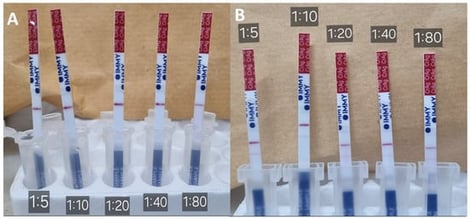
Cryptococcal antigen lateral flow assay with correct and incorrect diluents (Sample A pictured). Subpanel (A) shows the use of correct specimen diluent which yielded true-negative results. Serial dilutions using the specimen diluent as per manufacturer’s instructions, resulted in the IMMY CrAg LFA remaining a true negative for the two samples. Subpanel (B) shows the use of incorrect titration diluent which yielded false-positive results. Substituting specimen buffer with titration diluent at the 1:5 dilution step resulted in false-positive bands of consistent intensity up to the 1:80 dilution for both samples.

Sclerotium formation represents a critical transition phase in the life cycle of morel, shifting from vegetative growth to dormant structures. The capacity for sclerotium formation directly influences the yield and stability of artificial cultivation. To elucidate the molecular regulatory mechanisms underlying this process, a combined transcriptomics and metabolomics approach was employed to analyze gene expression and metabolite dynamics during sclerotium development of Morchella eximia. A total of 2567 differentially expressed metabolites (DEMs) and 2314 differentially expressed genes (DEGs) were detected, primarily enriched in amino acid metabolism, lipid synthesis, and energy metabolism pathways. Amino acid metabolism facilitates protein synthesis and supplies carbon skeletons, while lipid metabolic networks, particularly de novo fatty acid synthesis from acetyl-CoA precursors, glycerophospholipid metabolism, sphingolipid metabolism, and unsaturated fatty acid biosynthesis, play a central role in sclerotium formation. A regulatory model was constructed, focusing on signal response, transcriptional regulation, nutrient transport and metabolism, morphology transition, lipid accumulation, and membrane system remodeling, demonstrating that lipids not only provide energy storage and membrane structural components for sclerotia but also mediate developmental transitions and environmental adaptation through signaling molecules and regulation of membrane properties. These findings systematically reveal the regulatory network governing morel sclerotium formation at the multi-omics level, with particular emphasis on the central role of lipid metabolism and membrane remodeling. The results offer a theoretical foundation for improving morel cultivation yield and stability through targeted metabolic regulation strategies.

12 February 2026

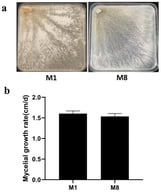
The cultural characteristics of sclerotia-producing (M1) and non-sclerotia-producing (M8) isolates of Morchella eximia. (a) The morphological characteristics of M. eximia isolates grow in a PDA plate. (b) The mycelial growth rate of M. eximia isolates.

Ophiocordyceps xuefengensis is an important medicinal fungus with considerable pharmaceutical and economic value. However, its industrial and scientific utilization has been severely limited by the lack of an efficient genetic transformation system, largely due to limited genomic information and wild growth. In this study, we established an efficient and stable plasmid transformation system within O. xuefengensis protoplasts mediated by PEG. To overcome low protoplast yield and transformation efficiency, key factors influencing protoplast preparation including enzyme composition and concentration, fungal age, and digestion conditions were systematically optimized. The optimal protocol involved digesting 4-day-old mycelia with a mixture of 1.5% lywallzyme 1 and 1.5% snailase at 34 °C and 130 rpm for 3.5 h, yielding at least 9.42 × 10⁷ CFU/mL protoplasts. Protoplast regeneration was significantly enhanced in PY medium supplemented with 0.6 M mannitol. Under these optimized conditions, a transformation efficiency of 45.5% was achieved, with stable plasmid integration confirmed over four successive generations. Furthermore, the transformation system was successfully applied to functional gene characterization by driving exogenous gene expression using the endogenous gpd1 promoter. This study provides a foundational platform for functional gene analysis and paves the way for further elucidation of growth and development mechanisms and metabolic engineering in O. xuefengensis.

12 February 2026

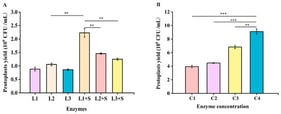
Optimization of the preparation enzyme system for O. xuefengensis protoplasts. (A) Types of enzymes: L1: 1.5% lywallzyme 1, L2: 1.5% lywallzyme 2, L3: 50 U lyticase, L1 + S: 0.75% lywallzyme 1 and 0.75% snailase, L2 + S: 0.75% lywallzyme 2 and 0.75% snailase, L3 + S: 25 U lyticase and 0.75% snailase; (B) enzyme concentration: C1: 0.75% lywallzyme 1 and 0.75% snailase, C2: 1% lywallzyme 1 and 1% snailase, C3: 1.25% lywallzyme 1 and 1.25% snailase, C4: 1.5% lywallzyme 1 and 1.5% snailase. Values are presented as mean ± SD (n = 3). Significance analysis between two different groups: ** p < 0.01, *** p < 0.001.

Blueberry rust disease is caused by the fungal pathogen Pucciniastrum minimum (syn. Thekopsora minima). Despite its importance as a plant pathogen, there are relatively few published studies on P. minimum. This study investigated and refined methodologies to cultivate and study this obligate parasite. P. minimum was successfully cultivated on detached blueberry leaves by misting leaves with water, followed by dusting with dry urediniospores. In vitro germination of urediniospores on water agar was achieved using a spore dusting technique, and germination rates were 70% higher compared to a spore suspension. Time after leaf detachment affected urediniospore germination and highlighted the importance of the processing time for replicability between experiments. Urediniospore viability could be evaluated by co-staining with fluorescein diacetate and propidium iodide, and the assessed viability was significantly higher than germination rates achieved in vitro. In detached leaf inoculations, leaves sourced from inside the glasshouse developed more rust than those from outside; this is discussed in the context of knowledge gaps on the infection process of P. minimum. This study resolves some key methodological issues involved with studying P. minimum rust urediniospores, and the general protocols we developed can be applied to other rust species for biological survival research.

11 February 2026

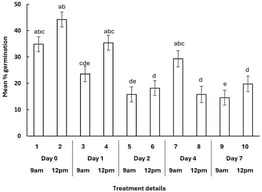
Mean percentage germination of Pucciniastrum minimum urediniospores over time after leaf detachment. Data presented is the combined average from all three independent experiments. Individual experiments gave similar statistical trends and can be found in Supplementary Table S1. Standard error bars are included on each treatment value. The Games–Howell post hoc test was used for multiple comparisons; treatments with the same letter are not statistically significantly different from each other, p-value > 0.05.

News & Conferences

Issues

Open for Submission

Editor's Choice

Reprints of Collections

Isolation and Control of Fruit and Vegetable Rot Fungi
Reprint

Isolation and Control of Fruit and Vegetable Rot Fungi

Editors: Nengguo Tao, Xiaoli Tan
Diversity and Ecology of Fungi from Underexplored and Extreme Environments
Reprint

Diversity and Ecology of Fungi from Underexplored and Extreme Environments

Editors: Daniela Isola, Francesc Xavier Prenafeta Boldú

Get Alerted

Add your email address to receive forthcoming issues of this journal.

XFacebookLinkedIn
J. Fungi - ISSN 2309-608X