

- Article

Molecular Mechanisms of Temperature-Regulated Cordycepin Biosynthesis in Cordyceps militaris
- Jiaxing Shao,
- Ziwei Zhang and
- Jie Tu
- + 5 authors
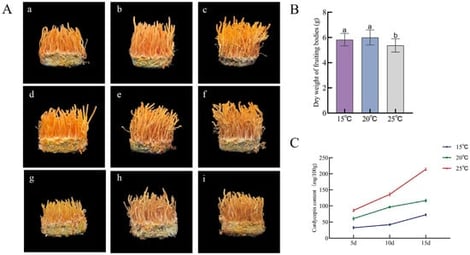
Cordycepin is a key active component of Cordyceps militaris, but the molecular mechanism underlying temperature-regulated biosynthesis remains unclear. In this study, Cordyceps militaris strain KN-1 was used as experimental material, with low-temperature (15 °C), control (20 °C), and high-temperature (25 °C) treatments applied during the fruiting body stage. Transcriptomics, untargeted metabolomics, weighted gene co-expression network analysis (WGCNA), and Reverse Transcription quantitative PCR (RT-qPCR) validation were integrated to elucidate the molecular mechanism of temperature-mediated cordycepin biosynthesis. The results showed that 25 °C increased fruiting body cordycepin content by 84%, while 15 °C reduced it. Transcriptomic analysis identified differentially expressed genes (DEGs) enriched in transmembrane transport and fatty acid metabolism, and untargeted metabolomics revealed differential metabolites (DAMs) enriched in lipids and organic acids, indicating that temperature primarily affects Cordyceps militaris membrane function. WGCNA showed that the MEblue module was positively correlated with cordycepin (r = 0.93), with Major Facilitator Superfamily (MFS) members accounting for the highest proportion (47.1%) that may affect cordycepin transmembrane transport. Multi-omics analysis indicated that high temperature promotes cordycepin accumulation through the synergistic regulation of multiple pathways: upregulating genes in the pentose phosphate pathway, purine metabolism, and cordycepin biosynthetic gene cluster (Cns1–Cns3), increasing protective agent pentostatin content, downregulating cordycepin-degrading genes, and enhancing cordycepin transmembrane transport. This study clarifies the molecular mechanism of temperature-mediated cordycepin accumulation, providing a theoretical basis for improving cordycepin production via temperature regulation, optimizing Cordyceps militaris strain quality, and facilitating efficient industrial production.
7 February 2026