Skip Content
You are currently on the new version of our website. Access the old version .

Journal of Low Power Electronics and Applications

Journal of Low Power Electronics and Applications is an international, peer-reviewed, open access journal on low power electronics published quarterly online by MDPI. 

All Articles (579)

This paper examines the implementation and resource utilization of Cascaded Integrator Comb (CIC) filters within FPGA-based Pulse Density Modulation (PDM) microphone applications. Three CIC filter designs were analyzed: one generated using MATLAB’s HDL Coder toolbox, one generated via AMD’s CIC Compiler IP, and one generated using an open-source CIC filter architecture. The study compares the efficiency of these three implementations in terms of slice LUTs and slice register usage. The maximum working frequency was also investigated. The results demonstrate that filters generated with the CIC Compiler require fewer FPGA resources, provide optimized multi-channel support, and have the option to utilize DSP48 slices for enhanced performance, while MATLAB-generated filters have higher working frequency and have great flexibility regarding the parameter, like the open-source CIC filter version.

26 January 2026

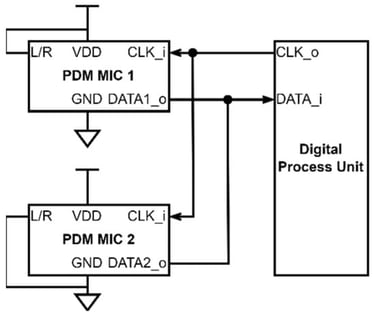
Connecting two microphones to the same PDM interface.

RSSI-Based Localization of Smart Mattresses in Hospital Settings

  • Yeh-Liang Hsu,
  • Chun-Hung Yi and
  • Kuei-Hua Yen
  • + 1 author

(1) Background: In hospitals, mattresses are often relocated for cleaning or patient transfer, leading to mismatches between actual and recorded bed locations. Manual updates are time-consuming and error-prone, requiring an automatic localization system that is cost-effective and easy to deploy to ensure traceability and reduce nursing workload. (2) Purpose: This study presents a pragmatic, large-scale implementation and validation of a BLE-based localization system using RSSI measurements. The goal was to achieve reliable room-level identification of smart mattresses by leveraging existing hospital infrastructure. (3) Results: The system showed stable signals in the complex hospital environment, with a 12.04 dBm mean gap between primary and secondary rooms, accurately detecting mattress movements and restoring location confidence. Nurses reported easier operation, reduced manual checks, and improved accuracy, though occasional mismatches occurred when receivers were offline. (4) Conclusions: The RSSI-based system demonstrates a feasible and scalable model for real-world asset tracking. Future upgrades include receiver health monitoring, watchdog restarts, and enhanced user training to improve reliability and usability. (5) Method: RSSI–distance relationships were characterized under different partition conditions to determine parameters for room differentiation. To evaluate real-world scalability, a field validation involving 266 mattresses in 101 rooms over 42 h tested performance, along with relocation tests and nurse feedback.

14 January 2026

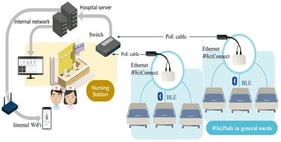
Information architecture of our smart mattress system.

Exploring Runtime Sparsification of YOLO Model Weights During Inference

  • Tanzeel-ur-Rehman Khan,
  • Sanghamitra Roy and
  • Koushik Chakraborty

In the pursuit of real-time object detection with constrained computational resources, the optimization of neural network architectures is paramount. We introduce novel sparsity induction methods within the YOLOv4-Tiny framework to significantly improve computational efficiency while maintaining high accuracy in pedestrian detection. We present three sparsification approaches: Homogeneous, Progressive, and Layer-Adaptive, each methodically reducing the model’s complexity without compromising its detection capability. Additionally, we refine the model’s output with a memory-efficient sliding window approach and a Bounding Box Sorting Algorithm, ensuring precise Intersection over Union (IoU) calculations. Our results demonstrate a substantial reduction in computational load by zeroing out over 50% of the weights with only a minimal 6% loss in IoU and 0.6% loss in F1-Score.

13 January 2026

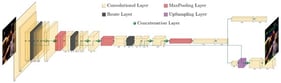
Illustration of the YOLOv4-Tiny architecture. Layer sizes and aspect ratios are drawn to approximate actual proportions.

SparseDroop: Hardware–Software Co-Design for Mitigating Voltage Droop in DNN Accelerators

  • Arnab Raha,
  • Shamik Kundu and
  • Deepak A. Mathaikutty
  • + 2 authors

Modern deep neural network (DNN) accelerators must sustain high throughput while avoiding performance degradation from supply voltage (VDD) droop, which occurs when large arrays of multiply–accumulate (MAC) units switch concurrently and induce high peak current (ICCmax) transients on the power delivery network (PDN). In this work, we focus on ASIC-class DNN accelerators with tightly synchronized MAC arrays rather than FPGA-based implementations, where such cycle-aligned switching is most pronounced. Conventional guardbanding and reactive countermeasures (e.g., throttling, clock stretching, or emergency DVFS) either waste energy or incur non-trivial throughput penalties. We propose SparseDroop, a unified hardware-conscious framework that proactively shapes instantaneous current demand to mitigate droop without reducing sustained computing rate. SparseDroop comprises two complementary techniques. (1) SparseStagger, a lightweight hardware-friendly droop scheduler that exploits the inherent unstructured sparsity already present in the weights and activations—it does not introduce any additional sparsification. SparseStagger dynamically inspects the zero patterns mapped to each processing element (PE) column and staggers MAC start times within a column so that high-activity bursts are temporally interleaved. This fine-grain reordering smooths ICC trajectories, lowers the probability and depth of transient VDD dips, and preserves cycle-level alignment at tile/row boundaries—thereby maintaining no throughput loss and negligible control overhead. (2) SparseBlock, an architecture-aware, block-wise-structured sparsity induction method that intentionally introduces additional sparsity aligned with the accelerator’s dataflow. By co-designing block layout with the dataflow, SparseBlock reduces the likelihood that all PEs in a column become simultaneously active, directly constraining ICCmax and peak dynamic power on the PDN. Together, SparseStagger’s opportunistic staggering (from existing unstructured weight zeros) and SparseBlock’s structured, layout-aware sparsity induction (added to prevent peak-power excursions) deliver a scalable, low-overhead solution that improves voltage stability, energy efficiency, and robustness, integrates cleanly with the accelerator dataflow, and preserves model accuracy with modest retraining or fine-tuning.

23 December 2025

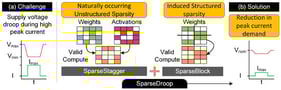
Overview of SparseDroop—leveraging inherent (SparseStagger) and induced block sparsity (SparseBlock) to stagger/cap MAC activity, reduce 
  
    I
    C
    
      C
      
        m
        a
        x


, and mitigate VDD droop.

News & Conferences

Issues

Open for Submission

Editor's Choice

Get Alerted

Add your email address to receive forthcoming issues of this journal.

XFacebookLinkedIn
J. Low Power Electron. Appl. - ISSN 2079-9268