Skip Content
You are currently on the new version of our website. Access the old version .

Journal of Developmental Biology

Journal of Developmental Biology is an international, peer-reviewed, open access journal on the development of multicellular organisms at the molecule, cell, tissue, organ and whole organism levels published quarterly online by MDPI.

Indexed in PubMed | Quartile Ranking JCR - Q2 (Developmental Biology)

All Articles (424)

Lampbrush chromosomes (LBCs) are a feature of amphibian oocytes and are typically associated with high levels of transcription during active oocyte growth. However, their state during winter hibernation has not been studied. Here, we investigated LBCs in early vitellogenic oocytes (early stage 4) of the grass frog Rana temporaria during winter hibernation. We found that the chromosomes retained their lampbrush morphology, and the phosphorylated form of RNA polymerase II resided on the lateral loops. Transcription on the lateral loops was reduced but detectable at cold conditions and significantly increased when the oocytes were transferred at room temperature. Satellite S1a transcripts were detected at the lateral loops of the chromosomes by RNA FISH. The possible significance of maintaining chromosomes in the lampbrush form during hibernation is discussed.

2 February 2026
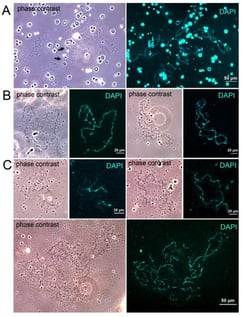
Lampbrush chromosomes (LBCs) in Rana temporaria oocytes. (A) LBCs isolated from stage 4 oocytes in the period of fast growth in summer. The arrows point to marker loops on one of the LBCs. (B,C) LBCs isolated from stage 4 oocytes during winter hibernation. LBCs were isolated either at room temperature (B) or on ice (C).

Female Aging Affects Coilin Pattern in Mouse Cumulus Cells

  • Alexey S. Anisimov,
  • Dmitry S. Bogolyubov and
  • Irina O. Bogolyubova

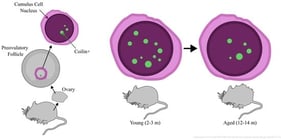
Cumulus cells (CCs) are a distinct population of granulosa cells (GCs) that surround the developing and ovulated mammalian oocyte. The features of their structural organization and the expression pattern of key genes significantly affect oocyte viability. Changes in the functional activity of the nucleus are often expressed in changes in the structure of nuclear bodies (NBs), including Cajal bodies (CBs). The diagnostic protein of CBs is coilin, which maintains their structural integrity. Using fluorescent and electron microscopy, we examined maternal aging-associated changes in coilin pattern in mouse CCs. We found that older mice had a decrease in the number of coilin-positive bodies, while external transcriptome data analysis revealed no significant changes in Coil and Smn1 gene expression. We hypothesized that the age-related dynamics of coilin-containing bodies are determined not by changes in the expression level of key components of these bodies, but by age-related changes in CC metabolism. Considering that CCs are a by-product of IVF protocols, making them available for analysis in sufficient quantities, age-related changes in the number and size of coilin-positive NBs in CCs may serve as a promising biomarker for assessing ovarian functional aging.

15 January 2026

Schematic visualization of the macro generating data: (1) identification and cropping of individual nuclei from *.lif stacks; (2) segmentation of nuclear objects from both channels, generating segmented TIFF files; (3) extraction of quantitative parameters into tabular format (*.csv file). Nuclear objects are designated as follows: blue circle, nuclear contour; red square, DAPI-positive region; green triangle, localization zone of the protein of interest (coilin). A, B, C—the number of bodies, their size and fluorescence intensity.

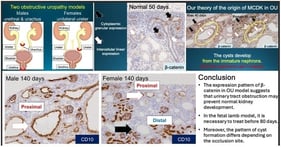
Obstructive uropathy (OU) during fetal development induces a fetal cystic dysplastic kidney. The mechanisms of cyst formation and the onset of renal dysfunction remain unclear. Determining whether nephrogenic potential persists during fetal life may suggest whether early intervention could preserve renal development. We aimed to evaluate residual nephrogenic activity in fetal cystic dysplastic kidneys using β-catenin and CD10 immunostaining, and to assess whether the site of obstruction influences cystogenesis. After appropriate approval, 20 timed-gestation fetal lambs had OU created at 60 days. Males underwent urethral and urachal ligation (n = 8, 3 lost), and females underwent unilateral ureteric ligation (n = 8, 1 lost). Fetuses were sacrificed at 80 days (n = 6) and 140 days (term, n = 10), comparing kidneys with normal controls of the same gestational age using immunohistochemical staining for β-catenin and CD10. Developing fetal cystic dysplastic kidneys were identified at 80 days. β-catenin staining showed the absence of granular cytoplasmic expression in cystic regions, indicating arrested nephrogenesis. In male models, cysts originated exclusively from proximal tubules. Female models exhibited mixed proximal and distal tubular involvement. CD10 staining confirmed the loss of proximal tubular markers. Renal development remained arrested at term. Cyst formation disrupts renal development early in gestation, which persists until term. Differences in cystogenesis between the models suggest that the site of obstruction influences pathogenic mechanisms.

9 January 2026

Representative hematoxylin and eosin (H&E) staining of fetal kidneys at 80 days of gestation. Panel (A) (normal kidney): Normal nephrogenic structures are highlighted. The red arrow indicates the nephrogenic zone, the green arrows point to the metanephric mesenchyme, and the yellow circle marks the ureteric bud. Panel (B) (obstructed kidney, OU): Developing cystic dysplasia is shown. The yellow circle indicates the ureteric bud, and the white arrows point to a cyst in the process of formation. Scale bar = 100 μm.

Discovery of New Markers for Haemogenic Endothelium and Haematopoietic Progenitors in the Mouse Yolk Sac

  • Guillermo Diez-Pinel,
  • Alessandro Muratore and
  • Giovanni Canu
  • + 1 author

Erythro-myeloid progenitors (EMPs) originate from the haemogenic endothelium in the yolk sac via an endothelial-to-haematopoietic transition (EHT) to generate blood and immune cells that support embryo development. Yet, the transitory nature of EHT and the limited availability of molecular markers have constrained our understanding of the origin, identity, and differentiation dynamics of EMPs. Here, we have refined the annotation of yolk sac haemato-vascular populations in publicly available single-cell RNA sequencing (scRNAseq) datasets from mouse embryos to identify novel molecular markers of haemogenic endothelium and EMPs. By sub-clustering key cell populations followed by pseudotime analysis, we refined cluster annotations and then reconstructed differentiation trajectories. Subsequent differential gene expression analysis between clusters identified novel cell surface markers for haemogenic endothelial cells (Fxyd5 and Scarf1) and EMPs (Fcer1g, Tyrobp, and Mctp1). Further, we have identified candidate signalling and metabolic pathways that may regulate yolk sac haematopoietic emergence and differentiation. The specificity of FXYD5, SCARF1, and FCER1G for haemogenic endothelium and EMPs was validated by immunostaining of the mouse yolk sac. These insights into the transcriptional dynamics in the yolk sac should support future investigation of EHT and haematopoietic differentiation during early mammalian development.

6 January 2026

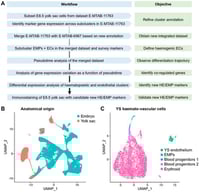
Re-analysis of E8.5 mouse embryonic scRNAseq data to study yolk sac EHT. (A) Workflow for the integrated re-analysis of mouse embryonic scRNAseq datasets E-MTAB-11763 and E-MTAB-6967. (B) UMAP of dataset E-MTAB-11763 showing cells sequenced from the E8.5 mouse embryo and labelled according to their anatomical origin as embryo and yolk sac. (C) UMAP obtained by subsetting haemato-vascular cells from the E8.5 yolk sac from E-MTAB-11763 and labelled based on our refined cluster annotation. EMP: erythro-myeloid progenitor; EC: endothelial cell; HE: haemogenic endothelium; YS: yolk sac.

News & Conferences

Issues

Open for Submission

Editor's Choice

Get Alerted

Add your email address to receive forthcoming issues of this journal.

XFacebookLinkedIn
J. Dev. Biol. - ISSN 2221-3759