Skip Content
You are currently on the new version of our website. Access the old version .
  • Tracked for
    Impact Factor
  • 9.1
    CiteScore
  • 22 days
    Time to First Decision

Journal of Cybersecurity and Privacy

Journal of Cybersecurity and Privacy is an international, peer-reviewed, open access journal on all aspects of computer, systems, and information security, published bimonthly online by MDPI.

All Articles (313)

The emerging scope of the Industrial Internet of Services (IIoS) requires a robust intrusion detection system to detect malicious attacks. The increasing frequency of sophisticated and high-impact cyber attacks has resulted in financial losses and catastrophes in IIoS-based manufacturing industries. However, existing solutions often struggle to adapt and generalize to new cyber attacks. This study proposes a unique approach designed for known and zero-day network attack detection in IIoS environments, called Denoising Adaptive Multi-Branch Architecture (DA-MBA). The proposed approach is a smart, conformal, and self-adjusting cyber attack detection framework featuring denoising representation learning, hybrid neural inference, and open-set uncertainty calibration. The model merges a denoising autoencoder (DAE) to generate noise-tolerant latent representations, which are processed using a hybrid multi-branch classifier combining dense and bidirectional recurrent layers to capture both static and temporal attack signatures. Moreover, it addresses challenges such as adaptability and generalizability by hybridizing a Multilayer Perceptron (MLP) and bidirectional LSTM (BiLSTM). The proposed hybrid model was designed to fuse feed-forward transformations with sequence-aware modeling, which can capture direct feature interactions and any underlying temporal and order-dependent patterns. Multiple approaches have been applied to strengthen the dual-branch architecture, such as class weighting and comprehensive hyperparameter optimization via Optuna, which collectively address imbalanced data, overfitting, and dynamically shifting threat vectors. The proposed DA-MBA is evaluated on two widely recognized IIoT-based datasets, Edge-IIoT set and WUSTL-IIoT-2021 and achieves over 99% accuracy and a near 0.02 loss, underscoring its effectiveness in detecting the most sophisticated attacks and outperforming recent deep learning IDS baselines. The solution offers a scalable and flexible architecture for enhancing cybersecurity within evolving IIoS environments by coupling feature denoising, multi-branch classification, and automated hyperparameter tuning. The results confirm that coupling robust feature denoising with sequence-aware classification can provide a scalable and flexible framework for improving cybersecurity within the IIoS. The proposed architecture offers a scalable, interpretable, and risk sensitive defense mechanism for IIoS, advancing secure, adaptive, and trustworthy industrial cyber-resilience.

5 February 2026
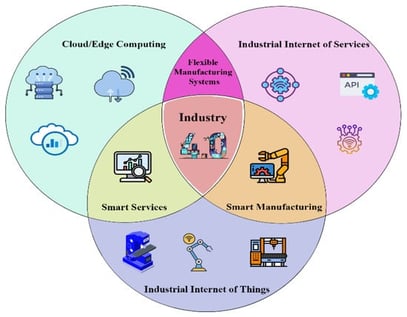
Industry 4.0 Architecture.

DIGITRACKER: An Efficient Tool Leveraging Loki for Detecting, Mitigating Cyber Threats and Empowering Cyber Defense

  • Mohammad Meraj Mirza,
  • Rayan Saad Alsuwat and
  • Nasser Ahmed Hussain
  • + 4 authors

Cybersecurity teams rely on signature-based scanners such as Loki, a command-line tool for scanning malware, to identify Indicators of Compromise (IOCs), malicious artifacts, and YARA-rule matches. However, the raw Loki log output delivered as CSV or plaintext is challenging to interpret without additional visualization and correlation tools. Therefore, this research discusses the creation of a web-based dashboard that displays results from the Loki scanner. The project focuses on processing and displaying information collected from Loki’s scans, which are available in log files or CSV format. DIGITRACKER was developed as a proof-of-concept (PoC) to process this data and present it in a user-friendly, visually appealing way, enabling system administrators and cybersecurity teams to monitor potential threats and vulnerabilities effectively. By leveraging modern web technologies and dynamic data visualization, the tool enhances the user experience, transforming raw scan results into a well-organized, interactive dashboard. This approach simplifies the often-complicated task of manual log analysis, making it easier to interpret output data and to support low-budget or resource-constrained cybersecurity teams by transforming raw logs into actionable insights. The project demonstrates the dashboard’s effectiveness in identifying and addressing threats, providing valuable tools for cybersecurity system administrators. Moreover, our evaluation shows that DIGITRACKER can process scan logs containing hundreds of IOC alerts within seconds and supports multiple concurrent users with minimal latency overhead. In test scenarios, the integrated Loki scans were achieved, and the end-to-end pipeline from the end of the scan to the initiation of dashboard visualization incurred an average latency of under 20 s. These results demonstrate improved threat visibility, support structured triage workflows, and enhance analysts’ task management. Overall, the system provides a practical, extensible PoC that bridges the gap between command-line scanners and operational security dashboards, with new scan results displayed on the dashboard faster than manual log analysis. By streamlining analysis and enabling near-real-time monitoring, the PoC tool DIGITRACKER empowers cyber defense initiatives and enhances overall system security.

2 February 2026

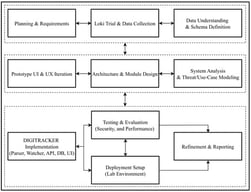
The methodology followed to develop and evaluate DIGITRACKER, showing the agile workflow from Loki data collection to implementation, deployment, and testing (security, performance).

Digital Boundaries and Consent in the Metaverse: A Comparative Review of Privacy Risks

  • Sofia Sakka,
  • Vasiliki Liagkou and
  • Chrysostomos Stylios
  • + 1 author

Metaverse presents significant opportunities for educational advancement by facilitating immersive, personalized, and interactive learning experiences through technologies such as virtual reality (VR), augmented reality (AR), extended reality (XR), and artificial intelligence (AI). However, this potential is compromised if digital environments fail to uphold individuals’ privacy, autonomy, and equity. Despite their widespread adoption, the privacy implications of these environments remain inadequately understood, both in terms of technical vulnerabilities and legislative challenges, particularly regarding user consent management. Contemporary Metaverse systems collect highly sensitive information, including biometric signals, spatial behavior, motion patterns, and interaction data, often surpassing the granularity captured by traditional social networks. The lack of privacy-by-design solutions, coupled with the complexity of underlying technologies such as VR/AR infrastructures, 3D tracking systems, and AI-driven personalization engines, makes these platforms vulnerable to security breaches, data misuse, and opaque processing practices. This study presents a structured literature review and comparative analysis of privacy risks, consent mechanisms, and digital boundaries in metaverse platforms, with particular attention to educational contexts. We argue that privacy-aware design is essential not only for ethical compliance but also for supporting the long-term sustainability goals of digital education. Our findings aim to inform and support the development of secure, inclusive, and ethically grounded immersive learning environments by providing insights into systemic privacy and policy shortcomings.

2 February 2026

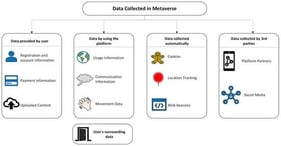
An overview of the data collected in Metaverse. The solid arrows indicate the direct collection/creation relationships and the dashed arrows indicate the indirect/analysis relationships.

Trusted Yet Flexible: High-Level Runtimes for Secure ML Inference in TEEs

  • Nikolaos-Achilleas Steiakakis and
  • Giorgos Vasiliadis

Machine learning inference is increasingly deployed on shared and cloud infrastructures, where both user inputs and model parameters are highly sensitive. Confidential computing promises to protect these assets using Trusted Execution Environments (TEEs), yet existing TEE-based inference systems remain fundamentally constrained: they rely almost exclusively on low-level, memory-unsafe languages to enforce confinement, sacrificing developer productivity, portability, and access to modern ML ecosystems. At the same time, mainstream high-level runtimes, such as Python, are widely considered incompatible with enclave execution due to their large memory footprints and unsafe model-loading mechanisms that permit arbitrary code execution. To bridge this gap, we present the first Python-based ML inference system that executes entirely inside Intel SGX enclaves while safely supporting untrusted third-party models. Our design enforces standardized, declarative model representations (ONNX), eliminating deserialization-time code execution and confining model behavior through interpreter-mediated execution. The entire inference pipeline (including model loading, execution, and I/O) remains enclave-resident, with cryptographic protection and integrity verification throughout. Our experimental results show that Python incurs modest overheads for small models (≈17%) and outperforms a low-level baseline on larger workloads (97% vs. 265% overhead), demonstrating that enclave-resident high-level runtimes can achieve competitive performances. Overall, our findings indicate that Python-based TEE inference is practical and secure, enabling the deployment of untrusted models with strong confidentiality and integrity guarantees while maintaining developer productivity and ecosystem advantages.

27 January 2026

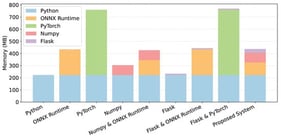
Memory usage of different runtime components and libraries in the Python ML environment. The stacked bars show the baseline footprint of Python together with ONNX Runtime, PyTorch, NumPy, and Flask. This comparison highlights their relative overheads, providing insight into their suitability for secure, memory-constrained inference deployments.

News & Conferences

Issues

Open for Submission

Editor's Choice

Reprints of Collections

Machine Learning and Data Analytics for Cyber Security
Reprint

Machine Learning and Data Analytics for Cyber Security

Editors: Phil Legg, Giorgio Giacinto
Cyber Security and Critical Infrastructures - Volume II
Reprint

Cyber Security and Critical Infrastructures - Volume II

Editors: Leandros Maglaras, Helge Janicke, Mohamed Amine Ferrag

Get Alerted

Add your email address to receive forthcoming issues of this journal.

XFacebookLinkedIn
J. Cybersecur. Priv. - ISSN 2624-800X