Skip Content
You are currently on the new version of our website. Access the old version .

Journal of Clinical Medicine

Journal of Clinical Medicine is an international, peer-reviewed, open access journal of clinical medicine, published semimonthly online by MDPI.
Indexed in PubMed | Quartile Ranking JCR - Q1 (Medicine, General and Internal)

All Articles (46,859)

  • Systematic Review
  • Open Access

Efficacy of Resin Infiltrants in Non-Cavitated Occlusal Carious Lesions: A Systematic Review

  • Samille Biasi Miranda,
  • Rodrigo Barros Esteves Lins and
  • Marcos Antonio Japiassú Resende Montes
  • + 6 authors

Objectives: To evaluate the efficacy of resin infiltrants (RIs) in controlling non-cavitated occlusal carious lesions (NCOCLs) in primary and permanent teeth. Methods: This systematic review followed PRISMA guidelines. Randomized clinical trials (RCTs) and in vitro/ex vivo studies comparing RI with placebo or other materials were included. Searches were conducted in five databases and gray literature up to December 2025. Risk of bias was assessed using the RoB 2.0 tool for RCT and an adapted instrument for in vitro/ex vivo studies. Certainty of evidence was evaluated using the GRADE tool, and data were synthesized qualitatively. Results: Eight studies were included, of which only two were RCTs, and six were in vitro and ex vivo studies. RCTs showed reduced caries progression in infiltrant-treated groups compared with controls, with efficacy comparable to conventional sealants. In vitro studies demonstrated improved resin penetration and sealing ability with optimized protocols. Risk of bias ranged from low to moderate. Certainty of clinical evidence was low, primarily due to the limited number of RCTs and methodological limitations. Conclusions: RIs may be effective in managing NCOCLs, with performance comparable to conventional preventive approaches. However, the limited number of clinical trials and short follow-up periods reduce the strength of the evidence. Long-term clinical studies are needed to confirm the sustained effectiveness and durability of RIs.

6 February 2026
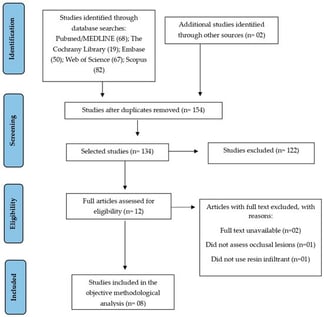
Flowchart of articles included in the systematic review.

Objective: We aimed to evaluate the morphometric characteristics of the internal acoustic meatus (IAM) using high-resolution computed tomography (CT), with emphasis on sex- and age-related differences, with particular emphasis on the IAM orientation angle as a less-studied spatial parameter and its potential clinical and forensic relevance. Methods: Temporal bone CT scans of 162 patients (94 females, 68 males; age 1–77 years) were retrospectively analyzed. Measurements included the IAM inlet diameter, length, mid-diameter, lateral angle (LA), and orientation angle. Inter-observer agreement was assessed in 30 randomly selected cases. Morphometric parameters were compared by sex and age using t-tests and Mann–Whitney U tests. Results: Mean IAM lengths were 11.0 mm (right) and 11.1 mm (left), and the mean mid-diameter was 4.2 mm bilaterally. IAM lengths and diameters showed no significant sex- or age-related differences (p > 0.05). In contrast, LA and orientation angle differed significantly by sex (p < 0.05), with females showing higher LA values, which may influence posterior fossa surgical exposure. Conclusions: IAM size parameters are largely independent of sex and age, whereas lateral and orientation angles exhibit sex-related variation. Preoperative evaluation of IAM orientation on CT can support skull base surgical planning, and LA may provide supportive morphometric information in forensic contexts, although it should not be considered a standalone sex classification parameter.

6 February 2026

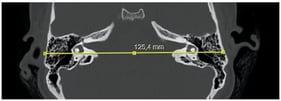
Axial high-resolution CT of the temporal bones showing measurement of the bitemporal distance (mm) using a line tangent to the lateral semicircular canals.

Left ventricular myocardial work (MW) has emerged as a valuable echocardiographic parameter for evaluating cardiac function and predicting clinical outcomes. Unlike conventional indices such as left ventricular ejection fraction and global longitudinal strain, MW integrates myocardial deformation with left ventricular pressure, providing a load-adjusted and physiologically meaningful assessment of myocardial performance. Growing evidence demonstrates that impaired MW is consistently associated with adverse outcomes, including heart failure hospitalization, mortality, and functional deterioration, across a wide spectrum of cardiovascular conditions such as ischemic heart disease, valvular heart disease, and cardiomyopathies. The noninvasive estimation of MW using commercially available echocardiographic software has enhanced its feasibility in routine clinical practice, enabling improved risk stratification and early identification of high-risk patients. This review summarizes current evidence supporting the prognostic value of MW, highlights its incremental role beyond conventional echocardiographic parameters, and discusses future perspectives for its integration into everyday clinical decision-making.

6 February 2026

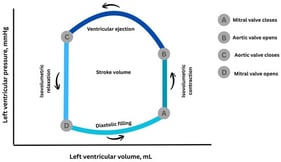
Schematic representation of the left ventricular pressure–volume loop in normal conditions. The loop illustrates the sequential mechanical events of a single cardiac cycle, including pressure rise at constant volume (isovolumetric contraction), systolic blood ejection into the arterial circulation, pressure decline at unchanged volume (isovolumetric relaxation), and diastolic ventricular filling preceding the next contraction. Different colors indicate the distinct phases of the cardiac cycle, and arrows denote their sequential progression.

Background/Objectives: Hydroxychloroquine (HCQ) is used to manage various autoimmune diseases, including systemic lupus erythematosus. The prolonged use of HCQ is associated with retinopathy and irreversible visual loss due to retinal toxicity. Despite adherence to dosage regimens, patients may develop functional rather than structural changes, without detectable abnormalities on routine examination using visual acuity and optical coherence tomography (OCT). The study aimed to detect early signs of retinopathy in patients with autoimmune diseases treated with HCQ. Methods: This cross-sectional study included patients (n = 36) with autoimmune diseases who were treated with HCQ. The control group (n = 35) comprised healthy volunteers matched for age and sex. All participants were screened using colour vision tests (Ishihara, Konan ColourDX high definition [HD]), and retinal thickness was evaluated using OCT. Results: Our findings suggest a significant reduction in the contrast threshold of the L and M-cone photoreceptors compared with that of the control using Konan ColourDX HD. The OCT measurements revealed no statistically significant difference in retinal thickness between patients and controls; however, the contrast sensitivity test showed a significant reduction at all spatial frequencies (p < 0.0001). Conclusions: The current study suggests that the Konan ColourDX cone contrast test HD and contrast sensitivity testing may be valuable for periodic monitoring of patients receiving HCQ, potentially enabling earlier detection of toxicity. However, longitudinal studies with larger cohorts are needed to confirm these findings and to further establish the clinical value of these functional visual tests.

6 February 2026

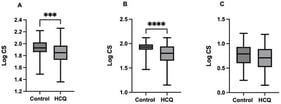
Effect of hydroxychloroquine (HCQ) on (A) L-cone, (B) M-cone, and (C) S-cone. Statistical significance was determined as follows: *** p &lt; 0.001, **** p &lt; 0.0001.

News & Conferences

Issues

Open for Submission

Editor's Choice

Get Alerted

Add your email address to receive forthcoming issues of this journal.

XFacebookLinkedIn
J. Clin. Med. - ISSN 2077-0383