Skip Content
You are currently on the new version of our website. Access the old version .
  • Tracked for
    Impact Factor
  • 3.3
    CiteScore
  • 23 days
    Time to First Decision

Instruments

Instruments is an international, peer-reviewed, open access journal on scientific instrumentation and its related methods and theory, published quarterly online by MDPI.

All Articles (414)

The accurate and non-invasive measurement of moisture content in wood is essential for the preservation of historical and artistic artifacts. This study presents the calibration of a planar Microwave Planar Capacitive Coupled Ring Resonator (MPCCRR) designed to indirectly and non-destructively assess the water content in wood samples. The method relies on analyzing shifts in the resonant frequencies and variations in the transmission parameter |S21| resulting from changes in the material’s dielectric permittivity. After preliminary characterization via parametric simulations (εr = 1–10) and validation with low-permittivity reference materials, the sensor was tested on three wood species (poplar, fir, beech), including measurements at two sensor positions and with different grain orientations. The results demonstrate a monotonic, repeatable response to increasing moisture content with frequency shifts up to ≈220 MHz and normalized sensitivities ranging from 3 to 9 MHz/% water content, depending on species and measurement position. Position 2 showed the greatest sensitivity due to stronger field–sample interaction, while Position 1 provided a quasi-isotropic response with excellent repeatability. Linear regression analyses revealed good correlations between the frequency shifts and the gravimetric water content (R2 ≥ 0.85). The MPCCRR sensor therefore proves to be a promising tool for the non-invasive monitoring of wood moisture, which is particularly suitable for the low-moisture range encountered in cultural heritage conservation, with an estimated moisture uncertainty of 0.12–0.35% under controlled laboratory conditions.

5 February 2026

Microwave Planar Capacitive Coupled Ring Resonator (MPCCRR) design and features: (a) MPCCRR design with highlighted dimensional parameters and the sample positioning adapted from [23], (b) real MPCCRR, and (c) MPCCRR computed insertion loss for ε = 1 (air) with the two peaks at fl and fh highlighted.

Sub-terahertz (sub-THz) frequencies are in the spotlight in the ongoing development of sixth-generation (6G) wireless communication systems, offering ultra-high data rates and low latency for rapidly emerging applications. However, employment of sub-THz frequencies introduces strict propagation challenges, including free-space path loss and atmospheric absorption, which limit coverage and reliability. To address these issues, highly directional links are required. The conventional beam-shaping solutions such as refractive lenses and parabolic mirrors are bulky, heavy, and costly, making them less attractive for compact systems. Diffractive optical elements (DOEs) offer a promising alternative by enabling precise wavefront control through phase modulation, resulting in thin, lightweight components with high focusing efficiency. Employing the fused deposition modelling (FDM) using high-impact polystyrene (HIPS) allows cost-effective fabrication of DOEs with minimal material waste and high diffraction efficiency. This work investigates the beam-shaping performance of the FDM-printed structures comparing DOEs and spherical refraction-based structures, wherein both are aiming for application in sub-THz communication systems. DOEs exhibit clear advantages over classically employed solutions.

4 February 2026

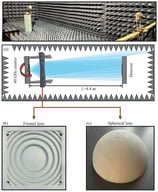
(a) Schematic representation of the experimental setup for angular characterisation of the structures. The measurement was conducted in an anechoic chamber. The emitter and the designed element were rigidly mounted, and the assembly was positioned on an angle-controlled tripod. At a distance of 4.4 m, a detector—the same chip, but without any beam-shaping solution—was placed. Angular intensity dependency was achieved by rotating the source coupled with the element. The inset above reveals a photo of the anechoic chamber during the characterisation. (b) A photo of one of the fabricated Fresnel type lenses, with a structure thickness of 7 mm. (c) A photo of the spherical lens, featuring an identical focal distance, with a structure thickness of 74 mm.

The Intelligent Knife (iKnife): Revolutionizing Intraoperative Tissue Diagnosis Through Rapid Evaporative Ionization Mass Spectrometry (REIMS)

  • Gabriel Amorim Moreira Alves,
  • Mohan Dodeja and
  • Arosh Shavinda Perera Molligoda Arachchige
  • + 2 authors

The intelligent surgical knife (iKnife), based on rapid evaporative ionization mass spectrometry (REIMS), represents a transformative advance in intraoperative tissue characterization. By integrating mass spectrometry with electrosurgical dissection, the iKnife enables real-time differentiation between cancerous and healthy tissues through molecular fingerprinting of the aerosol generated during cutting. This innovation significantly shortens operative time by eliminating delays associated with conventional histopathological analysis and enhances surgical precision by providing continuous feedback on tissue composition. Since its inception by Zoltán Takáts and colleagues, the iKnife has demonstrated remarkable diagnostic accuracy across multiple cancer types, including breast, ovarian, and colorectal malignancies, with reported sensitivities and specificities > 90% in selected tumour types. Beyond oncology, REIMS technology also shows promise for microbial identification and metabolomic profiling. This review provides a comprehensive overview of the iKnife’s development, underlying principles, clinical validation, and emerging applications, as well as its integration into surgical workflows and the challenges remaining for widespread clinical adoption. Future perspectives include miniaturization, AI-driven spectral interpretation, and expansion into robotic and image-guided surgery.

3 February 2026

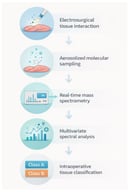
Instrumentation and data flow of the iKnife. The system integrates standard electrosurgical hardware with ambient ionization mass spectrometry. Surgical aerosol is transported to the mass analyzer for rapid scanning (150–500 ms), followed by automated spectral deconvolution and classification. This process overcomes the logistical and sampling limitations of conventional frozen section analysis by providing continuous, objective intraoperative guidance.

The shift toward Industry 5.0 places human-centred and digitally integrated metrology at the core of modern manufacturing, particularly in the automotive sector, where portable Laser Line Triangulation (LLT) systems must combine accuracy with operator usability. This study addresses the challenge of operator-induced variability by evaluating how algorithmic strategies and mechanical support features jointly influence the performance of a portable LLT device derived from the G3F sensor. A comprehensive Measurement System Analysis was performed to compare three feature extraction algorithms—GC, FIR, and Steger—and to assess the effect of a masking device designed to improve mechanical alignment during manual measurements. The results highlight distinct algorithm-dependent behaviours in terms of repeatability, reproducibility, and computational efficiency. More sophisticated algorithms demonstrate improved sensitivity and feature localisation under controlled conditions, whereas simpler gradient-based strategies provide more stable performance and shorter processing times when measurement conditions deviate from the ideal. These differences indicate a trade-off between algorithmic complexity and operational robustness that is particularly relevant for portable, operator-assisted metrology. The presence of mechanical alignment aids was found to contribute to improved measurement consistency across all algorithms. Overall, the findings highlight the need for an integrated co-design of algorithms, calibration procedures, and ergonomic aids to enhance repeatability and support operator-friendly LLT systems aligned with Industry 5.0 principles.

26 January 2026

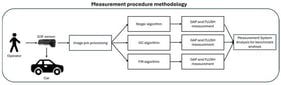
Block diagram describing measurement system methodology.

News & Conferences

Issues

Open for Submission

Editor's Choice

Reprints of Collections

Advances in Space AstroParticle Physics
Reprint

Advances in Space AstroParticle Physics

Frontier Technologies for Particle Measurements in Space
Editors: Matteo Duranti, Valerio Vagelli
Selected Papers from the 19th International Conference on Calorimetry in Particle Physics (CALOR 2022)
Reprint

Selected Papers from the 19th International Conference on Calorimetry in Particle Physics (CALOR 2022)

Editors: Fabrizio Salvatore, Antonella De Santo, Iacopo Vivarelli

Get Alerted

Add your email address to receive forthcoming issues of this journal.

XFacebookLinkedIn
Instruments - ISSN 2410-390X